Need a word or phrase translated?

Hello :)
I am working on a translation and need some help... it's an excerpt from a Japanese history textbook:

日本人もアメリカ人も、地域および国家の住民としての帰属意識をもっと同時に、国境を越えた地球的な市民としても生きているわけです。
(Suggestion: Japanese as well as Americans have more of a sense of belonging to their regions and states at the same time although they do live as cross-border global citizens.)

Sorry for any mistakes, English is not my first language.

Thank you very much in advance!
 
同時に means 帰属意識をも and 生きている are at the same time.
 
kanji.webp
Just want to ask of what is the last kanji...
I saw it from a name I cant find it in my IMEI pad where you can draw the kanji
and identify it...
The first is like amai, the second is ie and what's the third kanji???
 
ナ?テ??ーテ?SIZE=7]瑋[/SIZE]

Seems like a Chinese name.
 
OK... so its a Chinese name.. thanks for the help...
thats why i cant find it on my IMEI pad...
anyways what software are you using to identify kanji???
or you dont mean you know it all...
^^)
 
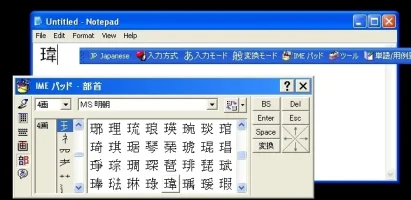
You can get the kanji on MS-IME pad searching by radical.

vpajiu-1.webp


Although I already knew 瑋 from the name of a general 司馬瑋. 🙂:
 
ime.webp
OK now I get it...
Thanks...
I didn't even thought of narrowing down the list using radical...
Thanks for that little tutorial in using IME pad...
 
Another question. ^_^

What does actually 奥通い mean? Is it a variation of 通い, 'commuting', 'going back and forth'? If so, what's the difference between these two expressions?
 
奥 seems to mean 大奥, but we need more context to answer your question.
 
奥 seems to mean 大奥, but we need more context to answer your question.

Thank you for fast reply. :)
I thought about that possibility too, but since there was no 大 sign, it seemed to me I should look for another interpretation.

The context could actually confirm 大奥 lead - the story is set in a world similar to the beginning of the Tokugawa shogunate. The previous sentence says about a daimyo 's concubines, and the one from which I took the expression goes like this:

戦々で奥通いもままならぬでは
いずれ血筋も絶えようぞ
 
Then, it no doubt refers to the place a daimyou's wife and concubines reside in.🙂: See the definition linked below. 大奥 is the term for shogun 's 奥.


(ウ) 特に江戸時代、将軍や大名・旗本などの屋敷で、主人の日常生活の場所。夫人や奥女中などが住み、主人以外の男性が立ち入ることはできない。将軍家の場合は大奥ともいう。
「奥」の検索結果 - Yahoo!辞書
 
Unfortunately, we lose control over pronunciation once it gets adopted into Japanese. There are even distinctions made that don't exist in the original language:
ガム
ゴム
ガラス
グラス
バー
バール
「接頭語」としての [プレ]は、「ローマ字読み」または、「綴り字発音」と呼ばれるものとなりますね。
多くの英語学習者も悩まされる問題だと思いますね !

It seems a serious book of popular history on 昭和時代 should properly use 前, unless of course it was intended to have the reader notice it as being different, perhaps carrying a greater emphasis, specificity or other effects.....which could very well be legitimate reasons. :?
 
Another question. ^_^

What does acctually 奥通い mean? Is it a variation of 通い, 'commuting', 'going back and forth'? If so, what's the difference between these two expressions?

I never heard those two expressions? Where and how did you hear that?
I have never used 奥通い in my life...:emoji_blush:
 
I, too, thought oldays-san would refer to 大奥 and 奥 in his post, but is he actually saying about the translation of 通い "'commuting' and 'going back and forth'", by any chance?
(oldaysjapanさんは恐らくnative Japanese speaker でしょうから、奥や大奥はご存知でしょう。)
 
toritoribeさん補足の説明大変ありがとうございます。
そうなんです、"通い"と言う言葉自体も日本語ではちょっとおかしくて、
使うのであれば、"通う"が正解です。ですので、そこをクリアーにしていただければ
もっと、的確なお答えやアドバイスが出来るかなぁとおもいました:-)
 
The context could acctually confirm 大奥 lead - the story is set in a world similar to the beginning of the Tokugawa shogunate. The previous sentence says about a daimyo's concubines, and the one from which I took the expression goes like this:

戦々で奥通いもままならぬでは
いずれ血筋も絶えようぞ

あ、であれば前述の僕の解釈は間違ってましたね。僕は英訳のことをおっしゃってるのかと思っていました。
「通い」に関して言えば、動詞の連用形の名詞的用法で、一般的な単語だと思いますよ。「通いのお手伝いさん」とか、「奥通い」と同じく複合語の接尾語的用法としては、古風な言葉だけど「郭通い」とか。

「奥通い」の使われている文脈と出典に関しては、僕のリクエストに答えて mariamorievnaさんがすでに提供済みですね。 :)
 
Thank you for fast reply. :)
I thought about that possibility too, but since there was no 大 sign, it seemed to me I should look for another interpretation.
The context could actually confirm 大奥 lead - the story is set in a world similar to the beginning of the Tokugawa shogunate. The previous sentence says about a daimyo's concubines, and the one from which I took the expression goes like this:
戦々で奥通いもままならぬでは
いずれ血筋も絶えようぞ
That was helpful. Thanks ! I've stumbled across 大奥(サマ) in Edo-era manga, likewise without the 大, and variations of 若奥 but never seriously enough to investigate further. 奥 alone might be shorthand for the interior zone of the castle where affairs of state were conducted (中奥).
 
Can someone translate this videogame logo?

april_4png-1.webp


Thanks!

I'm new at this, but I'm subscribed to thread, and I'm getting alerts, and this seemed simple enough.

どうぶつ is "animal," and 森 「もり」 is "forest," so this would be along the lines of "animal forest."

とびだす seems to be the verb for "to jump/fly/rush out," so I think とびだせ is the imperative.

So maybe you'd translate it as... "Jump Out! Animal Forest"?
 
Good try! Your translation is grammatically correct.👍
どうぶつの森 is a video game series, and the English title is "Animal Crossing".
とびだせどうぶつの森 is a 3D game, so とびだせ would mean more likely "Pop out" in this case.
 
I was wondering if someone could help me with a line from a song. I've tried to do research for quite some time (too long) with translating a few lines into kanji. I've asked a couple friends, but no one seems to be able to help. I've even attempted contacting the artist, but I'm not surprised that I didn't get a reply.

I'd just like to get this out of the way - yes, this is planned for a tattoo. I've read the sticky regarding such and I've thought long and hard about it. I've even lurked on this website for a while as well. I would welcome constructive feedback about it - whether it would be far too long or too complicated.

The line is supposed to mean (from what I've gathered through looking around and asking) something along the lines of,

It's not "for you I would die" But "for you I live".

I don't even know if this helps, but the Romaji would be (again, from what I've gathered)

"Anata no tame nara shineru" ja nakute "anata no tame ni ikiru".

Correct me if these are wrong, and as I said, I would appreciate constructive feedback as to whether or not it would be an inappropriate length for a tattoo. If anyone is willing to help me identify the translation into kanji, it would be very much appreciated.

~<3
 
Back
Top Bottom