Need a word or phrase translated?

チームの友達: a friend in our team/a teammate
友達のチーム: the team of my friend/my friend's team

Does this make sense?;-)
 
From my 一年生 reader. This is a mini biography of 野口英世.
「落ちたのか!おっかあが目を離したすきに!」
Did you fall dear? Mommy wasn't looking, すきに

I guess おっかあ is a contraction like mom. By the way, I am not even sure who is speaking here, I guess the mom is but could someone confirm this. Also, what is すきに ?
 
A gap or opening, you will often see it as part of the term 隙間

The term "gap" or "opening" should be thought of as in a context such as boxing....a time when the other person was distracted, not looking, or inattentive. 隙間 is used in a more concrete sense.
 
That's kind of hard to understand, what do you need すきに in there for? What does it add to 目を離した?

How would you translate all the quote by the way?
 
It is the noun modified by the preceding phrase, for one thing, and it would sound odd as heck without it. The sentence is saying WHEN it happened, which sort of calls for a noun.

It would be the difference between:

You fell. I wasn't looking.
You fell while I wasn't looking.

Are you familiar with nouns modified by verb phrases in Japanese? If not, that's something you will need in order to understand this.
 
I am not sure, it doesn't sound like something obscure or anything but I think I am not familiar with 'nouns modified by verb phrases' unless I am misunderstanding you. Can you give me an example?.
 
It will be several hours before I have a chance. On the road now.
 
by 'nouns modified by verb phrases,' Mike is referring to a clause being used to describe a noun.

Kind of like an adjective like 赤い (red) can modify 帽子 (hat) to make 赤い帽子 (red hat), you can use a clause ending in a verb to similarly describe something, like 赤い帽子をかぶってる男 (man wearing a red hat), where 赤い帽子をかぶってる is modifying 男.

So in your example, to make a full, single sentence, おっかあが目を離したすきに落ちたのか

おっかあが目を離した (mommy looked away/took her eyes off)

すきに (in that instant)

落ちたのか (you fell?)
 
It is the construction that corresponds to "relative clauses" in English and it is both comparatively simple to grasp and extraordinarily useful. One major thing it accomplishes is boosting you from simple sentences to more complex sentences.

I have heard that they have long since ceased teaching English grammar in America, so it might be a good idea to introduce relative clauses and relative pronouns a bit:

He is the man. He stole my car. -> He is the man who stole my car.
That is the hospital. I was born there. -> That is the hospital where I was born.
This is the house. I want to live in it. -> This is the house that I want to live in.

Japanese does the same linguistic task in a very simple way....you just have a verb phrase (which may be short, long, simple, or complex) which modifies the following noun. Being able to spot the phrase and recognizing what noun it applies to is key to successfully breaking down longer, more complex Japanese sentences and figuring them out instead of wandering around in them and getting lost.

In the example you asked about, think about what the term すき signifies.....it signifies an interval of time.....that is to say, a duration. And in English what do we use to show duration?......We use "while".

So the reason すきに must be there is because it is the part which indicates the duration of time....the period of time....in which the fall occurred. The bit that comes before it describes or defines the duration....."she wasn't looking". "She wasn't looking" alone only tells what was(n't) going on...the action (or lack of it, in this case). We need the when part as well, in order to combine the two into a single sentence and in this case the when part was a duration. In daily speech, we tend not to make such a fine distinction and we are just as likely to say "when I wasn't looking" as we are "while I wasn't looking". The important thing is to learn to recognize what communicative function things like すきに are fulfilling in a sentence. If you get hung up, ask yourself questions (who, what, where, when, why, which, how) and try to figure out what sort of information a word or phrase must be contributing to the sentence and you'll find that the process of elimination and common sense can go a long way toward helping you figure stuff out. Everything (ideally) has a function and a reason for being there....to communicate some bit of information. Figure out at least what type of information it must be and you're much farther down the road to solving the puzzle.
 
BTW, those are "girls' talking"? It seems like guys' one to me.


Wouldn't it be older guys, though, like over 30 ? At least the 越した事ァねえやな bit. :)
 
Little girl : 今日から私のこと布団たたき刺されってよんでいいよ。

So, the mother has found a terrible test (o/100) hidden under her daughter's futon and I imagined she has pierced it with rage.

What is the fonction of たたき here?
And I don't understand what is after the verb : 刺されってよんでいいよ

いいよ : it's OK.
But why : ってよんで ?

Thanks!
 
ってよん = と呼んで

....
 
Little girl : 今日から私のこと布団たたき刺されってよんでいいよ。

So, the mother has found a terrible test (o/100) hidden under her daughter's futon and I imagined she has pierced it with rage.

What is the fonction of たたき here?
And I don't understand what is after the verb : 刺されってよんでいいよ

いいよ : it's OK.
But why : ってよんで ?

Thanks!
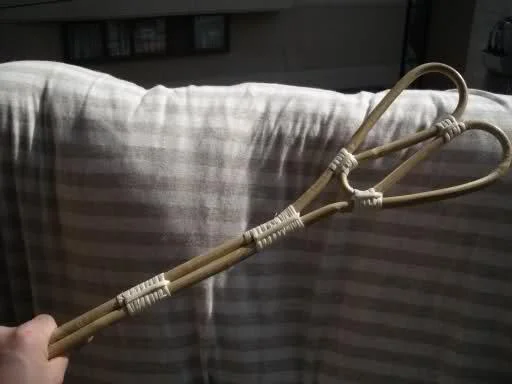
布団たたき is a stick to get the dust out from futon by whacking it.

aylt3s-1.webp


布団たたき刺され seems to mean a person who is pierced by a futon-tataki.😌
 
Translate

Hello all..

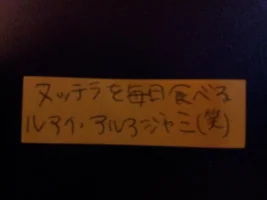
I am new here and I hope you guys can help me to translate the words in this picture..

Thanks.. 🙂:

20120310_200557.webp
 
ヌッテラを毎日食べる
ルアイ・アルアジャミ(笑)

I eat Nutella everyday.
Louay Al-Ajami(or probably a name of similar pronunciation) lol
 
I recently bought these mugs from a thrift store that the lady told me were Japanese for sake but they didn't look like they were for sake and weren't the traditional looking ones I have seen. I bought them anyway because they were $3 for the set.
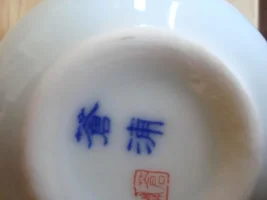
The bottom of the mug has the following stamped on, can someone please tell me if it is Japanese and what it says?
THANKS!DSC01349.webp
 
蒼浦
Aoura

Prabably that's a person's surname(not so common name). Or, it could be a company's name "Souho".
 
This is about the infamous のです | んです and derivatives. I have read several explanations but I still don't really get it.

For example DBJG translates, 日本に行く vs 日本に行くんです 'It is that I am going to Japan'. But what is that supposed to mean? When do you say "It is that I am going to Japan" in English?. Also, why is this so hard to explain, I see all the time people having difficulties to explain it as if it was something too strange for the 'western brain'.

Thanks for any help.
 
Think of it as similar in function to the "you see" that we sometimes tack onto plain statements to indicate that they are meant to be explanative of something.

Some indication that you at least saw the last hunk of text I typed up especially for you would be nice.
 
Back
Top Bottom