Need a word or phrase translated?

It says:

明日(あす)は、名古屋(なごや)ドームの
次世代(じせだい)ワールドホビーフェアへ
行(い)きたいと思(おも)っています。
(すれちがいの旅(たび))

ウィルスをもらわない
ように気(き)をつけたいと
思(おも)います。

行(い)ってきました。
すれちがい100人(にん)以上(いじょう)!
すごいね。
それにしてもスゴイ人(ひと)

高山(たかやま)みなみさん
今年(ことし)もステキでした。
 
And the translation, if you need.

Tomorrow, I'd like to go to The Next Generation World Hobby Fair at Nagoya Dome.
(A trip for *"Passing-by")

(*As you might know, "surechigai" refers to passing-by correspondence service via Nintendo DS/3DS or communication between users by using it.)

I'd like to take care not to catch (influenza) virus.

Nagoya Dome

I went there.
"Passing-by" with over 100 people!
Amazing.
At any rate, there're so many people.


*Takayama Minami is beautiful also this year.
(*a popular voice actress)
 
Thank you undrentide and Toritoribe! Very helpful, I appreciate it. And no actually did not know what surechigai refers to, so that is good to know.
 
Could someone please translate this for me?

君はたった一言で済ませるんだな

1年に一回聞けるか聞けないか。

田中が無理やり言わせるさようなら。

Thank you!
 
Last edited:
How did that old commercial go ??

"Why settle for a substitute when you can have the real thing"

:emoji_grinning: :emoji_imp:
 
Omg. Okay, I apologize if I offended anyone. But seriously, why do I always get rude comments on this forum? I never said "preferably natives" I said "native Japanese" because the sentences are hard, and I figured that people who are studying Japanese won't know how to translate them.
 
Omg. Okay, I apologize if I offended anyone. But seriously, why do I always get rude comments on this forum? I never said "preferably natives" I said "native Japanese" because the sentences are hard, and I figured that people who are studying Japanese won't know how to translate them.

Ah.....the soft bigotry of low expectations. You only know how hard they are related to your own abilities, which tells you precisely nothing about how hard they are related to the abilities of unknown others. There is nothing about them that makes them so difficult a foreigner can't possibly have learned enough to understand them. Just because they kick your butt is no reason to assume they kick every gaijin's butt.

Maybe the English in your question was too hard for our native speaking friends to understand. After all, they're learning English and they couldn't possibly have progressed enough to understand your post.

Which leaves you in a Catch-22 and renders your question unanswerable: the gaijins can't understand such hard Japanese and the Japanese can't understand such hard English.

By the way, clarifying that you never said "preferably native" but instead clearly stipulated "native Japanese" has barred me from answering, as I am not Japanese. If you had said "preferably Japanese" then the question would still be open for me to answer. Thanks to your clarification I now know definitely that you want only Japanese to answer, so I will refrain and defer to them.

(Do you really not understand how the wording of your post brought about the reaction it has? I often tick people off with what I say, but in my case it is intentional).

By the way, you left a number out of the second sentence. Might want to correct that....
 
why do I always get rude comments on this forum?
I always think I'd like to answer questions posted here as far as I can, but when I come across people who don't give any response to our reply, just as you've always done, I always wonder why they can't give us the courtesy of replying at least whether they can understand our answers or not, and at that time I always think of Japanese proverbs 暖簾に腕押し、糠に釘...
 
Help with translation

Hi everyone, I want to know how to say this in Japanese "sooner or later the discipline will defeat the intelligence"

Thank you very much!
 
「才能より、努力」

Maybe?

Hi thank you for your reply, but I meant how to say "sooner or later the discipline will defeat the intelligence", as when you say "thank you" you say in Japanese "Arigatō"

Regards
 
Hello together! Today I received a message from my japanese working colleague. At the end of his mail he wrote the followed:

またきます。
Soichiro


what does that "matakimasu" mean? I couldn't find it on the online translator.
 
It's また (again) きます (will come).
So the person says he'll come to see you again.
 
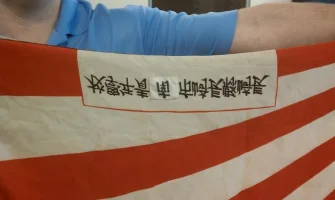
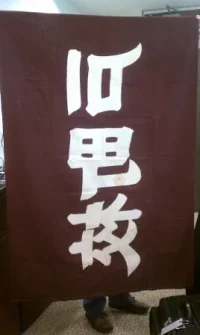
Hello, I am trying to help a friend with the translation of two flags that he is going to donate to a Japanese museum. Help is greatly appreciated. Thank you.
IMAG0554.webp
IMAG0555.webp
 
Please don't thread jack.

Why is he holding the flag upside down?

Won't the museum be able to read these?
 
Hello, I am trying to help a friend with the translation of two flags that he is going to donate to a Japanese museum. Help is greatly appreciated. Thank you.
You should read my previous post more carefully.;-)
BTW, there's a more appropriate thread for this topic.
Need a word or phrase translated? | Japan Forum

35i563k-1.webp

長崎縣長崎市南青年學校
Nagasaki ken Nagasaki shi minami seinen gakkou
South Youth School, Nagasaki City Nagasaki Prefecture

a40jzl-1.webp

戸町校
Tomachi kou
Tomachi School
(Tomachi seems like the name of a region in Nagasaki City.)
 
Actually I did but somehow ended up posting to this thread by mistake. Thank you, Thank you for your help! I knew someone here would have the knowledge and an appropriate response! Thank you!
You should read my previous post more carefully.;-)


35i563k-1.webp

長崎縣長崎市南青年學校
Nagasaki ken Nagasaki shi minami seinen gakkou
South Youth School, Nagasaki City Nagasaki Prefecture

a40jzl-1.webp

戸町校
Tomachi kou
Tomachi School
(Tomachi seems like the name of a region in Nagasaki City.)
 
I need a few phrases translating from English to Japanese.

I need English version translation - not Kanji. So I need a phonetic spelling.

Phrasee = "Peace be with you"
 
お医者になることに興味がありますか?

Are you interested in becoming a doctor?

私の例文はどうでしたか? (^o^)/
 
Very, very close but it should be 医者になること or お医者さんになること.;-)
(The former would be more common.)
 
Can someone help me translate this sentence please:
都立昂星小学校六年二組の教室では、もはや放課後恒例となった行事が発生していた。

I can understand several words (school, 6-2 classroom, after school, annual, event), but the meaning of the sentence as a whole escapes me.

Also, can someone please explain the expression "飛び抜けて"?
It was used in the phrase "飛び抜けて大柄な少年"

Thanks!
 
Last edited:
Back
Top Bottom