Need a word or phrase translated?

A girl just receives her report card and have bad notes. She's eating watermelon and says this :

人生もこれだけ甘ければいいのに

It will be nice if in life too, there will be sweet things?

Then another girl propose to add salt. : 塩かける, if I'm right.

She answers : かけてみるかな : Is that a question? Or is she saying that she will try?

Another one says : うちもかけるかあ: is that a question too? Or not. She wants to try too?

The first girl finds it : しょっぱ : I found : salty
But her friend responds : 人生みたいに : as life? What is the link between "salt" and "life" ???

Thanks in advance !
 
人生もこれだけ甘ければいいのに
It will be nice if in life too, there will be sweet things?
I wish life were also sweet like this(= watermelon).

Then another girl propose to add salt. : 塩かける, if I'm right.
Seems correct.

She answers : かけてみるかな : Is that a question? Or is she saying that she will try?
The latter.

Another one says : うちもかけるかあ: is that a question too? Or not. She wants to try too?
The latter.

The first girl finds it : しょっぱ : I found : salty
But her friend responds : 人生みたいに : as life? What is the link between "salt" and "life" ???
しょっぱい would be more close to "bitter" in English here.
 
Last edited:
Am I reading this right?

私の同期入社の中に 霊感の非常に強い奴が一人います 。
At around the same time I entered the company, there was this guy with a really strong sixth sense.
 
同期入社 means 同期入社の人 in this case.
います is the present tense.
 
あの子はちょっと癖があるっていうか、...複雑だからねぇ
止めやしないけど半端はよしなよ

I'm not really sure how to translate this, I'm pretty sure my attempt at it isn't right.

"That (child)boy is a bit peculiar...so, it's complicated.
You can't stop, but it's overwhelming."

As always, any help or advise is greatly appreciated!
 
This is from a screen cap of a video game, I always try to see what I can make out of these.
「んん?
やけに話しかけてくるよなあ。。。
オレは、あまり話したくないんだよ。」
My poor translation:
"Hmm?
(He/she/they) are desperate to go talk to them...
As for me, I don't want to say too much."
 
あの子はちょっと癖があるっていうか、...複雑だからねぇ
止めやしないけど半端はよしなよ

I'm not really sure how to translate this, I'm pretty sure my attempt at it isn't right.

"That (child)boy is a bit peculiar...so, it's complicated.
You can't stop, but it's overwhelming."

As always, any help or advise is greatly appreciated!
止めやしないけど=(彼と付き合うのを)止[と]めはしないけど
半端はよしなよ=中途半端(に彼と付き合うの)はやめなさい

That boy is a bit peculiar or... complicated.
I won't stop you (from going out with him), but you shouldn't do it(= to go out with him) by halves.


Rei Yahya;696322 said:
This is from a screencap of a video game, I always try to see what I can make out of these.
「んん?
やけに話しかけてくるよなあ。。。
オレは、あまり話したくないんだよ。」
My poor translation:
"Hmm?
(He/she/they) are desperate to go talk to them...
As for me, I don't want to say too much."
話しかけてくる: to talk to me
 
Would that make it something similar to...

"Hmm?
(You) desperately wanted to talk to me...
As for me, I don't want to say too much."

He's a pest, always coming up and talking to me. I don't want to talk to him.
 
止めやしないけど=(彼と付き合うのを)止[と]めはしないけど
半端はよしなよ=中途半端(に彼と付き合うの)はやめなさい

That boy is a bit peculiar or... complicated.
I won't stop you (from going out with him), but you shouldn't do it(= to go out with him) by halves.

Thank you very much!


Does anyone know what トコ means in this context? Is it like ところ?

こないだあれだけ疲れてるトコ晒しといてほっとけなんて言われたら逆に迷惑なんだ
 
Yes. とこ is the coloquial form of ところ.

Thank you. :)

And sorry for bothering you so much...but, I'm completely lost with this one...
I don't really understand how to translate this:
大きな流れを滞らせるような真似をしてはいけないしその為の個など
大きな流れ - is this something like "trend"?
滞らせる - back up, get behind?
Is it saying something like "I can't keep up with the trends"?
What is 個 here?
 
Yes. Trend, flow, current, march, or like that.

滞らせる is the causative of 滞る and means "to interrupt".

Probably 個 means 個人 or something.

真似 means 行為 here. Although it has a negative nuance.(e.g. 卑怯な真似はするな.)

I don't know the context, but the subject can be "you".
 
Yes. Trend, flow, current, march, or like that.

滞らせる is the causative of 滞る and means "to interrupt".

Probably 個 means 個人 or something.

真似 means 行為 here. Although it has a negative nuance.(e.g. 卑怯な真似はするな.)

I don't know the context, but the subject can be "you".

Thank you. I just want to make sure I have this right...it sounds kind of weird no matter how I try to word it, so I'm worried there's still something that I'm not understanding properly.

I'm pretty sure he's speaking about himself, so, would it be something like
"I can't let myself act like my flow has been interrupted"?
 
Could 個 possibly be an input error for 行為?

そのための行為 at least makes sense.
 
Thank you. I just want to make sure I have this right...it sounds kind of weird no matter how I try to word it, so I'm worried there's still something that I'm not understanding properly.
I'm pretty sure he's speaking about himself, so, would it be something like
"I can't let myself act like my flow has been interrupted"?
One shouldn't interrupt the big flow(of something) and such individuals (= ones who interrupts the big flow) ...

I think "aren't worthy of existence" or something like that would follow the sentence.
 
I'm a cashier at a nearby grocery store and I know a few Japanese customers, I'd love to be able to interact with them. I've thought of a few questions that I could ask, if anyone could give me a/correct my translation, I'd appreciate it very much.

What type of ____ is this/are these? この___のタイプは何ですか? - For produce, such as apples and potatoes.

Could I get your signature? 書き込んでくれませんか?

It'll be 30 dollars and 73 cents. トータルコストは30ドルと73セントですよ。

Would you like this meat wrapped up? (Not sure how to say this)

Do you have any bags? 袋がありませんか? I wasn't sure whether to put arimasu or arimasen, arimasen to me sounds natural, but then again, what do I know about natural? Barely anything. So I'll leave that up to a smarter someone. ありがとうございました。
 
What type of ____ is this/are these? この___のタイプは何ですか? - For produce, such as apples and potatoes.

Sorry I do not understand exactly what you mean to say.

Could I get your signature? 書き込んでくれませんか?
If you need customer's signature for payment by a credit card, etc.,
サインをお願いします。 (Your signature, please)
書き込む can be used when you want a customer to fill in some papers (applications, questionnaire, etc.)

It'll be 30 dollars and 73 cents. トータルコストは30ドルと73セントですよ。
(合計で)30ドル73セントになります。
You should not use ~よ when you are talking to customers.
It may sound too casual or patronizing.

Would you like this meat wrapped up? (Not sure how to say this)
おつつみしますか? or
つつみましょうか?
(Both mean "Shall I wrap it up?")

Do you have any bags? 袋がありませんか?
I'm not sure if I got it right - is it for customers to ask you if you have bags?
Or do you ask your customers if they have a bag?

When a customer wants a bag, they can ask you
袋はありますか? (Not が but は)
If you ask a customer if he/she has a bag
袋はお持ちですか?(Do you have a bag?)

ありがとうございました。
When asking someone for something, do not say "thank you" before you are given what you've asked.
(It could sound presuming.)
Instead, you can say よろしくお願いします。 ;-)
 
Sorry I do not understand exactly what you mean to say.


If you need customer's signature for payment by a credit card, etc.,
サインをお願いします。 (Your signature, please)
書き込む can be used when you want a customer to fill in some papers (applications, questionnaire, etc.)


(合計で)30ドル73セントになります。
You should not use ~よ when you are talking to customers.
It may sound too casual or patronizing.


おつつみしますか? or
つつみましょうか?
(Both mean "Shall I wrap it up?")


I'm not sure if I got it right - is it for customers to ask you if you have bags?
Or do you ask your customers if they have a bag?

When a customer wants a bag, they can ask you
袋はありますか? (Not が but は)
If you ask a customer if he/she has a bag
袋はお持ちですか?(Do you have a bag?)


When asking someone for something, do not say "thank you" before you are given what you've asked.
(It could sound presuming.)
Instead, you can say よろしくお願いします。 ;-)

1) The produce is often of different types, for example, there are Granny Smith apples and Fuji apples, and each one is unique in the register system. So I often have to ask 'what sort of apples are these?' or whichever sort of produce it is.

2) Thank you! That clears things up.

3) I will be extremely careful not to use yo, I'm glad I opted not to. 😌

4) Ahh, how simple!

5) Both are extremely helpful to know, I meant the second one. Thank you!

Also, thank you for correcting my 'arigatou gozaimashita'. It totally slipped my mind that the pre-thank you is yoroshiku.
 
So, you mean "variety"?

このリンゴの品種は何か、教えていただけますか?
Although cashiers never say this type of quetion in Japan.
 
So, you mean "variety"?

このリンゴの品種は何か、教えていただけますか?
Although cashiers never say this type of quetion in Japan.

If they never do, is there something more appropriate? (Thank you, by the way!)
 
The situation that cashiers ask customers the variety of apples/potatoes can't happen. That kind of information is provided by, for instance, the barcode tag on the product instead of asking customers, if the shop needs to know it.
 
The situation that cashiers ask customers the variety of apples/potatoes can't happen. That kind of information is provided by, for instance, the barcode tag on the product instead of asking customers, if the shop needs to know it.

Ahh, it's still one we have to ask at this store. Thank you for the explanation. 説明をありがとうございました。
 
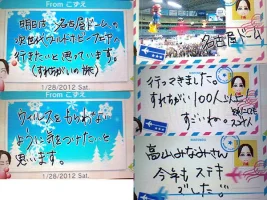
Could anyone please translate this set of images for me? I have an okay understanding of kana but sometimes I have a hard time figuring out handwritten characters. There's also a lot of kanji and I don't have any clue about that.

7Nyk8.webp

I tried to figure out what the characters are and this is what I came up with
どおむのるどほびもたいといています.っすれちいの

ウイルスをもらわないように? をつけたいそ ? ます.

??? ド-ム

テテっまきしたすれち?い100 トントヒ!すごいわ.

?? みなみさ
こんねもすてきでした

I'm sure a lot of that is way off... I also accidentally put it into a romaji > kana converter so I think some of it should be kata and is hira etc. In any case, have no way to translate as is. Could anyone please help and write out if possible? I'd like to be able to get better at picking up on handwritten kana...
 
Back
Top Bottom