Need a word or phrase translated?

Ah, so they differ from case to case. All the more confusion for me lol.

Does using an adjective to modify a verb turn it into an adverb?
As in 静かな部屋で静かに過ごす=> "I spend time quietly/peacefully in a quiet room"?
静かに would be quietly/peacefully?
And 速い車で速く走る => "I travel quickly in a fast car"?
速く = quickly?

Thank you for your explanations and examples!
 
Does using an adjective to modify a verb turn it into an adverb?
As in 静かな部屋で静かに過ごす=> "I spend time quietly/peacefully in a quiet room"?
静かに would be quietly/peacefully?
And 速い車で速く走る => "I travel quickly in a fast car"?
速く = quickly?
It's not categorized in adverbs in Japanese grammar. It's just a conjugation of adjectives; the adverbial form or the adverbial usage of a form(中立形, ク形). But, it's reasonable to think of the form as an adverb in English, as in your translations.:)
 
Yeah, I was going to say it's an adverb, but not a 副詞. But we don't need to go down that road again. hahaha
 
Thank you both for your explanations! :D
It was very helpful.

Could either of you direct me toward a resource that would inform me more of auxiliary verbs?
I feel like that would be too much to cover here...
 
How would one say:
Thank you for never failing to make me smile.

I'm going to try this as no one has answer it yet... but tell me if I'm wrong!:?

いつも私に微笑ませてくれてありがとう。

This is more like... Thank you for always making me smile. (I think.)
I feel like this would make more sense ~.~

ぜんぜん失敗しなくて、私に微笑ませてくれてありがとう。

This would be my try at your requested sentence.

Though, someone should probably double check me as I'm not sure...
 
Could either of you direct me toward a resource that would inform me more of auxiliary verbs?
I feel like that would be too much to cover here...
The auxiliary verb in general linguistics is almost equivalent to 補助動詞 in Japanese grammar. One of the definitions of 補助動詞 is that the verb follows the -te form of a verb.

examples of 補助動詞
「いる」「ある」「いく」「くる」「しまう」「おく」
「くれる」「やる」「あげる」「もらう」
「みる」「みせる」

補助動詞 - Wikipedia
(all in Japanese)


I'm going to try this as no one has answer it yet... but tell me if I'm wrong!:?
いつも私に微笑ませてくれてありがとう。
This is more like... Thank you for always making me smile. (I think.)
I feel like this would make more sense ~.~
Yeah, I think that's pretty good.:cool:(いつも私を微笑ませてくれてありがとう would be more natural, though.;-))

The literal translation 微笑ませることを失敗しないでくれてありがとう/失敗することなく私を微笑ませてくれてありがとう sounds too much literal.(The latter one is more likely "Thank you for always making me smile without failing".)
 
Yeah, I think that's pretty good.:emoji_thumbsup:(いつも私を微笑ませてくれてありがとう would be more natural, though. :emoji_wink:
The literal translation 微笑ませることを失敗しないでくれてありがとう/失敗することなく私を微笑ませてくれてありがとう sounds too much literal.(The latter one is more likely "Thank you for always making me smile without failing".)
いつも私に微笑(み)くれてありがとう. Does this always mean the other person is smiling ?

Kiyo90,

Without fail in the sense of never missing or consistently practiced is more naturally "kanarazu" or "kitto" /itsumo etc.
 
Last edited:
Kiyo90,

Without fail in the sense of never missing or consistently practiced is more naturally "kanarazu" or "kitto" /itsumo etc.

Are these the correct kanji for each:
必ず?
屹度?
What is the difference between the two?
Is 必ず more definitely/confident sounding than 屹度?

Also, for いつも、it can mean never or always, right? I'm slightly confused on this point.
So:
いつも私にいてくれる。(You) are always (here) for me.
いつも私にいてくれない。 (You) are never (here) for me.
Is that correct?

There's also something else that I can't remember... I remember reading somewhere that there's an adverb? that indicates change, opposite of まだ?
So... as in the sentence "I am no longer working at the book shop", how would it be translated?
(And to double check, "I am still working at the book shop" would be "まだ本屋で働いている" right?)

Sorry for the spew of questions... they just spontaneously sprung from my head while I was typing :sorry:
As always, thank you Toritoribe for the link and correct, and for Elizabeth for the correction.

Edit: Sorry, didn't see this.
いつも私に微笑(み)くれてありがとう. Does this always mean the other person is smiling ?

I think so? Isn't the default subject the listener, the people that you are thanking?
Taking the causative out makes it... "Thank you for always smiling at/for me" ? I think...
 
Last edited:
Are these the correct kanji for each:
必ず?
屹度?

Yes, although 屹度 is pretty much never used; it's probably always きっと (at least in my experience). According to the dictionary those kanji and 急度 are both 当て字, so they don't do much to convey meaning.

Kiyo90;675350 said:
What is the difference between the two?
Is 必ず more definitely/confident sounding than 屹度?

Usage. 必ず is used more for commands, like 毎日必ず宿題をしてきなさい. きっと is used for conjecture and guesses, like 明日はきっと晴れる. Although there does seem to be some overlap:

(2)自身の事柄に関しては決意を、相手に対しては強い要望を表す。必ず。
「一〇日には―お返し致します」
屹度とは - 難読語辞典 Weblio辞書

Kiyo90;675350 said:
Also, for いつも、it can mean never or always, right? I'm slightly confused on this point.

Yes.

So:
いつも私にいてくれる。(You) are always (here) for me.
いつも私にいてくれない。 (You) are never (here) for me.
Is that correct?

No, but that's because the particle should be と, not に. I'm not sure about the naturalness, though.
 
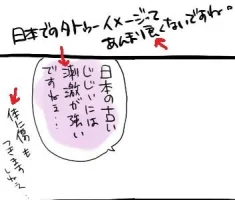
Alright so, I'm reading this comic that's has some dialogue about tattoos, but it's hand written, so it's hard to read.

日本の古いじじいには__激が強いですね
I'm not sure about the kanji where the blank is, but it looks like it could be either 溂 or 渕.
When I looked it up there wasn't any word for 溂激 or 渕激

Anyone have any idea as to what it might be? Any thoughts are helpful.
 
いつも私に微笑(み)くれてありがとう. Does this always mean the other person is smiling ?
いつも私に微笑(み)をくれて/微笑んでくれてありがとう

The giver is "you" because of 私に and くれて.

いつも私に微笑ませてくれてありがとう is not incorrect. This expression focuses more on the causee or "私", i.e., it has a nuance that 私 is the doer(smiler). Whereas 私を is more on the causer "you" or the fact that you make me smile; "I have an appreciation to あなたが私を微笑ませてくれること". This would be more suitable to the contect, I suppose.


Are these the correct kanji for each:
必ず?
屹度?
What is the difference between the two?
Is 必ず more definitely/confident sounding than 屹度?
In addition, きっと can't be used for unchanging truth, on the other hand, 必ず is hardly used for guess.

[用法] かならず・きっと――「この薬を飲めば必ず(きっと)病気が治る」「勉強すれば必ず(きっと)合格する」など、両語とも可能性の強い状態を表すが、「必ず」のほうが確率的により高い場合に使う。◇両語とも「この借りは必ず(きっと)返す」のように決意を表す語としても用いられる。◇「三に二をかけると必ず六になる」「太陽は必ず東から昇る」など、不変の真理を表す場合には「きっと」は使わない。逆に「彼はきっと帰ったんだろう」など、推量の気持ちの強いときには、「必ず」は使わない。

Also, for いつも、it can mean never or always, right? I'm slightly confused on this point.
So:
いつも私にいてくれる。(You) are always (here) for me.
いつも私にいてくれない。 (You) are never (here) for me.
Is that correct?
いつも私のそばにいてくれる/いつも私のそばにいてくれない can be alternatives to 私と.

Alright so, I'm reading this comic that's has some dialogue about tattoos, but it's hand written, so it's hard to read.

日本の古いじじいには__激が強いですね
I'm not sure about the kanji where the blank is, but it looks like it could be either 溂 or 渕.
When I looked it up there wasn't any word for 溂激 or 渕激

Anyone have any idea as to what it might be? Any thoughts are helpful.
I bet it's 刺激 or "stimulus". ;)
 
I bet it's ナスhナ槌 or "stimulus".;-)

That's what I thought too, but I couldn't make it into a natural sounding sentence.
Also, there was a ニ団 in the character too, like the ones I thought it might be. So, it doesn't seem right.
Thank you for the suggestion, though.
 
I think we may need to see a scan of it to be sure, but I thought the same thing Toritoribe did upon reading your initial post.
I tried to attach a picture.
The kanji with arrows by them are the ones that I'm having a hard time reading, but the one I'm most concerned with is the one I've already mentioned.
But help with any of them is much appreciated.
I can find kanji that look similar, but in the end they never end up making any sense when I try to translate the sentence.
 

Attachments

  • 12882.webp
    12882.webp
    12.6 KB · Views: 98
Ahh, thanks again Glenn and Toritoribe. :D

Though, why should the particle be と instead of に in いつも私にいてくれる?
I'm really bad at particles :(

The kanji in the upper right corner looks like 良 as in 良い. (良くない)... it's just really messy.
The sentence seems to say "In Japan, Tattoo's image is not very good."
At first I thought it was 色, but it didn't make sense, so I would go with this.

And for the two in the middle, it looks like what you typed, but those combinations don't make any sense... I looked it up in multiple dictionaries, including kanji dictionaries and couldn't find that compound word. The closest I found is the one already mention by Toritoribe.
 
@sl89
It does look a lot like 刺 with シ, but that character doesn't seem to exist. I don't know. :sick:

@kiyo
と is like "with". It's reciprocal, whereas に is more like "to", and is just one direction.
 
@sl89
It does look a lot like 刺 with シ, but that character doesn't seem to exist. I don't know. :sick:
@Kiyo
と is like "with". It's reciprocal, whereas に is more like "to", and is just one direction.
@Glenn:
Hmmm... so the sentence with be more like... "You're always here with me"?
What do you mean by reciprocal? That the verb taking on that particle is reciprocal?
I mean, I get the basic usage of the two... but a lot of times, in certain examples, they don't make sense to me.
And actually, 溂 ( ラツ) does exist:
... look it up on Jim Breen... it wouldn't let me post the link.
It just doesn't seen to have any compound with the second character (or even seems to be in usage that much).
@sl89
For the kanji on the left hand side...
住、伴、作、任、件。。。These are the closest (of the 220+ that I looked at with that radical) that I found that looks like the image... but all of them aren't the one in the image. I can't figure out what the scribbles in that sentence are suppose to be, so couldn't attempt to translate the sentence to see which one of them makes the most sense.
That person needs better handwriting >.>
 
@sl89
For the kanji on the left hand side...
住、伴、作、任、件。。。These are the closest (of the 220+ that I looked at with that radical) that I found that looks like the image... but all of them aren't the one in the image. I can't figure out what the scribbles in that sentence are suppose to be, so couldn't attempt to translate the sentence to see which one of them makes the most sense.
That person needs better handwriting >.>

I went through that process too.
I spent about 30 minutes going through various dictionaries trying to find something that would work, but had no luck at all.
This is why I dislike trying to translate written things. Typed is so much easier.

Thank you for trying.

Thanks to all who helped.
Even though it wasn't quite figured out, I still appreciate the assistance.
 
Last edited:
いつも私に微笑(み)をくれて/微笑んでくれてありがとう
The giver is "you" because of 私に and くれて.
いつも私に微笑ませてくれてありがとう is not incorrect. This expression focuses more on the causee or "私", i.e., it has a nuance that 私 is the doer(smiler). Whereas 私を is more on the causer "you" or the fact that you make me smile; "I have an appreciation to あなたが私を微笑ませてくれること". This would be more suitable to the contect, I suppose.
OK, that makes sense. I know the giver is "you" because of 私に and くれて but there are times that "make me/force me" overlaps with "give me" - at least in colloquial English. :)
 
日本のタトゥーイメージって良くないですね。体に傷もつきますしねえ。

That's the part outside the bubble. I still can't figure out what's before the 激, though. We may need some Japanese eyes on that one.

By the way, I found 溂 ( ラツ) via a Chinese dictionary, so I knew it existed (although it said the meaning was yet to be determined...), but that's not what the character before 激 looks to be. It looks like 刺 with シ, which is different from 束+刀 with シ.
 
@Glenn:
Hmmm... so the sentence with be more like... "You're always here with me"?
What do you mean by reciprocal? That the verb taking on that particle is reciprocal?
I mean, I get the basic usage of the two... but a lot of times, in certain examples, they don't make sense to me.

I mean you have to have two things working together with that と, like 友達と会う would mean you meet up with a friend and you had both planned it, or トラックと衝突した would mean that you collided with a truck and you were heading towards each other, but 友達に会う would mean you go to see your friend, but they weren't planning on seeing you, and トラックに衝突した would mean you collided into a truck, and it wasn't moving. Similarly, you can't really say 壁と衝突した, because the wall can't move (normally). Instead, you'd say 壁に衝突した. Also, you can't marry no one, so you have to say 美智子(or whoever)と結婚する. Does that make more sense?
 
日本のタトゥーイメージって良くないですね。体に傷もつきますしねえ。

That's the part outside the bubble. I still can't figure out what's before the 激, though. We may need some Japanese eyes on that one.

By the way, I found 溂 ( ラツ) via a Chinese dictionary, so I knew it existed (although it said the meaning was yet to be determined...), but that's not what the character before 激 looks to be. It looks like 刺 with シ, which is different from 束+刀 with シ.

To me it looks like a simple mistake made by the writer... 😌
I'm 99% sure he/she meant to write 刺激.
 
日本のタトゥーイメージって良くないですね。体に傷もつきますしねえ。

That's the part outside the bubble. I still can't figure out what's before the 激, though. We may need some Japanese eyes on that one.

By the way, I found 溂 ( ラツ) via a Chinese dictionary, so I knew it existed (although it said the meaning was yet to be determined...), but that's not what the character before 激 looks to be. It looks like 刺 with シ, which is different from 束+刀 with シ.

The only thing I can think of for it is that maybe it's the writer/artist's mistake, and it really is 刺激が強い, but I guess there's really no way to know for sure.

But, if it's 日本の古いじじいには刺激が強いですね, then how would it be translated in a way that sounds natural?
"Old Japanese men have strong stimulation" or maybe "Stimulation is strong in old Japanese men"
刺激 can mean motivation too (according to the dictionary), would that be better to use?
 
Perhaps "tattoos give old Japanese guys a strong shock" or something along those lines. It's the tattoos that are the strong stimulation.
 
Back
Top Bottom