Need a word or phrase translated?

I wish to do a tattoo and avoid the mistakes of others in this area.

My idea is this a question and an answer form like so:

"Are you a saint" 聖者であるか。

"No, I am a sinner" 否、私は罪人である .

It that right as stated the auto translate engine are very bad .

I know this means a sinner -person 罪人, and this is no 否 but is the context O K.

Thanks from advance for any help.
 
Damicci said:
So:
私は日本語の単語をたくさん勉強しました。
それ単語でそこはたくさんわすれちしまました。
I have studied a lot of Japanese Vocabulary.
Of that vocabulary, there is a lot I have already forgotten.

but using そこ as in specifying an unknown (not sure the grammatical term) and not a location doesn't seem right?
How about simply 私は日本語の単語・(こぼば)をたくさん勉強しましたが、もうほとんど忘れてしまいました。
 
un un but

I am not understanding what ほとん means in this instance.

I am used to seeing it as "truly/really?"
 
Damicci said:
un un but

I am not understanding what ほとん means in this instance.

I am used to seeing it as "truly/really?"
ほとんど is almost or mostly.
 
これ から みんな で めちゃくちゃ おどって さ わご さわご
Kore-kara minna-de mechakucha odotte sawago-sawago
All i can get is:
because of/from this, everybody ???????
i don't know the 単語 from this phrase.
 
Damicci said:
これ から みんな で めちゃくちゃ おどって さわご さわご
Kore-kara minna-de mechakucha odotte sawago-sawago
All I can get is:
because of/from this, everybody ???????
I don't know the 単語 from this phrase.

これから - "from now on, now"
めちゃくちゃ - "crazily"
おどって (おどる) - "to dance"
さわご(う) - "let's make a ruckus"

So, "Let's get together now, dance and get wild" - or something to that effect. 😌
 
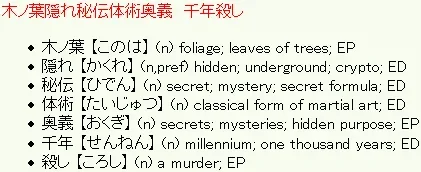
Okay, this one's from 「ナルト」: 木ノ葉隠れ秘伝体術奥義 千年殺し (or, このはがくれひでんたいじゅつおうぎ せんねんごろし). (The rōmaji for this should be something like "Konoha ga kure hiden taijutsu ougi sennegoroshi," but I'm so ill right now that I'm not sure about that. Must lie down …)

:sick:

UPDATE: Something like "Konoha hidden mystery classical-form secrets, one thousand years of murder," but I hope I can get something that makes a bit more sense. Sankyuu.
 

Attachments

  • 1000year.webp
    1000year.webp
    19 KB · Views: 209
Last edited:
Sorry to break this to you, but names of moves in anime like Naruto or Dragonball just can't be properly translated. You just gotta get the Romaji and use your imagination.
 
Yeah, like 九頭龍閃 (くずりゅうせん/kuzu-ryuu-sen), 龍翔閃 (りゅうしょうせん/ryuu-shou-sen), and 天翔龍閃 (あまかけるりゅうのひらまき/ama-kakeru ryuu no hirameki) from Rurouni Kenshi. For some reason, the last one uses kunyomi while the others use on'yomi; the only reason that I can think of is that it's the 奥義 (which was translated as "final attack") of 飛天御剣流 (ひてんみつるぎりゅう/hiten mitsurugi-ryuu). Speaking of "hiten mitsurugi-ryuu," I didn't even realize that the kanji 御 could be read mi.

Anyway, like @GaijinPunch said, they aren't translated, but merely transliterated in the translations. It just wouldn't sound cool to say "nine-headed dragon strike," "strike of the flying dragon," or "strike of the dragon who soars through the heavens," etc., not to mention that the Japanese versions are much more concise.
 
J44xm said:
Okay, this one's from 「ナルト」: 木ノ葉隠れ秘伝体術奥義 千年殺し (or, このはがくれひでんたいじゅつおうぎ せんねんごろし). (The rōmaji for this should be something like "Konoha ga kure hiden taijutsu ougi sennegoroshi," but I'm so ill right now that I'm not sure about that. Must lie down …)

:sick:

UPDATE: Something like "Konoha hidden mystery classical-form secrets, one thousand years of murder," but I hope I can get something that makes a bit more sense. Sankyuu.

I like the translation they used in one of the fansubs I saw a long time ago (back when it was still interesting): "One thousand years of pain." Seemed pretty accurate to me.
 
GaijinPunch said:
Sorry to break this to you, but names of moves in anime like Naruto or Dragonball just can't be properly translated. You just gotta get the Romaji and use your imagination.
Upon thinking about this, I'm not finding it making too much sense to me. Unless they're just stringing random words together, there's got to be something more specific they're shooting at, doesn't there?

Okay, how about this (more standard) statement: 「なるようになるさ!」 (naru yō ni naru sa!)? I'm getting things like "Come to become it" and "It reaches the point where it becomes!" from my general translation services and I'm curious what it's actually trying to say. Sankyuu.
 

Attachments

  • naru.webp
    naru.webp
    12.7 KB · Views: 153
Last edited:
ようになる means to get to a point that one does something, as in 辞典を使わずに日本語が読めるようになった would mean "I've gotten to the point where I can read Japanese without using a dictionary." In your case it seems as though something is missing before the first なる.
 
Last edited:
Thanks, Glenn. How bizarre, though, because what I posted was the complete answer to an actress/model's being asked what her favorite expression was.
 
「なるようになるさ」 is very often translated as "Que sera, sera" (what will be, will be--in the words of Doris Day)...

古すぎるかな・・・:emoji_stuck_out_tongue_winking_eye:
 
Ah, thanks epigene! I never would have guessed that one (which is obvious, I suppose). So it's an old set saying? Or are you wondering whether you're old? 😊
 
Too old? Hey, I'm only 27歳 and even I know that song. (Of course, I'm not quite like other 27-year-olds either.) Doris Day is a classic.
 
Last edited:
Yes, it's a common saying.

I thought most of the people here won't know Doris Day... 😌
 
木ノ葉隠れ秘伝体術奥義 千年殺し
Please understand that I haven't seen Naruto and seen only a couple of episodes of Rurouni Kenshin:

木ノ葉隠れ: A ninja skill to make oneself invisible (from old ninja movies I've seen as a kid)
秘伝: Secret tradition
体術: Skill or technique involving physical movement
奥義: A secret weapon (literally "the ultimate secret hidden deep inside a tradition or craft")
千年殺し: "Thousand years of pain" sounds good to me

After this, use your imagination! :cool:
 
Hey! I need some help, a friend of mine had this as her nickname:

いつもでまあなたをあいます.

I was just wondering what could that mean :S. Thanks in advance
 
kamuizero said:
Hey! I need some help, a friend of mine had this as her nickname:

いつもでまあなたをあいます.

I was just wondering what could that mean :S. Thanks in advance

There's a typo of some kind here. I think most likely it should be いつでもあなたを(に?)あいます。 It means "I'll meet you anytime." Did you copy that from your friend's nick, and if so, is your friend a native speaker?
 
yup I copied from her nick, and she's not a natve speaker so I don't know her japanese level :S maybe it was some typo error or something, is that the only possible option of a coherent translation??
 
Back
Top Bottom