Need a word or phrase translated?

...can anyone translate this for me,
1度の攻撃で~以上減る。
It doesn't make any sence to me >.<
Something falls/decreases more than ~ by a single attack.

Is it related to a game or something?

I did mean しつこい。
あの街宣車がしつこい sounds like "the 街宣車 follows me around" to me.😌 What do you want to say by しつこい?
 
Here ごく and わずか are separate words. ごく would mean something like "extremely"
I might translate it as follows:
To me, knowing only my own country and extremely few others, it seemed like something concerning a place hideously far away.

Oh~ Two different words. That makes sense. :)
Thank you for the help!
 
Translation

Hi Buntaro, would you be kind enough to translate 'life in every breath' into kanji if you can?

Many thanks!

Owain
 
I'm about to start a story focused on a character named Keiko Himura, who always uses Japanese greetings and honorifics. Thus, I need the romaji for some of her mannerisms.

Thanks to about's page on Japanese greetings, I know "see you later" and "see you tomorrow" are "dewa mata" and "mata ashita", respectively. What are "see you [insert-day-here]", "see you in [insert-month-here]", and "see you next week/month/year"?

What about "my dearest twin sister" and "twin sister dearest"?
 
Mata ashita/mata raishuu/mata shichigatsu ni. At least it feels like you need ni for an absolute time, as opposed to a relative time.

itoshii futago no imouto/oneesan.

I believe those should do the trick. I'm not so confident about the twin sister ones, though.
 
Even in twins, one is older and one is younger -- even if by minutes. So there *is* a "ne-chan"...
 
Yeah, I just meant the futago no part. I mean, literally it's right -- I'm just not sure if it's natural.
 
I'm about to start a story focused on a character named Keiko Himura, who always uses Japanese greetings and honorifics. Thus, I need the romaji for some of her mannerisms.

Thanks to about's page on Japanese greetings, I know "see you later" and "see you tomorrow" are "dewa mata" and "mata ashita", respectively. What are "see you [insert-day-here]", "see you in [insert-month-here]", and "see you next week/month/year"?

What about "my dearest twin sister" and "twin sister dearest"?
It totally depends on her personality, e.g., age, good or bad breeding, the person to talk to, etc. For instance, "see you later" has various alternatives in Japanese from "Gokigen'you" to "bye-bye".
 
What does this mean?

:emoji_thinking: What does this mean?

Watashiwa o tsuikai shite itadaki arigatogozaimasu...
Watashi-tachi wa besutofurendo ni narimasu!
 
I'm sure the writer is not a native Japanese speaker.

The first sentence doesn't make much sense. What the writer wanted to say would be "Watashi wo otsukai itadaki arigatougozaimasu", "Watashi no tame ni otsukai wo shite itadaki arigatougozaimasu" or something like that.
The second sentence means "We become best friends."
 
Last edited:
I think it's supposed to be tsuika itadaki (追加), as in on Facebook or something like that.
 
Ah, not "otukai" but "tsuika"! That makes sense.:) So, it's "Watashi (w)o tsuika shite itadaki arigatougozaimasu", meaning "Thank you for adding me to your list."
 
Yeah, I guess to be right it would have to be ご追加いただき... not just 追加いただき. Or what you have: 追加していただき. My 敬語 seems to be leaving me.... :(
 
あんときゃ毎晩のようにやってたのにな

I've never heard of it before, is あんときゃ supposed to be a slang form of あのとき or something?
 
Name for a sword

Hey
I'm an slightly over average Bleach-fan, and therefore I am to give my Katana a name based on how I'd want it to be :emoji_blush:. I would really like to have Fire and dragon in it. something like: "Dragon of Flame" or something similar.
any help would be really apreciated, thank you 🙂:
 
あんときゃ毎晩のようにやってたのにな

I've never heard of it before, is あんときゃ supposed to be a slang form of あのとき or something?
Very close. It's a contraction of あのときは. The last vowel "a" in "antokya" is from the particle "wa". This type of contraction often occurs in colloquial expressions.
e.g.
そりゃそうだ(from それはそうだ; sore wa --> sorya)
死にゃしない(from 死にはしない; shi ni wa --> shinya)

Hey
I'm an slightly over average Bleach-fan, and therefore I am to give my Katana a name based on how I'd want it to be 😌. I would really like to have Fire and dragon in it. something like: "Dragon of Flame" or something similar.
any help would be really apreciated, thank you :)
炎龍[enryuu] can be the one.
 
Very close. It's a contraction of あのときは. The last vowel "a" in "antokya" is from the particle "wa". This type of contraction often occurs in colloquial expressions.
e.g.
そりゃそうだ(from それはそうだ; sore wa --> sorya)
死にゃしない(from 死にはしない; shi ni wa --> shinya)

Thanks so much! :)
 
Yeah, I guess to be right it would have to be ご追加いただき... not just 追加いただき. Or what you have: 追加していただき. My 敬語 seems to be leaving me.... :(
I don't think ご before 追加 is ever a requirement. :?
 
Well, from the 謙譲語 section of Wikipedia:

語形変化には以下のような方法がある。

語彙自体を変える - 行く→伺う、見る→拝見する、する→致す
お / ご~する - 待つ→お待ちする、掛ける→お掛けする、相談する→ご相談する
お / ご~頂く・申し上げる - 買ってもらう→お買い頂く、辞退する→ご辞退申し上げる

It appears to be a requirement in 敬語. I know it is when you use 下さい.
 
While it is common to add ご to the counterpart's action, I somehow feel that in this particular context ご追加 is redundant and using only いただき (追加いただき) is just fine.

It is 100% personal feeling, no background and I simply cannot explain why - I have no problem with お手配いただき or ご理解いただき, for instance. 😌
 
Hello again everyone! I will be really grateful if anyone could spare some time to explain this 大御心 thingy. I have been searching for a while, but I still don't understand what in the pic.
 
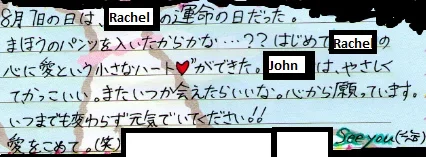
Translation Please

Can somebody please help me translate this. I am currently learning Japanese and understand very little hiragana. Help would be greatly appreciated ty :)
 

Attachments

  • Capture.webp
    Capture.webp
    22.1 KB · Views: 141
Last edited:
Hello again everyone! I will be really grateful if anyone could spare some time to explain this 大御心 thingy. I have been searching for a while, but I still don't understand what in the pic.
大御心 is a kind of omikuji which is available only in Meiji Shrine. See the explanations in the pages linked below.
Meiji Jingu-Your shrine visit-
Meiji Jingu-About Meiji Jingu-


The poem in the picture was composed by Empress Shouken/Empress Dowager Shouken.

Mirror
A mirror we look into every morning is untarnished
We want our hearts to be like it
 
Many thanks again Toritoribe. You are a lifesaver :D
By the way, what is the number at the bottom right corner for? I saw 1 and 2 but I don't know what that means :?
 
Back
Top Bottom