

Navigation
Install the app
How to install the app on iOS
Follow along with the video below to see how to install our site as a web app on your home screen.
Note: This feature may not be available in some browsers.
More options
Style variation
System
Light
Dark

You are using an out of date browser. It may not display this or other websites correctly.
You should upgrade or use an alternative browser.
You should upgrade or use an alternative browser.
Need a Kanji Translated? Just ask!
- Thread starter Mikawa Ossan
- Start date
-
- Tags
- kanji translation

They're bopomofo, some of which look similar to kana.
Thanks!!

- 22 Feb 2008
- 18,266
- 4,926
WOW! I didn't know that at all. Thanks!They're bopomofo, some of which look similar to kana.
(So, it must be a Taiwanese show.)

FinancialWar
Sempai
- 19 May 2006
- 1,065
- 44
Sorry, I thought there was some Hiragana on one of the images so I guessed Japanese. Thank you for letting me know it is Chinese.
These are not katakana. There are bopomofo used to aid pronunciation in Taiwan.
2
Last edited by a moderator:
BoxedLunch
後輩
- 3 Sep 2012
- 21
- 0
I've tried for the life of me to look up this kanji (using the radicals ハ and 口), but I just CANNOT figure out what it's meant to be!

"大???に" What is the symbol in the middle? I mean, it looks so simple! At first I thought it was 船, but the radical on the left looks too simple for that. It's like a 月 with only one line through it, and a 丶 at its top. Could someone please help? If it helps, the context is: "大???に のったつもりで おまかせを。"
"大???に" What is the symbol in the middle? I mean, it looks so simple! At first I thought it was 船, but the radical on the left looks too simple for that. It's like a 月 with only one line through it, and a 丶 at its top. Could someone please help? If it helps, the context is: "大???に のったつもりで おまかせを。"
- 22 Feb 2008
- 18,266
- 4,926
Yes, that's 船. Games, especially old ones often use very simplified kanji fonts due to the problem of the resolution.
BoxedLunch
後輩
- 3 Sep 2012
- 21
- 0
Ah, okay. That's really going to make things annoying, LOL. Well, I guess it'll make good practice to see how many I can decipher. Thanks for your help!
BoxedLunch
後輩
- 3 Sep 2012
- 21
- 0
(Disregard last post. I found the kanji I was looking for.)
Last edited:

Glenn
一切皆苦
- 8 Jan 2004
- 7,842
- 200
My guess is that the first one is more correct, but it seems that both are used as a translation, and there's even a third one (according to Wikipedia) -- 放浪願望.
ワンダーラスト - Wikipedia
ワンダーラスト(wanderlust)は英語で「旅行への強い情熱」を意味し、旅心・旅行熱・放浪願望などと訳される。
ワンダーラスト - Wikipedia
- 22 Feb 2008
- 18,266
- 4,926
I would use 放浪願望. 旅心[たびごころ] sounds a bit classical, and 旅行熱 is often used for a specific "wanderlust", for instance, 円高で、人々の海外旅行熱が高まっている.
Glenn
一切皆苦
- 8 Jan 2004
- 7,842
- 200
It's a pretty common phenomenon known as 連濁 (rendaku). In the case of 花火, it could be that it was once はなのひ and that turned into はなんひ then into はなんび then into はなび. That's just a guess on my part, though. At any rate, this phenomenon is more generally referred to as assimilation, and it happens in English all the time too. For instance, the prefix "in-", which is a negator, changes when it comes before words that start with "m", "p", "b'", and "l", such as "immaterial", "impotent", "imbalance", and "illegal", but not before other sounds, like in "insufficient", "indeterminate". This is actually manifest in the spelling in these words, but that isn't always the case. For instance, "n" sounds like "ng" (like in "king") whenever it comes before "k" or "g", like in "think" and "bring", but we don't spell it any differently.
TheArtiste
後輩
- 8 Aug 2013
- 4
- 0
Translating Artwork Characters
Hi everyone,
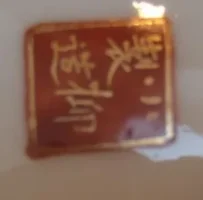
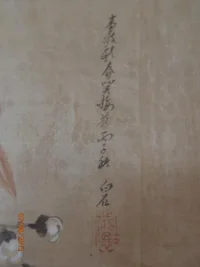
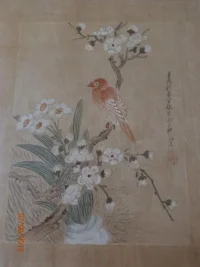
I'm new to this forum, but have recently become interested in far-eastern artworks. This is a venture into new territory, after studying European/Western art for a while. My knowledge is severely lacking on some pieces that I have acquired so I'd like to know the historical periods behind them and to understand the markings. My Japanese is severely lacking (I'm definitely a beginner).I don't even know if the symbols are Kanji, although I am hopeful.
First off I have a collection of hand-painted plates with markings on the reverse, and a silk painting (in which the fabric is embellished with manji symbols). I don't expect them to be particularly old, although this doesn't matter too much since I just like the designs and workmanship! Can anyone help with the character interpretations?
Thanks in advance everyone.
Hi everyone,
I'm new to this forum, but have recently become interested in far-eastern artworks. This is a venture into new territory, after studying European/Western art for a while. My knowledge is severely lacking on some pieces that I have acquired so I'd like to know the historical periods behind them and to understand the markings. My Japanese is severely lacking (I'm definitely a beginner).I don't even know if the symbols are Kanji, although I am hopeful.
First off I have a collection of hand-painted plates with markings on the reverse, and a silk painting (in which the fabric is embellished with manji symbols). I don't expect them to be particularly old, although this doesn't matter too much since I just like the designs and workmanship! Can anyone help with the character interpretations?
Thanks in advance everyone.
- 22 Feb 2008
- 18,266
- 4,926
The first picture is turned 90 degrees to the right. 小柳製造[Koyanagi Seizō] seems like the name of a company. (Koyanagi can be the name of the artist.)
The last two characters of the vertical line on the silk painting; "白石" is the name of the artist. It could be Hakuseki, Shiraishi or Shiroishi, if s/he is Japanese. It can be Chinese, though.
The three characters above it; "丙子秋" shows the season and year (of the drawing, mostly). 丙子[Hinoene or Heishi] refers to 1996, 1936, 1876, 1816, 1756,,, and 秋[aki] means autumn.
The last two characters of the vertical line on the silk painting; "白石" is the name of the artist. It could be Hakuseki, Shiraishi or Shiroishi, if s/he is Japanese. It can be Chinese, though.
The three characters above it; "丙子秋" shows the season and year (of the drawing, mostly). 丙子[Hinoene or Heishi] refers to 1996, 1936, 1876, 1816, 1756,,, and 秋[aki] means autumn.
TheArtiste
後輩
- 8 Aug 2013
- 4
- 0
Thanks for the information - it is most interesting. I quite like the idea that nothing is completely definite in meaning, such as the dates, although perhaps this is due to transliteration? I know that dates can be ambiguous even within Japanese, but are names in Japanese itself (not just the transliterated forms) also ambiguous?
You've encouraged me to learn more! Thanks for the patience regarding my ignorance.
You've encouraged me to learn more! Thanks for the patience regarding my ignorance.
- 22 Feb 2008
- 18,266
- 4,926
See the wiki page linked below.
Sexagenary cycle - Wikipedia
丙子[Hinoene / Heishi] "The year of yang fire rat" comes every sixty years, so it's impossible to identify the year only from this information.
BTW, why do you think it's a TRANSLITERATION???
Sexagenary cycle - Wikipedia
丙子[Hinoene / Heishi] "The year of yang fire rat" comes every sixty years, so it's impossible to identify the year only from this information.
BTW, why do you think it's a TRANSLITERATION???
Last edited:

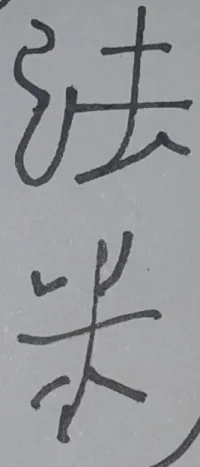
I have a problem with the kanji 汽
I believe the definition is Steam/Vapor but when I go to this site 汽 ? Tangorin It tells me the kanji doesn't really exist and steam/vapor is 蒸気.
Help please.
I believe the definition is Steam/Vapor but when I go to this site 汽 ? Tangorin It tells me the kanji doesn't really exist and steam/vapor is 蒸気.
Help please.
I have a problem with the kanji 汽
I believe the definition is Steam/Vapor but when I go to this site 汽 ? Tangorin It tells me the kanji doesn't really exist and steam/vapor is 蒸気.
Help please.
Well I don't know about that specific kanji but there are plenty that are only found in compound words. So perhaps it does mean "steam" but the dictionary is telling you there's no result for words made of just the kanji on its own?
2
Last edited by a moderator:
littlemonk
後輩
- 27 Aug 2013
- 1
- 0
Hi!
I am new in the JREF. First of all, I would like to thank you for this extend and complete website about Japan, its culture and its language. I would like to ask your help to translate a Japanese kanji tattoo. My friend did the tattoo when he was a teenager, together with his girlfriend, as proof of how stupid teenage love can beツ… I know it sounds ridiculous but he can't remember the meaning of it. Also they did it in a cheap nonprofessional place, so probable the meaning is different.
Can you tell us the meaning of the Kanji? I assumed its possible that there is more than one.
We will appreciate your help. Thank you in advance. You guys are making a great job here.
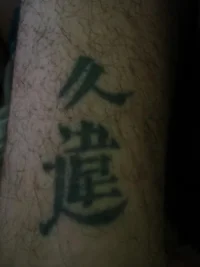
I am new in the JREF. First of all, I would like to thank you for this extend and complete website about Japan, its culture and its language. I would like to ask your help to translate a Japanese kanji tattoo. My friend did the tattoo when he was a teenager, together with his girlfriend, as proof of how stupid teenage love can beツ… I know it sounds ridiculous but he can't remember the meaning of it. Also they did it in a cheap nonprofessional place, so probable the meaning is different.
Can you tell us the meaning of the Kanji? I assumed its possible that there is more than one.
We will appreciate your help. Thank you in advance. You guys are making a great job here.


