Need a Kanji Translated? Just ask!

Hello,
I take an interest in Japanese history and I came across a drawing taken from the cover of the book Musashi and I was curious as to what the Kanji means.
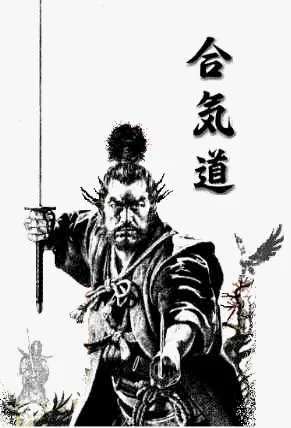
telapr11gif-1.webp

I've tried an online Japanese dictionary but it is difficult without being able to cut and paste the text. I believe that part of it means to join the way or something similar but I could be way off.
Any help would be greatly appreciate, thank you.
This is off topic, but the character seems to me to closely resemble a famous actor 三船敏郎[Mifune Toshirō], who actually played Miyamoto Musashi in a movie.
 
This is off topic, but the character seems to me to closely resemble a famous actor 三船敏郎[Mifune Toshirō], who actually played Miyamoto Musashi in a movie.
You have a good eye. It is most likely done so to capitalise on the popularity of the films since the English translation of the novel was released in the early 1980's around the same time of cult favourites in the West such as Shogun Assassin's English adaption and Kagemusha etc.. and also because there is no real detailed portrait of Musashi (at least to my knowledge) Most of the fan art is definitely adapted from Mifune Toshiro.

Just for comparison:

musashianepicnovelofthesamuraiera-1.webp

en_baba_samuray_03JPG-1.webp
 
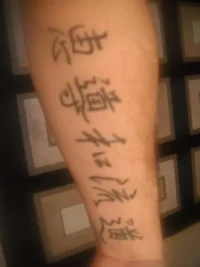
恵導和流道 ?

What did the tattoo artist tell you it means? I'm pretty sure it doesn't say "Fang of the Lunar Wolf", but you never know....
 
Hello. The Japanese culture is beautiful. I'm an European and always eager to learn. Maybe along the way I'll try to learn Kanji the right way considering it is a totally new way of looking on written words for an Western and it requires an open mind. Could you please translate my drawing, it was an tattoo on a man who never wanted to translate it?

untitled.webp
 
I think he was under the impression it means "unprepared".
 
Hello everyone! I just registered and I'm excited to start getting involved with this forum as it looks like a great resource about all Japanese topics. I have a few quick questions I'm hoping you guys can help me out with...
.
I'm working on an artwork involving a villain-like character and I wanted to use a short dark phrase in the background that would fit a villain. This post actually hopes to answer three somewhat random things:
.
1. How accurate Google Translate actually is
2. Proper word order
3. How Japanese handles "nonsense" word generation
.
For example, I went ahead and Google-translated "Lethal Occupation," just as a starting point for finding the right phrase. I always like to take the result and translate it back into English just to make sure I do get what I started with, but I noticed something funny. The result was 致死職業. This takes care of question one, how accurate Google is. Can anyone verify that this is the correct Kanji translation for Lethal Occupation?
.
Question two also comes into play here. I noticed that if I translated both 致死職業 and 職業致死, I still got Lethal Occupation as a result. Google did not pick up that I had reversed the order (since I expected something like Occupation Lethal); so I ask, what is the correct grammar in Japanese for short phrases like this?
.
Question three involves a different example and I don't want to overdo it on my first post... I apologize if this was too long and I will keep future posts shorter if need be. On the plus side, I did try to segment it into short paragraphs for easy reading. Thank you for your time! :)
 
"Lethal Occupation" isn't even clear in English. Lethal to whom?

Paragraphing is always appreciated. Thank you.
 
There's no elaborate meaning behind it. If you've ever played any of the Hitman games, it's like the motto of the Agency, Merces Letifer, deadly trade. Again, I'm still getting a feel for what I'm looking for so I just wondered what that would be like in Japanese. An adjective and a noun, that's all there is to it.
 
1)
It's completely depending on the word, but unreliable in most cases.

2)
Thinking about "word/phrase + particle" as a set, it's relatively free in a sentence, but still there are some rules.

For instance, 致死職業 sounds rather awkward, but the meaning "Lethal Occupation" is barely understandable. However, 職業致死 would be interpreted as "death by work". It's necessary to know grammar and the original meanings of each kanji 致 and 死 to understand why the meanings differ depending on the order.

I would say something like 命がけの仕事/生死をかけた仕事 for "Lethal Occupation".
 
You missed my point. "Lethal Occupation" is unclear English, and that's never a good starting point for a translation....especially with machine translation. It is unclear because it can be interpreted two ways. The translation you got out of Google implies the one you don't mean....that the one getting killed is the person who is in the occupation....not that the person in the occupation is deadly to others.
 
Interesting points. I think I have what I need to revise my goal and it even helped with the third question. Thank you both for your quick replies!
 
Hello again! I was wondering if someone could tell me what these three kanji are. Sorry the picture is so small and a little blurry. Thanks in advance! <3
 
Could anyone help me with this kanji?

e8jxip-1.webp


It's from a game, and it's pixelated and tiny.

In context, its:
玉に(KANJI)るなんて

It's too tiny for me to read :(

It kind of looks like 東, but I'm not sure.

And this one too:

ff5v6r-1.webp

I can't really see what the left radical is.

Thanks so much
 
Last edited:
摑引寄

The first kanji is the traditional form (旧字体) of 掴.
 
Hi guys 🙂:
I am restoring a Japanese Sentra and would like the "Nissan" name to place on the car. I came across this

日産 <-- Does anyone know if this is kanji or katakana?

Basically I am looking for the word "Nissan" of that era around the 1930s.

Thanks in advance.
 
Back
Top Bottom