Need a Kanji Translated? Just ask!

Hi,
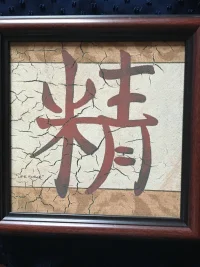
I bought this piece a few years ago, and it says in quotes that the translation is "life force." I think this is kanji, but I compared it to a kanji alphabet in order to see if that was the correct translation and I couldn't identify the characters (maybe they are too stylized?). I'd like to know the pronunciation and the translation, if possible. The image is attached. Thank you!
 

Attachments

  • image.webp
    image.webp
    1 MB · Views: 244
Hi,
I bought this piece a few years ago, and it says in quotes that the translation is "life force." I think this is kanji, but I compared it to a kanji alphabet in order to see if that was the correct translation and I couldn't identify the characters (maybe they are too stylized?). I'd like to know the pronunciation and the translation, if possible. The image is attached. Thank you!

I believe it's this one
精 - Jisho.org
pronounced せい "sei"

as a single character is defined as:
Noun
1. spirit; sprite; nymph
2. energy; vigor (vigour); strength
3. fine details
4. semen

I've also heard it used to express sexual desire (as in "her sexual desire awakened") but I don't know if that's a common meaning.

EDIT: I think it might be intended as the Chinese character in this context
Word dictionary - 精 - MDBG English to Chinese dictionary
pronouced "jing" in pinyin
 
Last edited:
I believe it's this one
精 - Jisho.org
pronounced せい "sei"

as a single character is defined as:
Noun
1. spirit; sprite; nymph
2. energy; vigor (vigour); strength
3. fine details
4. semen

I've also heard it used to express sexual desire (as in "her sexual desire awakened") but I don't know if that's a common meaning.
Interesting. Thanks.
 
Hi,
I bought this piece a few years ago, and it says in quotes that the translation is "life force." I think this is kanji, but I compared it to a kanji alphabet in order to see if that was the correct translation and I couldn't identify the characters (maybe they are too stylized?). I'd like to know the pronunciation and the translation, if possible. The image is attached. Thank you!
Seems like written by someone who is not familiar with kanji/Chinese characters.

oh39ud.webp
 
Seems like written by someone who is not familiar with kanji/Chinese characters.

oh39ud.webp

Good point. Then most likely the artist just looked up a kanji with a nice shape/meaning and didn't consider the nuances. But it's always nice to know what something says before hanging it on your wall.
 
Hi! New here :D
I'm trying to guess what kanji are the two that I share here with you. The file in which they appear has very, very bad quality, as you can see. Any ideas?
Thank you very much :)

Help.jpg
 
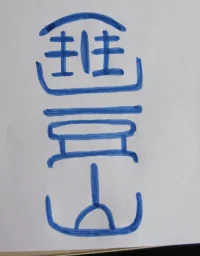
Hello. I have a box with what looks like a kanji on which I would like to translate. It did not photograph well so I have drawn it. Can anyone tell me if it looks correct and what it says. Thanks.chinese.webp
 
That's the traditional form of 豊 and a variation of 山, reading "Hōzan" or "Toyoyama", probably the name of an artist, place or something.

豐 - Wiktionary
 
Hi, sorry to ask for something sort of different to the purpose of this topic. I don't know much Kanji yet, but I'm working on a project where I need to represent facial expressions with the corresponding Kanji for the emotion (Joy, sadness, fear, anger, surprise, disgust) and I think I've already got them, but please correct me if I'm wrong:
- - - - -
Also, I need a Kanji to represent a neutral/calm facial expression and I'm not sure which would apply...
Maybe ??
Anyways, any advice would be highly Appreciated. Thanks in advance.
 
Joy: 喜
sadness: 悲/哀
fear: 恐/怖
anger: 怒
surprise: 驚
disgust: It's hard to represent this in a single kanji.
calm: 穏
 
Question: there are two kanji with the same meaning that have the reading いり.

One is 炒り and the other is 煎り. (meaning something like "roast (without oil)", but that's not the question)

In the latter of these, 煎り, the part that I would call 'tsuki' is written in a slightly different way--the third & fourth strokes are different than I would expect. I asked some natives at dinner tonight and nobody could give me any info why.

How about you folks? I would assume it's something historical, but if so, can you explain the history?

Calligraphic convention, for one reason or another (and if so, what is that)?

If I write this character with the 'normal' way of writing the tsuki part, will it look strange to people, or go unnoticed?

Thanks in advance!
 
煎 is the "correct" way and the other is a 許容字体, or "accepted variant". You can see the same phenomenon through many other kanji which contain that element.
 
In the latter of these, 煎り, the part that I would call 'tsuki' is written in a slightly different way--the third & fourth strokes are different than I would expect. I asked some natives at dinner tonight and nobody could give me any info why.
The most likely answer is that the 'tsuki' you see there, is not a 'tsuki' at all and came from some other element. Some fonts keep it differentiated with a different design. Perhaps @lincstreff can add something here. I bet he has a shelf full of kanji references (not to mention the one that he wrote).

If I write this character with the 'normal' way of writing the tsuki part, will it look strange to people, or go unnoticed?
I highly doubt people would notice. Did all the people you asked know the correct stroke order?
 
The most likely answer is that the 'tsuki' you see there, is not a 'tsuki' at all and came from some other element.
Amazingly I was right for a change.
「煎」という漢字の意味(名前・名付けの意味)・成り立ち・読み方・画数
It's a boat, not a moon. And now you can amaze all your Japanese friends with this bit of trivia that they don't know. I wonder how many other kanjis have "moon" elements that are really "boats."

As an aside, my fourth grader tells me that the 月 in 勝つ also comes from 'boat' even though it's written like the traditional tsuki. And it appears he's right: 「勝」という漢字の意味(名前・名付けの意味)・成り立ち・読み方・画数

All of this demonstrates why I gave up on advancing my kanji 能力 almost 20 years ago. :banghead:
 
Last edited:
I don't have much to add beyond the useful info already provided, but I'll mention a couple of things in brief. The forms of the characters have changed over time, both long ago and in comparatively modern times. Generally, the changes were made with the goal of making the characters simpler to both read and write. In Japanese, a major simplification effort was implemented just after World War II, but it was only applied to the toyo (later called joyo) characters, and any others were left alone. This is why the form of 煎 is inconsistent with the form of 前, even though both share a common component. Only the latter was selected as a common use character.
Simplifications also took place in mainland China. More characters were affected than in Japan. Sometimes the simplifications were consistent with the Japanese ones, but in many cases they differed. In Taiwan and Hong Kong, the traditional (pre-WWII) character forms are still used.
Even though the "tsuki" component of the above characters is strongly believed to have depicted a boat (character etymologies are only theories - not fact, as I stress in my book), the form has long resembled the moon component, which is why it is often treated that way, such as in character component databases.
 
That's good info--in the meantime, someone else suggested that it's a modified 肉 and/or 舟 (and based that on an old memory), so I guess he was part right.

When I was learning all the joyo kanji it took me a long time to work out why all the parts of the body seemed to have "moon" in them (臓、腿、胸、脳 etc.) - it being a modified "flesh" was not obvious to me at all.
 
That's exactly the reason why the radical of those kanji is called にくづき, not つきへん. Incidentally, 月 which is originated from 舟 is called ふなづき. 服 or 朕 belongs to this group, too.
 
Hey guys, I have one that I would like translated. This was a Keirin track racing bicycle used by a guy named Takizawa Masamitsu, nicknamed "The Monster." I need help translating the decals on the frame. Thank you!

GuEvyDG.webp
 
Back
Top Bottom