


- 14 Mar 2002
- 21,057
- 18,914
Loneliness and social isolation have become critical issues in Japan, a country facing both rapid ageing and population decline. Data from the National Institute of Population and Social Security Research showed that in 2020, 38% of households were composed of single individuals, with projections indicating this will rise to 44.3% by 2050. A 2022 survey by the Japanese government illustrated the extent of the problem, with nearly one in three respondents reporting some form of loneliness. In 2021, the government appointed a minister responsible for addressing loneliness and social isolation. The following year, legislation was passed formally designating these problems as matters of national concern and obligating local governments to implement countermeasures.
Against this backdrop, generative AI is being explored as a tool to provide companionship and emotional support, serving as a stand-in for daily social interaction. While these technologies may be beneficial, concerns have been raised about their emotional impact. Critics cite the risks of overdependence and the eventual erosion of distinctions between genuine human connection and artificial simulation.
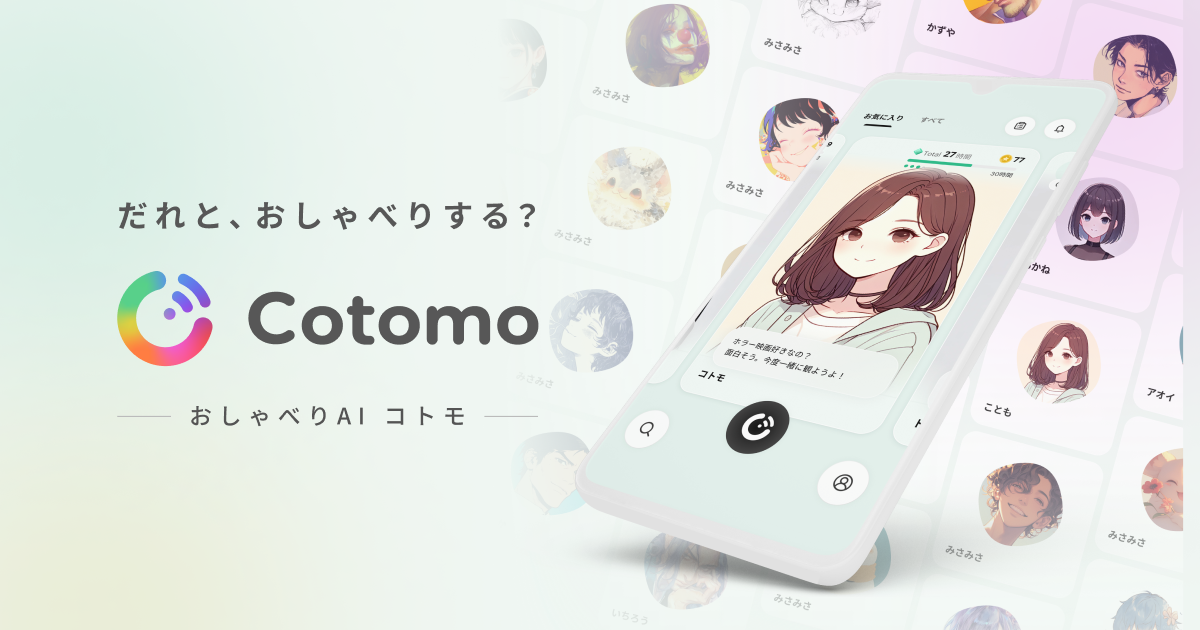
Cotomo, another AI app developed by the Japanese startup Starley, takes things a step further. Unlike traditional voice assistants, Cotomo is designed for casual, emotionally expressive conversations and features a distinct personality. Users can customise the chatbot by choosing its name, voice, character traits, and speaking style. Cotomo isn't meant to sound like a professor. Instead, users prefer a chatbot that comes across as gentle, slightly naive, and friendly. One of the most popular personas resembles a cheerful high school friend. The app has now surpassed one million downloads, with some users reportedly chatting for several hours each day.
Tohoku University is currently testing the use of Cotomo among elderly individuals. In a pilot project, seniors engaged in regular conversations with a specially programmed AI designed to prompt reminiscence about childhood and life during the Showa era. The goal of the project is to support cognitive health, alleviate loneliness, and help prevent the onset of dementia. Early results have been encouraging, showing that participants either maintained or even increased their desire for social interaction. Other companies are also exploring similar applications. Rohto Pharmaceutical, for example, is working with children who, for various reasons, are unable to attend school, using AI to support their emotional well-being and mental health.

 www.japantimes.co.jp
 cotomo.ai
Against this backdrop, generative AI is being explored as a tool to provide companionship and emotional support, serving as a stand-in for daily social interaction. While these technologies may be beneficial, concerns have been raised about their emotional impact. Critics cite the risks of overdependence and the eventual erosion of distinctions between genuine human connection and artificial simulation.
Hachioji, a leafy suburb about 40 kilometers west of central Tokyo, at the foothills of the Okutama Mountains, partnered with Ziai, a startup developing active-listening AI algorithms, to launch a chatbot service called HachiKoko. A pilot program ran from 3 February to 30 April, allowing residents to access the service by scanning QR codes posted on the city's website, at all 13 consultation desks and in the youth counseling center. Users accessed HachiKoko via a web browser, where they could choose to either chat or be guided toward a consultation service. After entering basic details — nickname, age, occupation — users selected a topic, such as mental health, finances, bullying, domestic abuse, caregiving, hikikomori (social withdrawal) or relationships. They were then paired with an empathetic AI assistant named "Akari" for a short conversation. [...] AI-based active listening is a double-edged sword, so to prevent users from becoming overly dependent, conversations are limited to a maximum of 15 turns. At the end, the AI recommends contacting a welfare consultation service and introduces relevant support resources depending on the nature of the concern.
Cotomo, another AI app developed by the Japanese startup Starley, takes things a step further. Unlike traditional voice assistants, Cotomo is designed for casual, emotionally expressive conversations and features a distinct personality. Users can customise the chatbot by choosing its name, voice, character traits, and speaking style. Cotomo isn't meant to sound like a professor. Instead, users prefer a chatbot that comes across as gentle, slightly naive, and friendly. One of the most popular personas resembles a cheerful high school friend. The app has now surpassed one million downloads, with some users reportedly chatting for several hours each day.
Tohoku University is currently testing the use of Cotomo among elderly individuals. In a pilot project, seniors engaged in regular conversations with a specially programmed AI designed to prompt reminiscence about childhood and life during the Showa era. The goal of the project is to support cognitive health, alleviate loneliness, and help prevent the onset of dementia. Early results have been encouraging, showing that participants either maintained or even increased their desire for social interaction. Other companies are also exploring similar applications. Rohto Pharmaceutical, for example, is working with children who, for various reasons, are unable to attend school, using AI to support their emotional well-being and mental health.
The rise of AI companionship in a lonely Japan
AI chatbots are becoming stand-ins for pets and partners — offering comfort, connection and raising new concerns.
Cotomo app:
音声会話型おしゃべりAIアプリ Cotomo(コトモ)
Cotomo(コトモ)は毎日のおしゃべりから、あなたのことを覚えてより身近な話し相手になってくれる音声会話型おしゃべりAIアプリです。


