Learning Japanese through Translation

Ok great, I had the general idea right which for 7 days into Japanese is good enough at this point in time. Moving on with another one (if I've missed a question or comment in a previous thread, let me know, I do try not to miss anything. Or if you'd like to go back on something for that matter).

I'll be using a new structure from now on: Screenshot, script, individual element interpretation.
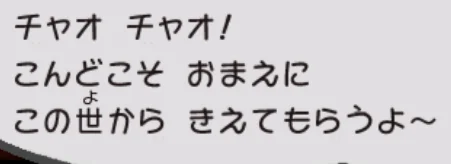
qNGdiFA.webp

「チャオ チャオ!
こんどこそ おまえに
その世から まえてもらうよ」

「チャオ チャオ」:onomatopoeia.
「こんど」:今度:[adv.] this time
「こそ」:[part.] for sure
「お前」:[pro.] you
[に」: [part.] target of a verb
「その」:[adj.] that
「世」:[n.] world
「から」:[part.] from...
「まえて」: ーて form of... a まえる verb or maybe : ...before? It's the て that's bothering me here. It make sense as 送り仮名 but I can't see it's purpose with 前+て. I can't find any まえる verbs which make sense in this context and "before receiving" would make some sense.
「もらう」:[五段 v.] to receive
「よ」:[part.] the speaker is informing the listener of something new.

So basically I'm missing the まえてもらう. Once I get this one, I'll be able to provide a translation.
 
Once again replied at the same time as Toritoribe. Will reply to message later.
 
「チャオ チャオ」:onomatopoeia.
It's Italian "ciao".

「その」:[adj.] that


「まえて」: ーて form of... a まえる verb or maybe :
えて
I can't find any まえる verbs which make sense in this context
You should suspect if you did misreading in that case just like おぼった.

You need to look up the explanation(s) about the expression "the -te form of verb + もらう" or similar ones ~てあげる/くれる, i.e., so-called やりもらい動詞 to understand the sentence. I have to say it's not so simple. Good luck.
 
Ah! Those typos.
「チャオ チャオ!
こんどこそ おまえに
この世から えてもらうよ」
With the corrections, I can safely say that:

「きえて」 is the 「ーて」form of 消え:to disappear/vanish. Starting to make more sense now.

I remembered reading about もらう in the giving and receiving part of my book.
So from what I can gather, まらう has only one meaning: "to receive".
To quote the book:
"One thing to point out is that since you receive from someone, 「から」is also appropriate in addition to the 「に」target particle."
This wasn't sufficient information so I browsed on the net for some more information.
ErB13Xx.webp

So in my case:
おまえ (この世から) 「きえて」「もらう」よ
Person+に+verb て form+もらう
So I'd say it means something along the lines of:
Ciao! Ciao!
"This time around I'll have you disappear from this world! (for my benefit)"

Pretty sure it's about right.
 
Next one:
pl0dilY.webp

「だけど やくそくだから
今回も チャンスを やるよ。」
だけど:[conj.] however
やくそく:「普通名詞」a promise
だから:[conj.] for this reason
今回:「自走名刺」this time
も:「助詞」although 「も」can sometimes means also, I'd say it's used more for emphasis here, like "even".
チャンス: 「外来語」chance
を:「助詞」direct object of the verb
やる:「五段」to give
「よ」:「助詞」
"However, because of my promise, this time I'll even give a chance."
Again, pretty confident about this one too.
 
Next one:
B84TVId.webp

「ぼくの名前を 当てたら
名前と 体を かえしてやる」
"If you can expose my name I will restore your body and your name."
「ぼく」:「代名詞」I, me
「の」:「助詞」noun connector
「名前」:「普通名詞」name
「を」:「助詞」direct object
「当てたら」:「一段」verb meaning "to expose", conditional inflection.
「名前」:「普通名詞」name
「と」:「助詞」"and"
「体」:「普通名詞」body
「かえして」:「五段」-て form of the verb 「返す」"to restore"
「やる」:「五段」to do.
So about: かえしてやる:
2mzIbDM.webp

I'm on a roll tonight.
 
First, let me just say that the more you post, the more I get the sense that you have fairly good instincts for figuring out Japanese grammar and sentence structure. With efficient study, practice, and reinforcement, I'm far more confident that you will be able to learn and improve your reading skills than I was after your first few posts.

Which game did you use? I picked Paper Mario because it's one of the few games which use furigana for kanji, which makes them faster to look up than using radicals. The downside is that I'm exposed to very few kanji in that game. The up side is that it allows me to focus on grammar.
The very first game I played (and completed) in Japanese was Final Fantasy VIII, which came out a year or two before Paper Mario, I believe.

When I played it, however, it had not yet been released in English.

...Now I'm feeling really old.

So I'd say it means something along the lines of:
Ciao! Ciao!
"This time around I'll have you disappear from this world! (for my benefit)"
Color me impressed that you were able to figure out the ~てもらう form. Yes, you mostly have the right idea here, though you're missing the nuance of こそ in your final translation. (Also it's worth noting that 今度 can often effectively mean "next time" depending on the context, though in this case "this time" appears to be the correct interpretation.)

"However, because of my promise, this time I'll even give a chance."
Again, pretty confident about this one too.
You're not hugely off, but your interpretation of the role of も is wrong.

Note that, like other case particles such as に and が, も marks the noun that comes before it.
If it were "even a chance" (or "also a chance"/"a chance as well") is would have to be チャンスもやるよ。
This is 今回チャンスやるよ, so the も goes with 今回, and チャンス is a simple direct object.

Does this change your interpretation at all?

「ぼくの名前を 当てたら
名前と 体を かえしてやる」
"If you can expose my name I will restore your body and your name."

"Expose" is not the right interpretation of 当てる here.

Look at this dictionary entry and see if you can't find a definition that makes more sense in this context:
当てるの意味 - 和英辞典 - コトバンク
 
than I was after your first few posts.
Honestly, it's just practice. I study about 5 hours a day so I'm starting to see the patterns better. Spaces help a lot too especially in parsing text.

If it were "even a chance" (or "also a chance"/"a chance as well") is would have to be チャンスもやるよ。
Oh right, yeah, good point.
This is 今回チャンスやるよ, so the も goes with 今回, and チャンス is a simple direct object. Does this change your interpretation at all?
Yes and no (まあまあ). I understand your explanation. I just need to make sure to apply that in the translation.
My initial translation was:
"[...] this time I'll even give a chance."
"give a chance" is accurate for チャンスをやるよ. Honestly, I feel like both "even" and "also" fit for 「も」here.
Perhaps:
"Even this time I'll give you a chance." or "This time too I'll give you a chance." As they're both plausible, I find it difficult to choose one. The thing is that they don't exactly mean the exact same thing, there's a nuance there, which makes choosing one over the other matter. It's not the same situation as the 「の」conversation we had with mdchachi before.

Regarding the dictionary software, I'd like to have the best there is out there. I need to have the best tools available. People link to kotobank a lot. What's the best Japanese-English dictionary software out there (that money can buy)?

"Expose" is not the right interpretation of 当てる here.
You're right... it's "to guess" (by checking your link)!

EDIT: I've made my donation to the forum. Just saying :P.
 
3VhcCU7.webp

I decided to challenge myself further in this one. This text is written fully in katakana which makes it more difficult to understand.
「スターストーンヲ 7ツ アツメルト
イツタイ ドンナコトガ
オコルノデショウカ?」
I prefer to understand from hiragana so:
「スターストーンを 7つ あつめると
いつたい どんなことが
おこるのでしょうか?」
*
「スターストーン」:外来語:Star stone
「を」:助手:direct object (d.o. from now on)
「つ」:助数詞: "To count generic object that has a rare or no counter"
「あつめる」:一段:"to collect/gather" also written: 集める.
「と」:助詞:"if"
「どんな」:連体詞:what kind of

こと」:Ok so I've seen 「こと」show up very often in the text. To quote GJG:
When you combine こと, the generic word for an event with ある, you can talk about whether an event exists or not.
It's not combined with ある here however. Moving on:
Using the past tense of the verb with こと, you can talk about whether or not an event has ever taken place.
In this case, it's not used in combination with a verb in the past either.
Checking ADJG next:
こと (n.) a thing which is intangible
That could be it. In the sense of: "what kind of thing". I'll go with that.
「が」:助手:subject marker
「おこる」:五段:"to happen", also written 起こる.
「のでしょう」:So this is a combination of の「助手」+ でしょう. It reminds me of: はがすのです on the previous page so it's likely the same construction. I'll check this one further before translating although I know what the sentence means now.
「か」:助詞:question marker
 
(The speaker already gave another hint previously, right?)
Sort of yes.
Did you read my reply in the previous page, by the way? Any response?
I always read your replies, often more than once :). I just forgot to reply to it so here goes:
に indicates the location of existence, thus, "the noun phrase that precedes it(= に)" is a location.
That's clear.

What is "in a state of existence" is the subject, not "the noun phrase that precedes it".
Hmm...
See, パン屋 is in a state of existence, and 通りの向こう is the location where the bakery exists.
パン屋通りの向こうある。
See, I would've said/thought that パン屋 is the subject (が) and that に introduces the adverbial clause 通りの向こう.
You should do that for all nouns which follow verbs/adjectives
Ok.
Did you realize that my reply about the subject of the first sentence, by the way? It's clear who the subject is now, right?
Which sentence are you referring to? This one?
「かいだんを のぼった先にある
トビラの 近くに はられている 紙を 風使いの チカラを はがすのです。」
The subject is not "I". It's a suggestion/an instruction said to the listener(s).
Well I think it's one of those examples where the subject is simply omitted, like jt_ talked about. It's implied that it's aimed to the listener but he's not mentioned in the text.
 
いつたい
たい (small tsu)

「のでしょう」:So this is a combination of の「助手」+ でしょう. It reminds me of: はがすのです on the previous page so it's likely the same construction.
のでしょう can't have the imperative nuance of のです. It's "explanatory の + でしょう(か)".

The rest are OK except repeated typos 助手 for 助詞.:emoji_wink:

パン屋通りの向こうある。
See, I would've said/thought that パン屋 is the subject (が) and that に introduces the adverbial clause 通りの向こう.
Yes for the subject, but 向こう is a noun "the opposite side" here, thus, 向こう is the location of existence. Note that particles are usually attached to nouns.

Which sentence are you referring to?
This one.

「空中に ふわふわ うかぶ 街の中
とうぎ場の ロビーが 見えます」
"I see a lobby inside the competition center in a town flying gently in the air."

My reply was to the question #1 in your post.
 
Regarding the dictionary software, I'd like to have the best there is out there. I need to have the best tools available. People link to kotobank a lot. What's the best Japanese-English dictionary software out there (that money can buy)
Actually I think online sources are quite sufficient for your needs.

いつたい どんなことが
You forgot the いったい part. It's not いつたい by the way. Hard to tell from the game's font.

「つ」:助数詞: "To count generic object that has a rare or no counter"
I never thought of つ as a stand alone thing. 7つ is basically shorthand for ななつ i.e. "seven."

こと (n.) a thing which is intangible
That could be it. In the sense of: "what kind of thing". I'll go with that.
Yep. こと is a very important word that comes up a lot.
For example in the right context and inflection どんなこと! can mean What The Fudge! or What is going on here! But that's not the reason it comes up a lot. It's often paired with verbs to mean "the thing that is <whatever>" like in the あること example.
 
Ok, thanks. Interesting about the 7つ part.

「スターストーンを 7つ あつめると
いったい どんなことが
おこるのでしょうか?」
「いったい」:I'm not sure. There are quite a few definitions. I decided to pick "in the region" but it's likely wrong here. There's also "what the heck" but wouldn't fit here. I really don't see.

"If you gather the seven star tones, what kind of thing will happen in the region?"
How would I express the "explanation" mood of のでしょうか here?
 
「いったい」:I'm not sure. There are quite a few definitions. I decided to pick "in the region" but it's likely wrong here. There's also "what the heck" but wouldn't fit here. I really don't see.

"If you gather the seven star tones, what kind of thing will happen in the region?"
How would I express the "explanation" mood of のでしょうか here?
Nope, it's the "what the heck one" used to add emphasis. This word could be translated in many ways.
One translation could be: If (you) gather seven star stones what in God's name (do you think) will happen?

As for the explanatory の, there is often no easy way to express that in English so it's frequently ignored in translation.
 
「いったい」:I'm not sure. There are quite a few definitions. I decided to pick "in the region" but it's likely wrong here.
See example sentences in dictionaries in those cases.

一帯を英語で訳す - goo辞書 英和和英
一帯を英語で・英訳 - 英和辞典・和英辞典 Weblio辞書

You can see 一帯 are used with particles. Thus, 一帯 is actually a noun, so it can't mean "in the region" just by 一帯. It should be 一帯に or 一帯で. That's why your interpretation of いったい and translation "what kind of thing will happen in the region?" can't be correct here.
Also note that 一帯 is not just "the region" but "the whole region".
Incidentally, as for the difference between 一帯に起こる and 一帯で起こる, the former has a nuance of "to/towards" (e.g. If/When you gather the seven star stones, it brings a disaster to the whole region), whereas the latter is "in/at" (e.g. a disaster happens in the whole region).
 
As for the explanatory の, there is often no easy way to express that in English so it's frequently ignored in translation.
Ah ok so I can sort of dismiss it then as being implied.
You can see 一帯 are used with particles. Thus, 一帯 is actually a noun, so it can't mean "in the region" just by 一帯.
Ah ok, yes right. Makes sense. Never realized particles are mostly used with nouns, it'll come by incredibly useful for sure.
Anyways, I think that's it for this one. Here's another one:
MLC92WJ.webp

「オレ わからないことが あると
ときどき そこの フランクリ先生にきいたりするんだ」
オレ:[pron.] Me, I
わからない:五段:negative form of わかる, "to understand"
こと:Again that word. See in this case it's:
"When you combine こと, the generic word for an event with ある, you can talk about whether an event exists or not."
For some reason, I would consider that I'd fit better as "a thing which is intangible". I'd interpret the whole clause together: 「わからないことが」as "something if I don't understand".
が:助詞:subject marker.
STOP: I was browsing DBJG (I got it today by mail) and I spotted 「ことが ある」which is exactly what I have here. It means "there are times when".
と:助詞:if (conditional)
そこ:there (place near the speaker)
の:助詞:attributive
フランクリ:[proper noun] Something like "Frankie".
先生:普通名詞:teacher
に:助詞:the verb does something toward...
きいたり: this one is causing me trouble. I think it's an inflection of きく, to listen. Actually, I'm pretty much certain of it. I don't recognize the inflection however. The conditional is similar (きいた) but it's not the same. Can I have a hint please so I can figure it out on my own?
する:[irr. v.] to do.
んだ;Shorthand for のだ I think which in turn means an explanation, the reason why.
 
You left ときどき off your breakdown list.

フランクリ:[proper noun] Something like "Frankie".

Frankly. (I looked it up online.)

きいたり: this one is causing me trouble. I think it's an inflection of きく, to listen. Actually, I'm pretty much certain of it. I don't recognize the inflection however. The conditional is similar (きいた) but it's not the same. Can I have a hint please so I can figure it out on my own?

Hint: Yes, it's an inflection. One that uses the past tense form of a verb. Is that enough of a hint? You should be able to figure it out from that.

Edit: rather than use 'past tense', as I just did, a cleaner way to refer to this verb form, to avoid possible misunderstanding, is:
"ta" form (in Japanese: タ 形)
I think this way of referring to it is fairly standard in English-based Japanese-language education.
 
Last edited:
One that uses the past tense form of a verb
Well I *think* it's the past conditional.
So the verb is きく. In order to get the inflection of the past conditional, you first conjugate it in the past and then add 「ら」.
So きく is a 五段 verb. So get the past form, I must first the ending of the verb, in this case, く. According to my book, く switches to 「いた」in the past. So basically we go from: き to きいた.
To get back to the past conditional, I simply add 「ら」to the past きいたら...
Which leaves me where I was.
But the excerpt uses きいた...
That's what I don't understand.
EDIT: ときどき is sometimes.
 
OK, another hint.
The conditional is not the only grammatical construct that uses the "ta" form. There are others.
 
If I check the conjugation of きく
There's the past presumptive: きいたろう
Then there's the past conditional I've already talked about.
No り there. Couldn't find any anyways, sorry!
 
Look up the ~たり~たり(する) verb inflection.
I'm sure you can find it in DBJG, and online as well.

As an added "hint" or bonus information, it's often presented in examples using two or more verbs, but in actual usage you often encounter it with just one (and the subsequent する).
 
STOP: I was browsing DBJG (I got it today by mail) and I spotted 「ことが ある」which is exactly what I have here. It means "there are times when".
Actually, it's more simple. It's just こと as a general meaning "thing" and ある as "there is/to exist/to have". Thus, わからないことがあると means "when I have something I don't understand". The nuance is closer to "when I come across~", though.
Note that even when an expression is seemingly the same as a set phrase that has a special meaning, it doesn't always mean that.

I think it's an inflection of きく, to listen.
Yes, the original verb is きく, but the meaning is not "to listen" here. Look up another definition.
 
Oh yeah, you're right, it is in the dictionary, p.458:
"[...] Inexhaustive listing of actions or states"
Ah so the り is not really part of the conjugation, it's more like a particle that's used in combination with the -ta form.
How can I be sure about the meaning of きく? It can even mean "to ask", "to follow", "to learn". Those are quite distinct verbs.
"when I have something I don't understand"
Ok, that's what I had thought.
 
Oh yeah, you're right, it is in the dictionary, p.458:
"[...] Inexhaustive listing of actions or states"
Ah so the り is not really part of the conjugation, it's more like a particle that's used in combination with the -ta form.
No. I guess it won't kill you to think of it that way if it helps you remember how it's formed, but たり is a verb inflection in itself. If you look it up in a grammar reference or even a native Japanese-Japanese dictionary, it's always going to be listed as たり, not as a particle "り".

How can I be sure about the meaning of きく? It can even mean "to ask", "to follow", "to learn". Those are quite distinct verbs.
The two basic meanings of きく are hear/listen and ask, and should be easily distinguished from context. If you're talking about what you do with your favorite song, it's going to be "listen." If you're talking about something you do when you don't understand something, 99% of the time it's going to be "ask." I'm not sure where you're getting "follow", unless it's something like these examples (from 聞くの意味 - 和英辞典 - コトバンク):
  • この子は親の言うことをよく聞く
    This child obeys his parents./This child minds [does] what his parents tell him.
  • 彼の忠告を聞いてたばこをやめた
    Following [Taking] his advice, I gave up smoking.
In this case, I'm sure you can see how this is just an extension of the "listen" sense of the verb. "Follow" in the sense of "I followed him home" is a completely different verb.

As a bit of advice, you'll want to (1) always use dictionaries that provide example sentences (as Toritoribe-san emphasized above), so you're not just seeing an English word and assuming the Japanese word has the same range of meanings and (2) going the other way, try to understand and internalize the nuances of Japanese words in their own right, rather than trying to force them into an English gloss which may not always be applicable.
 
Last edited:
Back
Top Bottom