Japanese, Egyptian, Aztec Connections...?

No sense?

Unrendite...your comment...that "Comparing modern words/sounds to seek for the origin does not make sense".

Well, actually, it is a science, called etymology.
Definition of etymology | Dictionary.com
et·y·mol·o·gy
1. the derivation of a word.
2. an account of the history of a particular word or element of a word.
3. the study of historical linguistic change, esp. as manifested in individual words.

But many things do not make sense to me either, so I relate!

What is more fascinating to me is like the example given... Yatagarasu...and the Wikipedia lookup on a three legged bird, and the plausible Egyptian meanings.

Lets dwell on that name, if you don't mind....

Ya and Ra. Ra and Ya. Sun and Moon. as in Ro-yal? as in Ra-Ja?

I sometimes stun myself when looking for x-y-and z and find rainbows, in addition. But you can't be me, and I can't be you, and the world is wonderful with our differences. Don't change.

Be skeptical.
 
Unrendite...your comment...that "Comparing modern words/sounds to seek for the origin does not make sense".

Well, actually, it is a science, called etymology.
Definition of etymology | Dictionary.com
et·y·mol·o·gy
1. the derivation of a word.
2. an account of the history of a particular word or element of a word.
3. the study of historical linguistic change, esp. as manifested in individual words.

But many things do not make sense to me either, so I relate!

What I said "does not make sense" is comparing modern words.
Especially if you are talking about etymology.

And where did you get the idea that the word "sushi" has the meaning of "flowers"?

EdZiomek said:
Japanese... Sushi... Flowers...? correct me if I am wrong on this. The fish meal is made to resemble flowers.

Not because sushi looks like flowers to you? I would not call it etymology.
 
I am sorry if this is a little off topic...but I always felt that the Japanese language sounds like some Native American languages. I am no great speller of Japanese so please forgive the mistake that is coming up. I live by a town called Okauchee (pronounced Oh Kah Chee) and it reminds me of a train stop in Tokyo, Okachi machi (please that's what it sounds like to me, and I know the spelling is wrong!)
 
It's "haha". But its pronounciation had changed over centuries - it used to be pronounced "fafa" and "papa" in the past.
I think it is another aspect which has been ignored by those who claim same/similar sound = having the same roots/origin. (Don't you agree?)
Comparing modern words/sounds to seek for the origin does not make sense.
you are right thats why in the dictionary there is a part that lists the etymology. I think that if the etymology is unknown word sound similarity may be a clue but not if the etymology is known. Like Daberu.

It's "haha". But its pronounciation had changed over centuries - it used to be pronounced "fafa" and "papa" in the past.
I think it is another aspect which has been ignored by those who claim same/similar sound = having the same roots/origin. (Don't you agree?)
Comparing modern words/sounds to seek for the origin does not make sense.
you are right thats why in the dictionary there is a part that lists the etymology. I think that if the etymology is unknown word sound similarity may be a clue but not if the etymology is known. Like Daberu. Unknown etymology and similarity to Hebrew in that the 2 words are almost identical. So then i will accept that maybe Japanese adopted a Hebrew word. But thats why i said to argue we would need a Japanese linguistics major. He would know etymologies and such so then arguement would be productive. Untill then we are just taking stabs in the dark.
 
Last edited:
Sushi meaning flowers!

Well, I was told that the food called "Sushi" was named because it was meant to take edible fish products and present them as if they were "flowers".

Hence, Sushi.

And not being a Japanese linguist, this is how I arrived at that understanding. And over the years, having presented this idea, I have just now been challenged on this meaning. But I can't defend myself other than to say, I have no doubt that there is absolute truth in that meaning somewhere.

Maybe I am wrong. Maybe I was misled. Maybe its like the name "mountain oysters", with a completely different meaning.

GoldieGirl... yes, I too see the remarkable similarities in Amerindian and Japanese names... Yokohama and Oklahoma. Nippon and Neponset. Nehon and Nihantic. Japan and Shippan.

My favorite is Shikoku -chuo Aki and Chikugo.

Compare with Texcoco (te-chay-ko-ko) and Chicago. Locals of Illinois will tell you, Chicago means "stinky place", or "onions". I say it may originally have been (gleaned from an old map) Te-she-ko-ko, which in the 4-syllable syntax, means... Divine Chief Osiris, who was God of the Underworld. Lookup Ka (her) Ka on Yahoo or Google for the Osirian references, and I believe it originally came from the sound a black crow makes... Ka-ka.

But names are tricky, and I would not put my life savings on the modern day meaning of names, titles, descriptive phrases...the New York Yankees are "Bronx Bombers", "Sultans of Swat", "Murderers Row", and "Damn Yankees". 3000 years from now, people will wonder..."Who were the Pinstripes?" All of the above are one and the same.
 
Well, I was told that the food called "Sushi" was named because it was meant to take edible fish products and present them as if they were "flowers".

You got wrong information.
Sushi used to be fish fermented with rice. It looks totally different from what it is today.
If one takes your way to find (to me it is more like conjure) the word's origin, you can make almost every words has the same origin.
Again, it is not etymology.
 
I wouldn't say that because words sound similar that they have similar meanings. It's the structure and meter of the words and the language that would make me think that there is a connection.
 
Well, I was told that the food called "Sushi" was named because it was meant to take edible fish products and present them as if they were "flowers".
Hence, Sushi.
And not being a Japanese linguist, this is how I arrived at that understanding. And over the years, having presented this idea, I have just now been challenged on this meaning. But I can't defend myself other than to say, I have no doubt that there is absolute truth in that meaning somewhere.
Maybe I am wrong. Maybe I was misled. Maybe its like the name "mountain oysters", with a completely different meaning.
Can I guess you didn't bother to corroborate your theory with any Chinese or Japanese sources before so casually disseminating this information ? There's nothing in any of the kanji or phonetics of sushi anyone could have found to remotely suggest flower. The fish was fermented with rice as a means of long-term storage and preservation in the absense of refrigeration.

Not that it isn't rare to find any ancient culture, and sushi did originiate more than 2,000 years ago, that could afford to create and name foods solely for their delicate aesthetic appeal or presentation value. It doesn't exactly require being a Japanese linguist to figure that one out.
 
Certainly...

Elizabeth, certainly you can GUESS!

Yes, the answer is, I did TRY and corroborate over the last several years the origin of the name Sushi.

But there are wonderful moments in my blogging past when I am challenged, and I dive right into published books and articles on the subject, and what do you know!?!

Sometimes I am right, sometimes I am wrong, but most oftentimes, I stumble across amazing OTHER similar meanings. Stunning (to me) revelations!

Can I ever convince you or any of the other 6 billion people on this planet?

No, no, absolutely not.

They are having a debate on the History Channel website...something like "Who deserves credit for discovering America." I am anxiously awaiting the results, because, with all the confirmed history of the Viking presence in the Americas, and the unconfirmed Irish monks, and the almost CERTAIN Menzies data of a 1423 Chinese presence and exploration, and the Cretan language symbolics of the Mayan, and the Greek-Hattusan stone examples found almost identical in Peru and Bolivia, and the Sumerian cuneiform examples of Bolivia, and the Samurai -type figure shown in the Temple of Gold in Lima Peru, and the Thor Heyerdahl proof of Egyptian and European presence in ancient Americas, I am almost certain Christopher Columbus will win the vote.

Because the worst blindness is perfect eyesight that refuses to see.

So yes, Elizabeth, you have every right to guess, and you will have to believe me, I did try to corroborate, but this is the first challenge after several years, and I thank you for stirring up my curiosity.

Now, I must reprove the "Sushi-flower" meaning to myself, or apologize! To you I can't prove anything, can I?

No problem. Valid points you raise!
 
ナスOナ?}窶ケ{ツ絶?卍仁ツ ツ「ナ津??佚」ニ棚ニ椎?ニ竪ニ停?愴暖窶堙?ス窶楪」ツ Prince Mikasaツ is a specialist of ancient Orient
Takahito, Prince Mikasa - Wikipedia
why did he become a specialist of ancient Orient?
Prince Mikasa became the oldest living member of the Japanese imperial family. After serving as a junior cavalry officer in the Japanese Imperial Army during World War II, the prince embarked upon a postwar career as a scholar and part-time lecturer in Middle Eastern studies and Semitic languages.
it is very interesting
eVen Emperor is not permitted to see Yata no kagami
...
Yata no Kagami - Wikipedia
1187786634-1.webp

1187786584-1.webp

1187786557-1.webp


http://www.ne.jp/asahi/pasar/tokek/TZ/C-IL-egami.html
 
Atlantean ties to Japan mythology?

Thank you Caster 51 and all...

On another thread and mentioned in part on this website, I recently posted my research on the fascinating Atlantean naming conventions of the Valley of Mexico. Yes, there are maybe 200 or 2000 persons before me (over the last 400 years) who claim this location as a potential Atlantean location. To be fair, I can't name one location in the world that hasn't been named "Atlantis" in theory!

But anyways, one of the extremely important double-temple locations among the Aztecs was named Coyo-huacan. Along with the figure of a dragon-type character, and its location at the Gateway to Tenochtitlan (theory:"God of darkness, underworld-land") I believe the name of this temple meant, "temple of the dragon 3-star-cluster called Sirius, Set, Sutekh, Saite, also known as Koyo, related I believe to Tokyo and Kyoto ...again...only my very-flawed amateur theories here...don't shoot me please!

In astronomical circles, I believe this star cluster is referred to as Sirius A and B, and mythologically "C".

I found these images in a tourist map commissioned in 1973 to incorporate the pre-Conquistador naming conventions, plus the ancient iconography of the Valley of Mexico... (it may have been one of the greatest unintended accidents of history research, illuminating the lost Atlantean location)

Atlatzinco...A-t-la-tos-in-ka

Atlauntenco...A-t-lan-ten-in-ka

Atlaco...A-t-la-so...(there is also a location called...A-t-leesh-ko)

Atlacualco..."A-t-la-cua-lee-so"
http://img254.imageshack.us/img254/3420/tpeyacac5zr5.jpg
(note the companion place name... Tepeyacac...I say is "Hill or Iachos"

Atlacuinuayan
http://img406.imageshack.us/img406/1908/2atlanscloseupuu7.gif

Atlazolpa...A-t-la-sol-pa

Atlapulco ...the Polis of A-t-la

Atlipac...At-la-pas
http://img260.imageshack.us/img260/175/aztecmapatlipac2kz2.gif

Atlanco... A-t-lan-in-ka
http://img258.imageshack.us/img258/2608/6saveatlantiscentralmn3.gif
http://img107.imageshack.us/img107/317/atlancowl6.gif

Atoyac...A-to-yas...A-to-lass
http://img250.imageshack.us/img250/401/gatewayleftatollas2sz9.gif

Note: Coyo-huacan showing a dragon-type character in the lower portion of the graphic, which sits at the Gateway to the Tenochtitlan-underworld area.

"Plano reconstructivo de la región de Tenochtitlan" -1973- by Luis Gonzalez Aparicio
http://www.bereda.com/losos/L-M/frames4.htm
(hit the top-left button called "Mapa Antiquo")

Also, I propose...educational guesses at pronunciations...
Double-Temple of Venus, ... Tena-huacan...Tena-wah-can
Double-Temple of Hephaestos... Epazo-Huacan (have read existed, but could not locate)
Shrines of Venus... Atenco...A-ten-in-ka
Double Temple of Set, Saite, Coyote: Coyo-huacan
Temple of Iachos...Tepeyacac
Double Temple of Isis-Ishtar-Aphrodite...Iztapalopan..Ish-ta-pa-la-pan

Net, net... Coyo, To-kyo, Kyo-to... all are potentially related naming conventions among the Aztecs and Japanese cultures.
 
Net, net... Coyo, To-kyo, Kyo-to... all are potentially related naming conventions among the Aztecs and Japanese cultures.

Do you know that both Kyoto and Tokyo are quite new?
These names started to be used in the 19th century.
 
Hello everybody
Just to clarify a misunderstanding. Aztec is a name invented by foreigners for the Mexica (read Mehika, sometimes also read as Meshika) tribe that came from Xicomostoc to settle where their war god Huitzilopochtli told them an eagle would be devouring a snake on top of a Nopal (sort of cactacean plant). The proper term is Mexica (hence, Mexico, etc etc).
Their language is called Nahuatl.
And flower would be Xochitl, no Zocchi :)
 
Too often....

Juan, thank you for your contribution.

Too often, I am educated about American history by foreigners. It is an ironic fact that I totally accept.

And too often, I educate Chinese persons about Chinese history, or African Americans about African history, and again, do not be offended, I feel like I am educating you about your own history.

I have gone to Teotihuacan. Has anyone ever told you of the exact translation of Teotihuacan into Egyptian? Have you ever heard of Tehoti? Or Djeheuty? Or Thoth? Or Hermes?
http://www.world-mysteries.com/gw_edziom3.htm

You mention Chicomoztoc, thank you. You don't have to believe me, and I am not guaranteeing my theories, but I say that this name is "Sheikh Moses-Thoth". The Egyptian name might be "Tutmoses". This figure I believe stands at the Gateway to your famous "bent mountain" Colhuacan. He holds a shepherd's crook in his left hand, and a staff in his right hand, and he has a beard. These are very close to the myths surrounding the biblical Moses.

http://img502.imageshack.us/img502/152/sheikhmoses4xw5.gif

http://img502.imageshack.us/img502/83/sheikhmoses3pl8.gif

(note the spiral design behind the feathered crown)

http://img187.imageshack.us/img187/1401/chicomoztoc2ht1.gif
(depicted in "The Aztecs" by Richard Townsend, with the 7 Caves of the Moo-shee-cas, at Colhuacan...)

And too often, persons dutifully report...x-y-z is a manufactured name, and I gently ask..."Where did you find that information?"

And too often, I answer with the factual news..."Well, if Aztecs, and A-z-tecas is a manufactured name, how come it shows up on the Davalos map?

http://img250.imageshack.us/img250/401/gatewayleftatollas2sz9.gif

If you look to the left of Coyo-huacan, you will notice a circle object within a circle object. It's name is "Chimal-iztac", which is arguably "Chee-mal-ee-zz-te-ka", very close to Azteca. And the mythology of the ancient Israelites/Semitic tribes is that they believed in the God called Sutekh.

And, surprise, surprise, surprise, when I looked up "Sutekh", lo and behold, the hieroglyphic to the right of the explanation contains a very similar dog-like creature in its name, almost identical to Coyo-huacan!
Sutekh - Wikipedia

So Juan, I have some questions...

1. What is your source that the name Aztecs and Aztecas is a manufactured name?

2. Were you even aware of the Davalos/Aparcio/Penafiel map, owned by the City of Mexico City, printed in 1973?

3. Are you aware that the name "Moo-shee-kas", as in Mexico, can plausibly be the name of "Sheikh Moses", i.e., prince Moses?

4. Are you aware that the Conquistadors held religious Inquisitions in the Valley of Mexico against certain indigenous tribes, since they were totally convinced that they were "Lost tribes of Israel"?

5. The Aztecs had Xochimilco, Xochimanco, (Zho-she-meel-ko)...but are you aware that this name compares very well with the Egyptian Pharoah "Shesheng"..."Sho-Shee-eeen-ka"?

I am sure there are a million things you could teach me about America, which would also stun me.

PS...Puebla...possibly the best ceramics in the world, I've been there, and yes... "ceramics and clays", one of the minor benchmarks of Atlantis.
 
Last edited:
Egyptian/Greek Mythology enthusiasts only...

PS...while I am on this Set-Sutekh-Saiute-Coyo subject matter, I mentioned one other plausible find of mine, and that concerns the River Styx.

Remember the Egyptian underworld name... Tat-land. I proposed Tenoch-titlan.

Remember the Greek underworld name... Hades, very similar to Haiti.

But to get to the Greek underworld, you "had to cross the River Styx".

Well, just as I say Passaic is Psyche, and Ogygia is Hawaii, I believe the "River Styx" is actually pronounced "Su-te-cha", aka Sutekh.

For me, it is amazingly interesting to have the double-temple of Coyo-huacan placed over a stream/river, next to the sun symbolic of the circle within a circle (actually a reflective astronomical tower) named Chimal-iztac. Coyo-huacan sits in guardian over the Gateway to the Lake Texcaca, across from Colhuacan, explicitly the gateway to Tenochtitlan.

This extraordinary geographic placement begs the question...is the River Styx of Greek mythology actually pronounced... Suteka or Sutecha? Conclusion or question...you have to cross the River Sutecha to get to "the Underworld".

And the place of Sutekh, Sutecha, is the ..."i-z-tac"... "A"-Z-TE-KA.

Only my deep, sincere, theory.
 
So Juan, I have some questions...
1. What is your source that the name Aztecs and Aztecas is a manufactured name?
2. Were you even aware of the Davalos/Aparcio/Penafiel map, owned by the City of Mexico City, printed in 1973?
3. Are you aware that the name "Moo-shee-kas", as in Mexico, can plausibly be the name of "Sheikh Moses", i.e., prince Moses?
4. Are you aware that the Conquistadors held religious Inquisitions in the Valley of Mexico against certain indigenous tribes, since they were totally convinced that they were "Lost tribes of Israel"?
5. The Aztecs had Xochimilco, Xochimanco, (Zho-she-meel-ko)...but are you aware that this name compares very well with the Egyptian Pharoah "Shesheng"..."Sho-Shee-eeen-ka"?
I am sure there are a million things you could teach me about America, which would also stun me.
PS...Puebla...possibly the best ceramics in the world, I've been there, and yes... "ceramics and clays", one of the minor benchmarks of Atlantis.

1. A known fact among the educated native (like in blood descendants) Nahuatl-speaking people here, they never refer to themselves as aztecas or the people of Aztlan (where somebody who coined the aztec assuredly coined the term)
2. You should check on the map of Cuauhtinchan, which supposedly tells the location of Chicomostoc. I'll see if I can find an internet reference. And no, I was not aware of it. Are you sure it is Davalos/Aparcio/Penafiel? Makes more sense if it were Dávalos/Aparicio/Peñafiel (ok special characters can be tricky). However, I thank you for bringing it to my attention.
3. Could be. But it, to the best of my very limited Nahuatl knowledge, has different etymological meaning, and is pronounced Mae-shee-kah.
4. Not only that. The conquistadores were basically very narrow minded and culturally very unsophisticated, which is a pity, as they basically killed all the intelectual elite, as well as most manuscripts. Fortunately, there were enlightened priests that salvaged what few codex we have of them. There are many analogies between prehispanic philosophy and religion to not only Jewish but also Hindu and other ancient religions. Consider Guadalupe, the most revered manifestation of the Virgen Mary in Mexico (for Catholics at least) appeared in the whereabouts of a place dedicated to Tonantzin before her, which is an almost match for the bodhisatva Kuan Yin, or Matsu. And if you visit altars of churches in very ethnic communities, they have a striking similarity to some Budhist and Taoist altars.

5. I'm not that well versed on ancient egyptian pharaohs, as my education has been more on the buildings part of things, being an architect myself. I CAN tell you that some Cambodian stone structures have a striking resemblance to some pyramids here though.

If you want similarities, take Quetzalcoatl, "the plumed serpent" and compare it to the Chinese-Japanese dragon. The similarities are striking.

BTW Miguel Leon Portilla, an eminent scholar on prehispanic studies, concludes that the Mexica's religion was in fact monotheistic.

As to the underworld, the underworld was Mictlan, not Teotihuacan. However, Mictlan has striking similarities with the Hades underworld.

However, there is plausibility on the confusion of Aztec vs Mexica terminology, as the Nahuatl language was written with ideograms, not characters, so there is no straightforward way to translate it without a little mmm "poetic" license.

I live in Puebla btw :) Sure there is nice pottery here. Quite expensive too, lots of checks and balances por it to be official talavera pottery. In Puebla we have some very similar typical stuff with striking similarities to Chinese thingies, courtesy of the China Poblana, which was a Chinese wife of a prominent citizen centuries ago. She must have been bored, and a bit of a socialite, as her influence is quite notorious in things like the formal typical female dress, and even some types of candies.

I have a Mexica type of Yin Yang illustration taken from the Codex Borgia somewhere, I'll look for it and upload it, if anybody is interested.
Yin Yang in the Positive-Negative thing, no pictorically similarities though.
 
Last edited:
Sun and Moon at noon...

Juan, you gave me a lot of good leads, thank you very much. Yes, with the estimated 200-500 individual distinct tribes of ancient Mexico, there were Asiatic peoples (which would include Cambodian and Chinese and Japanese tribes), African-type tribes (which would include Nubian-Egyptian), and Caucasian tribes. I believe Mexico to be the Grand Central Station of the Western ancient world.

But there is a myth out of Mexico, an important and intriguing legend, of a location where once a year, the Sun and Moon visibly appear at noon in the sky at one location. And the manifestation of that is the graphic of the sun and crescent moon in one image.

Is that the Teotihuacan area?

Have you heard of this phenomenal location with this event?

Thank you for your participation.

PS...graphic comparing Greek Medusa, "Tonatiu"-center of Aztec calendar, and Mahakala, Bhuddist divinity...

http://img348.imageshack.us/img348/4022/3compare1vf.jpg
 
Last edited:
Mmmm the centre of the Aztec Calendar (which I presume you mean the solar one) is Ometeotl, with the 4 tezcatlipoca representing the cardinal points. Sort of I Ching, with the Center and the 4 directions and stuff.

What I do know about Teotihuacan is the legend as to the creation of the cosmos as it is today. The gods were still fabricating the world and someone needed to sacrifice himself in order to provide for a sun. Nobody ventured forward, but one of the humblest of the gods just sacrificed himself so there would be a sun. On seeing such a selfless sacrifice, one of the higher ranking gods felt ashamed of his own excessive pride, and sacrificed himself too. However, with two suns the heat became unbearable, so a rabbit was thrown to one of the suns to dowse it's heat (hence the rabbit on the moon). There are several variations of the story, and the layout of the avenue of the dead, as well as the position of the several important buildings in the layout correspond to the main celestial bodies visible (without pollution or cloudy skies) with the naked eye. However, I have not heard that particular phenomenon about Teotihuacan. Could be though, I'm no expert on the matter.
It is common for most pyramids here to have some sort of alignment with celestial bodies, be it the sun, moon, venus, mars, the equinox or solstice. So I find it quite likely there is indeed a place where such a phenomenon occurs.

I would relate Medusa more with Coatlicue than with Tonatiuh...
 
Ancient Peruvian Amaruca, Chaldean Omoroka

First article on the serpent known to the Incas as Omorka, and Omoroka...and why do the Japanese name their boats with a Maru suffix?

Are they references to ancient snake Gods of creation? Could it be Japanese boats were named after sea-serpent figure Gods?

From research...."Bridging the Americas Reuniting the Eagle and the Condor"
http://www.earthdance8.org/PERU-E~4.pdf

Amaruca - America, "Land of the Serpent"
Peruvian prophecy states that all the Americas were once united by a common spiritual tradition and leader, and that they will be again. We were anciently united as Amaruca or Ameruca, meaning the "Land of the Serpent", during a time when the serpent was the universal symbol of mystical wisdom and spiritual power. One legend states that North and South America were named after a culture bearer known historically as Aramu Muru or Amaru Meru, the "Serpent Meru." Aramu Muru came from the ancient continent of Mu with many power objects, including the powerful Solar Disc that had previously hung in an important temple in his homeland.

From my other research, in the same naming convention as the Incas...
Omorca, Omoroka (Chaldean version of Babylonian Tiamat)
http://www.websters-online-dictionary.org/Om/Omorca.html
Omorca: The goddess who was sovereign of the universe when it was first created. It was covered with water and darkness, but contained some few animals of monster forms, representations of which may be seen in the Temple of Bel. (Berosius.).

Second article...for your information,

...which I found interesting in light of a few paragraphs from...
...Excerpts from the Atlantis Rising Forum... The Tracing of Dan

Contribution of Boreasi ...."TRACING DAN" By Walter W. Baucum
http://forums.atlantisrising.com/cgi-bin/ubb/ultimatebb.cgi?ubb=get_topic;f=1;t=001526;p=0

...In the Herald's College, London, there is a very ancient manuscript deducing the Saxon kings from Adam and from David. Odin is listed in the genealogy (as is also his wife, Frea) tracing the Royal House of Britain back to David."

One might cross-relate this paragraph to the previous JREF article on
Jomon and Yayoi Origin of Japanese Royal Families, by Color Red....
Jomon and Yayoi origin of Japanese royal families

So the English Royal family, and the Japanese Royal family, and the House of David may be related? I say yes.

Note: I should have submitted the last paragraph of info onto the correct, Color Red thread....
 
Last edited:
Bhuddist Capricorn Symbol at Tula?

I believe I have an interesting observation to share with you, that of the iconic symbolism of the Bhuddist Sign for Capricorn, on the wall of Tula, Mexico. I might add that the "goat fish", or various zoomorphic sea creatures, also were written about in the Atlantean mythologies pertaining to Poseidon. There is also the published opinion that wherever Atlantis may be found, the artwork would be displaying murals of "dolphins" or similar sea creatures. While there are no direct, conclusive Japanese references in this material, it does intrigue me with coincidental Asian-theology, even Atlantean-style possibilities.
Tula wall, with Capricorn-style crown....
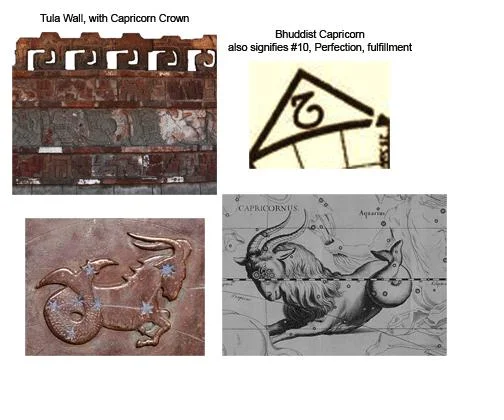
capricornback3bt9gif-1.webp
Bhuddist Capricorn Zodiac references....
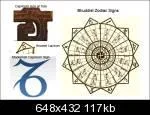
calendar5ur6thgif-1.webp
"Capricorn traverses the depths as well as the heights. In the ancient Sumerian myth, when the goddess Inanna is trapped in the Underworld, it was Enki, god of wisdom, land and waters, pictured like the goat-fish of Capricorn, who was able to save her. He took some bits of clay from underneath his fingernails (he had been sculpting mountains, no doubt) and fashioned two little critters who buzzed down unseen through the gateways to the lower world. They fearlessly approached and consoled the raging underworld goddess so that she would free Inanna. ... "
Skyscript: Star Lore of the Constellations - Capricorn the Goatfish
Capricorn, bringer of rain?
"The constellation has a widespread association with aquatic creatures in ancient times. Early Hindu astrologers depicted it as a goat's head upon the body of a hippopotamus and it was known by some Latin authors as Neptune's Offspring or The Rain-bringing One. This is partly because the Sun's passage through this section of the sky coincided with the rainy season of the ancient year. The symbolic roots are also tied into the worship of Ea, one of the most important Babylonian gods who ruled over Waters, Wisdom and Magic. Ea's domain was the 'Primeval Deep', and he was known by the title 'Antelope of the Ocean'."
Ed Z--Author's Note: From other material, I am led to believe that this Capricorn "antelope of the ocean" evolved into various other aguatic animals with more modernish ancient cultures, including the dolphin and the sea horse.
"Classical mythology linked the constellation figure of Capricorn with Pan who during the war of the Titans jumped in terror into the Nile and changed his shape into that of a goat-fish. Thus the words 'panic' and 'pandemonium' originated. Greek myth also associated the symbolism to Dionysus (Bacchus to the Romans), the god of wine, agriculture, and earthly fertility; or Liber 'the free one', an older Italian god of fertility and growth in nature. All of the classical associations exploit the symbolism of the goat's horn as a drinking vessel and cornucopia - an abundance of the gifts of nature as seen in the sustenance offered by the goat's milk. Capricornus is the Latin name for the constellation which refers only to a goat's horn, a potent symbol for fertility which gave rise to a reputation for hedonistic behaviour and the more negative tendencies associated with 'acting the goat'.
In many respects these attributes present an extreme quality of Zeus who was nourished in infancy by the goat Amalthea. A deeper spiritual significance, and a more Saturnian flavoured origin is revealed in the ancient depiction of this star group as a goat's forebody attached to the tail of a fish.
Ea was the most stoical of the ancient gods and his mythological traits reveal him to be a constant friend to humanity. The Greeks preserved his character in their own myth of Oannes, an exceptionally wise creature, described by Berossus as half-fish and half-human, who was said to have emerged from the ocean on four occasions to bring culture and civilisation to mankind.
Ea and Oannes are both described as articulate, patient, tolerant and serene. Their lack of emotional excitability are impressed upon the character traits associated with the star sign Capricorn.
Despite its zodiacal importance, Capricorn is unremarkable as a constellation, possessing no stars brighter than 3rd magnitude. It is second only to Cancer for its lack of luminosity and, like Cancer, was regarded as a celestial portal between Heaven and Earth. Whereas Cancer was 'the Gate of Men', through which souls descended to Earth from Heaven, Capricorn was 'the Gate of the Gods', the portal of ascension through which souls of the departed ascended back to Heaven. This ties neatly with Hermetic Philosophy, which regards the sphere of the Moon, the planetary ruler of Cancer, as the final realm in which incarnating souls acquire shape and form in birth, and the sphere of Saturn, the planetary ruler of Capricorn, as the final realm in which ascending souls free themselves from earthly trappings upon death. It is assumed that this association developed whilst the Sun's ingress into Cancer marked its greatest elevation and Capricorn marked its nadir. Early philosophers looked upon water as the element from which all life emerged, hence symbolism of an aquatic or amphibious nature is prevalent in the constellations linked to these points.
This Hermetic-Platonic philosophy has a direct relevance to Babylon and therefore strengthens the argument that Capricorn celebrates the mythology of one of their prominent gods. The name 'Babylon' is the Greek form of bab-ili, the Assyrian translation of the Akkadian ca-dimira, 'gate of the gods', by which name it was locally known. The Hebrew name Babel (bab 'gate' + el 'god') shows the connection more clearly.
As 'the Gate of the Gods' Capricorn was favoured for times of sacrifice, and in the zodiacs of Denderah and Esna, where it is depicted by a goat-fish, it is called Hu-penius, meaning 'the place of sacrifice'. Goats were a creature of choice for atoning sacrifice - Letviticus of the Old Testament describes a ceremony whereby one goat is offered in sacrifice, to be slaughtered on the north side of the altar, whilst a second becomes a sin offering, a scapegoat which after the ceremony is exposed to the wilderness as the bearer of man's sin.
This scapegoat fell naturally into the symbolism of evil, some Biblical translations refering to it as Azazel, an outcast evil spirit residing in the wilderness. Azazel has subsequently been seen as a demonic goat god that has influenced pagan illustrations of the devil. But this is a very distorted vision of the symbolic properties of the goat. The goatfish however can be seen as a powerful dualistic emblem, uniting creatures that roam the mountains with those that swim the depths of the ocean, a symbol of the integration of spirit in matter which must one day be separated and held to account.
Ptolemy noted the stars in the horns to be like Venus with a lesser influence of Mars; those in the mouth like Saturn with a lesser influence of Venus; those in the feet and belly like Mars and Mercury, and those in the tail like Saturn and Jupiter.
Manilius suggested that the stars in the first half of the sign are subject to Venus 'and that with a guilt involved', whilst 'a more virtuous old age is promised by the conjoined fish below'. ...
Manilius also saw Capricorn as the source of metal-workers' talents because Capricorn, as the sign of winter, related to the year's (and therefore the earth's) depths. He associated Capricorn with that which needs a 'renewal of flame' because its season brought back a renewal of the sun's light following the winter solstice."
FYI...more to come...
 
Daberu coming from Daben

Like Daberu. Unknown etymology and similarity to Hebrew in that the 2 words are almost identical. So then i will accept that maybe Japanese adopted a Hebrew word. But thats why i said to argue we would need a Japanese linguistics major. He would know etymologies and such so then arguement would be productive. Untill then we are just taking stabs in the dark.

Isnt daberu a new word? It came from the word daben and made into a verb during the Meiji Era .
 
toru ;to take
kaku; to write
sumu; to live
horobu; ruin
harau; exorcies

agam(agumu))to get tired of (doing)
aka(aki))weariness
akar(akeru) to leave,to empty
anta(anata) you
avar(owari) finish
avna,Aramaic (iwane).stone
barer(bareru)to be exposed
haer(haeru)to shine
hakar(hakaru)to measure ,to survey
hake(kaku)to strike
hake(hikae)to wait
haya,Aramaic(hayai) fast
hazaza(hazusu)to unfasten to remove
havia(hebi) snake
horer(horeru, horu)to excavate
kama(kome) rice.grain
karas,syria(karasu) crow
kava(kawa)river,to transport the water
kor,(kori,koru) ice, cold
kubita,syria(kabuto) hat, helmet (of armor)
mavar(mawaru)to turn. pathway,detour
mits(mitsu)nectar ,honey
mono,Aramaic (mono) thing.
motsa(matsu)exit ,end
nagav(nuguu)to wipe
nakamu(nikumu) hate ,revenge
nakar(nokeru)to repel
nasa (nasu 生す)to give birth
nase(nasu) to try
nigar(nagare)stream
sa'ar,syria(suru) to do
............
.. there are so many... if you want, i can write more than 100 kunyomi
 
Last edited:
the Japanese national anthem,
wagakimi75-1.webp
wagakimi275-1.webp

ツ図ツ―2ツ 窶ーテ、ナ誰ニ地ツ ツ静ァツ青「ナスq窶堙「窶堋ソ窶堙ヲ窶堙可 窶堋ウ窶堋エ窶堙ェツ静篠渉。ツ 窶堋「窶禿樞?「テ帚?堙?青ャ窶堙? 窶佚帚?抖窶堙槐ステオ窶堙懌?堙
ツ ツ図ツ―3ツ 窶ーテ、ナ誰窶堙債 ツ静ァツ青「ナスq窶堙「窶堋ソ窶堙ヲ窶堙可 ツ債ケ窶堋エ窶氾ァツ静寂?抖ツ 窶堋「窶堙坂?「s窶堙?青ャ窶堙? 窶佚崢渉。窶堙槐ステオ窶堙懌?堙

ナ誰窶堋ェ窶佚」窶堙債、ツ静ァ窶佚」窶堙俄?敖ェツ静ァ窶佚」窶堙可 窶堋ウ窶堋エ窶堙ェツ静寂?堙固?テ樞?堙??堙遺?堙ィ窶堙??佚帚?堙娯?堙樞?堋キ窶堙懌?堙?...
Kimi ga Yo wa
Chiyo ni Yachiyo ni
Sazare-Ishi no
Iwao to Nari-te
Koke no Musu made
Kimigayo - Wikipedia

at first, the begining of "kimigayo ha" was "wagakimi ha" acording to waka document.
someone changed it after 100 years..

corerct is "窶堙ュ窶堋ェナ誰窶堙債 ツ静ァ窶佚」窶堙俄?敖ェツ静ァ窶佚」窶堙可 窶堋ウ窶堋エ窶堙ェツ静寂?堙個 ナ?テ樞?堙??堙遺?堙ィ窶堙? 窶佚帚?堙娯?堙樞?堋キ窶堙懌?堙?

and according to a document. there is a such waka...
窶堋ォ窶堙昶?堋ェ窶佚」窶堙債 窶冢窶堙ヲ窶堙銀?堙「窶堋ソ窶堙ヲナスqツ ツ債ケツ々窶氾ァ窶堋「窶堋オ窶堙個 窶堋「窶堙坂?堙吮?堙??堙遺?堙ィ窶堙? ナ津??ーテ?/B]ナ停?コ窶堙槐ステオ窶堙懌?堙
kimigayo150-1.webp

窶堙杵eツ??スqツ、窶堙系oツ??停?コツ、ツ渉。ツ、窶堋キsuツ??ステオツ、窶堙ュwaツ?≫?禿
koke窶佚崢(moss ツ)
why was ナ津??ーテ? ツ(old familyツ) written instead ofツ 窶佚
why was wagakimi chaged to kimigayo

so It means this poetry was not Japanese...
i think This Japanese poem is a sentence of a certain concealed language from which the vowels are obviously operated like this
Ancient Japan and the Jews


I think it is very interesting more than " japanese language's origin was korean"
http://judea.naritacity.com/journal_japan_080115.asp
http://judea.naritacity.com/journal_japan_080215.asp
http://judea.naritacity.com/journal_japan_080315.asp
http://judea.naritacity.com/journal_japan_080415.asp
 
How likely are chance resemblances between languages? + Zompist

toru ;to take
kaku; to write
sumu; to live
horobu; ruin
harau; exorcies
agam(agumu)ツ)to get tired of (doing)
aka(aki)ツ)weariness
akar(akeru) to leave,to empty
anta(anata) you
avar(owari) finish
avna,Aramaic (iwane).stone
barer(bareru)to be exposed
haer(haeru)to shine
hakar(hakaru)to measure ,to survey
hake(kaku)to strike
hake(hikae)to wait
haya,Aramaic(hayai) fast
hazaza(hazusu)to unfasten to remove
havia(hebi) snake
horer(horeru, horu)to excavate
kama(kome) rice.grain
karas,syria(karasu) crow
kava(kawa)river,to transport the water
kor,(kori,koru) ice, cold
kubita,syria(kabuto) hat, helmet (of armor)
mavar(mawaru)to turn. pathway,detour
mits(mitsu)nectar ,honey
mono,Aramaic (mono) thing.
motsa(matsu)exit ,end
nagav(nuguu)to wipe
nakamu(nikumu) hate ,revenge
nakar(nokeru)to repel
nasa (nasu ツ青カ窶堋キ)to give birth
nase(nasu) to try
nigar(nagare)stream
sa'ar,syria(suru) to do
............
.. there are so many... if you want, i can write more than 100 kunyomi
I suggest you have a look at How likely are chance resemblances between languages? look it up on google: How likely are chance resemblances between languages? + zompist

(The forum wont let me post links to third party websites yet.)

Apparently, someone made the similar comparison between Quechua (one of the languages spoken by Andean natives in South America) and Semitic languages.
Didnt someone say that linguists discourage making connections just because the word may sound the same or have the same meaning?
I could easily say that the Japanese word kasa (umbrella) comes from Spanish casa (House). The umbrella resembles a small house in which one take refuge from the rain, just as one would go inside the house, under the roof to take refuge from the rain as well.
 
Back
Top Bottom