Is UK entering Japan's nightmare, too ?

Astroboy

先輩
Joined
5 Dec 2007
Messages
1,307
Reaction score
26
UK is following US economy - credit crunch and house price crash - because they had tried to prevail Anglo-American Global Capitalism.
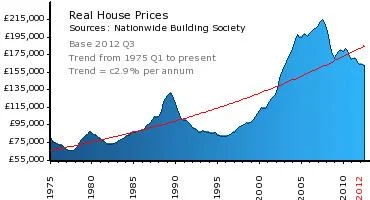
homepagepng-1.webp

UK House Prices - Property News - Indices - Forum

Maybe ... UK situation will be worse than USA coz UK heavily relies on financial industry and does not have exportable industry today.

Japan could have revived from the nightmare by promoting manufacturing industry and those exports, but I have a big question how UK plans to revive. Still financial industry?? :eek:
 
the U.K. has moved to a knowledge and service based economy.

we don't manufacture...we add value :P

as for the house prices...it's only a momentary blip...

look at the graph...it goes up...it goes down....it goes up..ect.

also in total the house prices have STILL gone up...tho in real terms by only 0.1 percent this year...

those lads in the square mile (finance sector) will make packets of money regardless...

and the UK is still a world leader in R&D especially in the biotech industry...

all in all it may be a little overcast...but it sure is no hurricane.
 
the U.K. has moved to a knowledge and service based economy.
we don't manufacture...we add value :P
as for the house prices...it's only a momentary blip...
look at the graph...it goes up...it goes down....it goes up..ect.
also in total the house prices have STILL gone up...tho in real terms by only 0.1 percent this year...
those lads in the square mile (finance sector) will make packets of money regardless...
and the UK is still a world leader in R&D especially in the biotech industry...
all in all it may be a little overcast...but it sure is no hurricane.

Huuuum. But sounds like an official statement of Prime Minister Brown.

"Knowleddge and service based economy" means financial business or something like a call centre business?
 
House price falls accelerate

The decline in house prices accelerated in September and sales fell to the lowest level in at least 30 years, a survey showed Tuesday, in a sign the housing market slump may have some way to go yet.

The Royal Institution of Chartered Surveyors said its house balance fell to -84.2 last month from -81.8 in August, broadly in line with economists' forecasts......House sales fall to 30-year low
m02d20081013t2i6365352w192r20081013T2347-1.webp

Although global credit crunch has been somewhat normalised, House price continues to fall in UK ...... meaning Britons pain has not yet been healed.

They said UK economy is strong and much better than old-fashioned Japanese economy & politics (calling JaPain Japain) .... So, they must be able to cure their "pain" soon. 😊
 
British PM says world can learn lessons from Japan's mistakes

LONDON —
British Prime Minister Gordon Brown said Tuesday that the international community can learn lessons from the slow way in which Japan dealt with its banking crisis in the 1990s. He said that governments facing similar crises in their banking systems should act quickly to recapitalize their institutions in order to restore confidence in the economy.

Brown said, ツ'ツ'It's recognized that in Japan they had the problem of nonperforming loans which is similar to subprime. The lesson is that you have got to deal with it (the problem) quickly, act decisively.'' Analysts claim that in the 1990s, Japan's government failed to inject public money quickly enough into their banks when they got into trouble and also helped to conceal their real debts. This caused the banks to slow their lending, leading to a downward spiral in the economy which, some claim, could have been lessened had the government intervened earlier with capital injections.
http://www.japantoday.com/category/...-world-can-learn-lessons-from-japans-mistakes

So, he said "it was Japan's mistakes...." 😌

Either way, he will soon know whether it was mistake or not. I assume that UK bubble burst will be worse than Japanese case as their property bubble was much bigger than the Japanese case. Plus they don't have any non-finncial industry to cure their financial troubles.

Good Luck. 🙂
 
England:

The August trade deficit was 8.198 billion pounds, which is another record and much worse than expected.

September house prices fell 1.3% mom and 12.4% yoy.

That paragon of stupidity PM Gordon Brown, who sold and leased most of England's gold at $275.00 an ounce, has called Iceland's behavior totally unacceptable and the government will consider legal action. Brown is furious that 300,000 bank customers are blocked from accessing deposits in online bank Icesave and that $1.6 billion of taxpayers money is stranded in Icelandic bank accounts. Iceland's government has told Alistair Darling, Chancellor of the Exchequer (Secretary of the Treasury) that they have no intention of honoring their obligations in England. Thus, Mr. Darling has frozen the assets of Landbanki until the situation is cleared up. The Bank of England has guaranteed the funds of British depositors but not those of wholesale deposits made by local authorities. 108 councils have deposited $1.6 billion in Icelandic banks.

Anti-terrorism laws were used to recoup money owed to UK depositors.

A large number of retailers could go bust in the new year says Begbies

Traynor the largest corporate insolvency specialist. Banks are likely to
support retailers though Christmas, but little further.

More than 100 billion pounds will be wiped off the personal fortunes of Britain's wealthiest industrialists and entrepreneurs in the coming months as tumbling stock markets and sliding property prices take their toll. Steel magnates, City brokers, hedge fund managers and the owners of Premier League football clubs will see their spending power cut, and that is likely to influence the price of urban mansions and hit sales of luxury goods.

The government has offered banks like Royal Bank of Scotland, Barclays and HSBC Holdings up to $87 billion, to shore up their capital in exchange for preference shares. It will also provide a guarantee of $423 billion to help banks refinance debt and the Bank of England will double the amount it lends to banks under the special liquidity scheme to $340 billion.

Source: The International Forecaster

And who gets to pay for this disaster? The banks themselves? Nope! You and me, the taxpayer in the UK, Europe, and the US and your children and grand children will pay for it for many, many years and may even be slaves to the state because of it. It is downright theft and a transfer of wealth from the workers to the elite.

Perhaps this video clip is still pertinent today concerning freedom:


Thomas Jefferson said:
ツ"When the government fears the people, there is liberty. When the people fear the government, there is tyranny.ツ"

Sadly far too many people today, of all countries, fear the government and thus live in tyranny and the noose is being tightened on a daily basis. One look at the massive changes in the banking systems of the industrialized nations and the massive fluctuations in the markets will tell you that. It's almost as if the governments are saying, "do as we say, or we'll crash the markets and you'll be broke."
 
Last edited by a moderator:

Er... Gordon Brown is the Scottish Prime Minister of the United Kingdom. Why the fixation with England? (which, unlike Scotland, doesn't have its own government.)

BTW, William Wallace may have been a heroic fighter against the Norman conquerors of England and would-be conquerors of Scotland, but the film Braveheart is just a sickening parody of history. So quoting from it is a dubious practice.
 
UK government says Migrant numbers 'must be reduced'
The number of migrants allowed into the UK under the points system may have to be reduced because of the economic crisis, an immigration minister says.
BBC NEWS | UK | UK Politics | Migrant numbers 'must be reduced'

Until recently UK has been proud of its open-society for foreign migratnts, and many of Britons bashed the Japanese closed-society. But once situation changed, they are going to change the Rule again as usual.

I am not interested in Briton's migration policy, but I am always interested in Briton's mentality. 😊
 
"BriPain"

UK Balance of Payments
2008 Q2: UK deficit of £11.0 billion


A current account deficit of £11.0 billion in the second quarter of 2008, up from a deficit of £5.5 billion in the previous quarter. The second quarter deficit was equivalent to -3.0 per cent of Gross Domestic Product (GDP) compared with -1.5 per cent in the previous quarter. The higher current account deficit was a result of a fall in the surplus on the income account, which was down £6.0 billion, on the previous quarter at £4.5 billion.

The main contributory factor behind the falling surplus on income account was a fall in the surplus on direct investment from £17.3 billion in the first quarter to a surplus of £14.4 billion in the second quarter and a rise in the deficit of other investment from £5.8 billion in the first quarter to a deficit of £7.5 billion in the second quarter of 2008. This is a record deficit on other investment and largely reflects a rise in net income payments made by UK financial institutions.
Home - Office for National Statistics


As far as I know, UK economy heavily relies on investment from overseas - meaning .... UK financial companies collect money from Gulf countries, Asian countries and Russia, and they make money in gambling at London City Casino. However, once global credit crunch occurs, such "investment" money from overseas suspended. As UK already abondaned "manufacturing" a long time ago, UK deficit for balance of payment will never stop but get worse ....

Meaning UK is getting closer to financial crisis.....😊

They said "JaPain" Japain as they are good at bashing others or they believe that their economy is superior to the Japanese one.
0808LD2-1.webp


Japanese media has never said "BriPain", but as they are confident of their own economy, let's have a look at HOW they can overcome "BriPain".
 
UK recognises China's direct rule over Tibet
The British Government has been accused of undermining the Dalai Lama in negotiations with China by recognising Beijing's direct rule over Tibet for the first time.
UK recognises China's direct rule over Tibet
miliband460_1108288c-1.webp


I thought UK is one of the most "Pro-Human Right" country in the world.

Does this news has something to do with UK recession - Britons need Chinese financial help ? 😊
 
left a nation broken

The domino effect: Road to recession

It began with the banks. Then house prices began to tumble. In the months that followed, the shock waves spread, engulfing first high streets, then factories – and thousands of jobs. In this gripping account, Paul Vallely travels across Britain to meet the people whose lives – and livelihoods – have fallen victim to the domino effect that left a nation broken
Recession - the domino effect: Share YOUR story

IF UK follows Japan's path, UK will revive some 15 years later. 🙂
So don't be depressed so much. 🙂
 
what is true is that economies go through very long cycles. The West had a very poor 70s while Japan was booming. In the 90s, it was the other way round. I see no reason why the "West" should not have a difficult decade.

When UK and the US were booming, we had a many people trying to put great theories of anglo-saxon superiority behind the economic figures. If 5 years from now, US and UK are in crisis and China is booming, I expect to see the same books and forum discussions about the way Chinese thinking and culture is superior to the rest of the world.
 
great theories of anglo-saxon superiority behind the economic figures.

That was already proved "FAKE".
They have not produced "VALUE" but played "Gambling", using money of others, for the past ten years or so. It's not simply "Bubble burst" but "More Seismic".

Because their economies are not backed up with Real Economy, shrinking of economy must be very painful. Considering huge external debt of UK economy, I personally believe that UK economy may fall into the hands of IMF - meaning the same collapse as Iceland.

As I said, Japan revived from nightmare by promoting manufacturing and innovation, while they continued to tell us "Japan is slow", but Japan's slow change has proved Right as the country could have sharpened the competitive edge of manufacturing sector at the end of the day.

I really wonder how they plan to revive from the nightmare.
 
As I said, Japan revived from nightmare by promoting manufacturing and innovation, while they continued to tell us "Japan is slow", but Japan's slow change has proved Right as the country could have sharpened the competitive edge of manufacturing sector at the end of the day.
As I am in the international logistics business, I see more goods made outside Japan. True, the high end luxury cars, electronic goods (digital camera and camcorder), and what-not are still manufactured in Japan; but, more and more products are manufactured or assembled overseas. As key developing countries (China, Vietnam, India, and others) start catching up with their manufacturing capability on par with Japan's, the lower labor costs would prompt Japanese manufacturers to shift their factories to overseas (as they have already been doing).
 
As I am in the international logistics business, I see more goods made outside Japan. True, the high end luxury cars, electronic goods (digital camera and camcorder), and what-not are still manufactured in Japan; but, more and more products are manufactured or assembled overseas. As key developing countries (China, Vietnam, India, and others) start catching up with their manufacturing capability on par with Japan's, the lower labor costs would prompt Japanese manufacturers to shift their factories to overseas (as they have already been doing).

It is true that J-companies have been shifting to overseas for the past 20 years. But "Shifting" does not simply mean Shifting, but "Investing", setting up factories and merger & acquisition of local firms.

Japan's Current Account Surplus Jumps 26% In 2007
http://www.foxbusiness.com/markets/e..._477160_3.html

Japan's current account surplus increased in 2007, marked the highest reading for the second straight year since comparable data became available in 1985.

Trade account is always surplus and thus not interested. But The income account, net income from Japanese investment overseas, reached yet another record-high surplus in 2007, up 18.4 percent from the previous year and the fifth straight year of growth.

An increase in direct investment returns and stock dividends from Japanese investment abroad pushed the income account surplus up to a record for the fourth straight year......

The income account surplus exceeded that of merchandize trade for the third straight year, indicating Japan's economy depends more on returns from overseas investment as a major source of income than on earnings from exporting goods.
Japan is earning income earned from investment overseas, and in other words, people in overseas are working for Japan, and Japanese don't need to work so much.

Most of developed countries earns income from overseas investment, but that of Japan is now siginificant.

Japan's income balance 2007: +16,273 Billion JPY (147.9 Billion USD)
US income balance 2006 (latest): +36.6 Billion USD

http://www.bea.gov/international/xls/table1.xls

Japan earns trade surplus, while USA is usually trade deficits.
Plus Japan earns from foreign investment 4-times more than USA.
Japan cannot consume money within Japan, and thus interest rate is always near ZERO, and Japan invest money in foreign countries. And again income from investment overseas piles up....

Maybe those numbers of 2008 will be different, but the point is that Japan does make investment (not Gambling) for real economies. 🙂
 
Maybe those numbers of 2008 will be different, but the point is that Japan does make investment (not Gambling) for real economies. 🙂
Following that line of thinking, USA also makes investments overseas to manufactures goods for its (USA's) domestic consumption. Apple designs its products and lets its overseas factories take card of production. Same for Dell, Cisco, Nike, Motorola, and many others. It seems the western models are similar to Japanese's ones.
 
start catching up with their manufacturing capability on par with Japan's, the lower labor costs would prompt Japanese manufacturers to shift their factories to overseas (as they have already been doing).

Yes, many Asian countries have been developing their economies by benchmarking Japan. It is true as J-companies are shifting or investing there and local firms are also improving their edges.

But it is unlikely to catch up as J-companies retain key technologies and core industrial materials within Japan.

The best example is South KOrea... S Korea is known as an exporter of mobile phone, car, home electronics in the world market, but nobody knows that inside of their products are "Made-In-Japan". From the independence of S Korea, some 60 years ago, the country has NEVER marked trade surplus with Japan. In short, S Korean companies need to purchase Japanese key parts/machineries for manufacturing their products for exports. China, Vietnam and others are also following this South Korean model. 😌
 
Following that line of thinking, USA also makes investments overseas to manufactures goods for its (USA's) domestic consumption. Apple designs its products and lets its overseas factories take card of production. Same for Dell, Cisco, Nike, Motorola, and many others. It seems the western models are similar to Japanese's ones.

Except automobile industries, US manufacturing companies are still OK. But I am talking about UK economies here. :eek:
 
By the way, what is it UK manufactures for overseas consumption? Can someone have the stats on its export trend? Based on my prior experience in importing from UK (to New York to be more specific), there are china ware, aero space products, textile, oil rig parts,...... UK does have well-respected university education, die-hard cultural influence (from its legacy as the major colonial power in late 19th and early 20th centuries), among others.
 
Is Britain set to turn into Japan?
Nomura economist Richard Koo has written a couple of books on Japan's problems. His take, in "The Holy Grail of Macroeconomics" is that companies reached a point where they simply didn't want to borrow money. Their key goal became to pay down debt – he calls this a "balance sheet recession."

If companies and consumers are focusing on paying down debt, he argues, then the state has to step in and spend for them. And that's what Japan did. In fact, Koo argues that the economy there would have been in an even worse state if the government hadn't stepped up spending as it did.

That's a worrying thought. The one piece of good news from his book is the fact that he doesn't think that the US will suffer the same sort of 15-year stagnation as Japan has, simply because it's got Japan to learn from. "Now that we have much better knowledge of the way the balance sheet recession operates, the US has no reason to make the same mistake made in Japan."
http://www.moneyweek.com/news-and-charts/economics/is-britain-set-to-turn-into-japan-14095.aspx

I must say this article is quite right, but the point is that Japanese companies have already completed repayment of debts and normalised their Balance Sheet. But UK companies have entered into Balance Sheet Recession.
 
Pound sinks to record low as euro nears parity

The pound has fallen to a record low against the euro this morning, nearing parity with sterling, as fears about the strength of the British economy gathered pace.
The Times & The Sunday Times

So .... soon be Stg P 1 = Euro 1 = USD 1 ..... JPY 1 ?
 
Britain faces worst recession in living memory, Cabinet minister Tessa Jowell admits

Tessa Jowell, the Olympics Minister, said the forthcoming downturn was expected to be "deeper than any that we have known".
http://www.telegraph.co.uk/finance/...ory-Cabinet-minister-Tessa-Jowell-admits.html

Unfortunately, her comment is right, meaning that UK is following Japan's nightmare or even worse. But the point is .... how the UK could get out of the hell or how the UK could revive from the nightmare ? after the "competitive" financial service sector collapsed. 😊
 
Unfortunately, her comment is right, meaning that UK is following Japan's nightmare or even worse.
UK is not following Japan's path. It is following its own path. UK's dependence on the financial industry (compared to its total GDP) is causing its unwinding now. One of the pundits even called London (UK's financial center) Reykjavik-on-Themes (Iceland was thinking it is UK, UK was thinking it is USA, USA was thinking it is world). Japan has been behind the financial services. But, in the hindsight, it got lucky as it did not got directly into the risky financial instruments.
 
Suddenly vulnerable
Dec 11th 2008
From The Economist print edition

Asia's two big beasts are shivering. India's economy is weaker, but China's leaders have more to fear....Suddenly vulnerable
5008LD1-1.webp

I suggest UK "Economist" to spend more time to analyze its own "Economy".
 
Back
Top Bottom