News Four workers killed after falling into manhole during pipe inspection in Saitama

thomas

Unswerving cyclist
Admin
Joined
14 Mar 2002
Messages
21,056
Reaction score
18,912
Four men lost their lives on Saturday after falling into a manhole during a sewage inspection in Gyōda, Saitama Prefecture, just north of Tokyo, according to police reports. Authorities detected traces of hydrogen sulfide — a colourless and highly toxic gas — near the scene and are now investigating whether it played a role in the deaths.

Emergency services were alerted around 09:25 a.m., when one worker apparently fell into the manhole, with three others descending after him in an attempt to help. None of the four, all believed to be in their 50s, responded after entering the shaft. The manhole, roughly 60 centimetres in diameter and 12 metres deep, is part of a 2.6-metre-wide sewer line installed in fiscal 1981. It lies about 4 kilometres northeast of JR Gyōda Station.
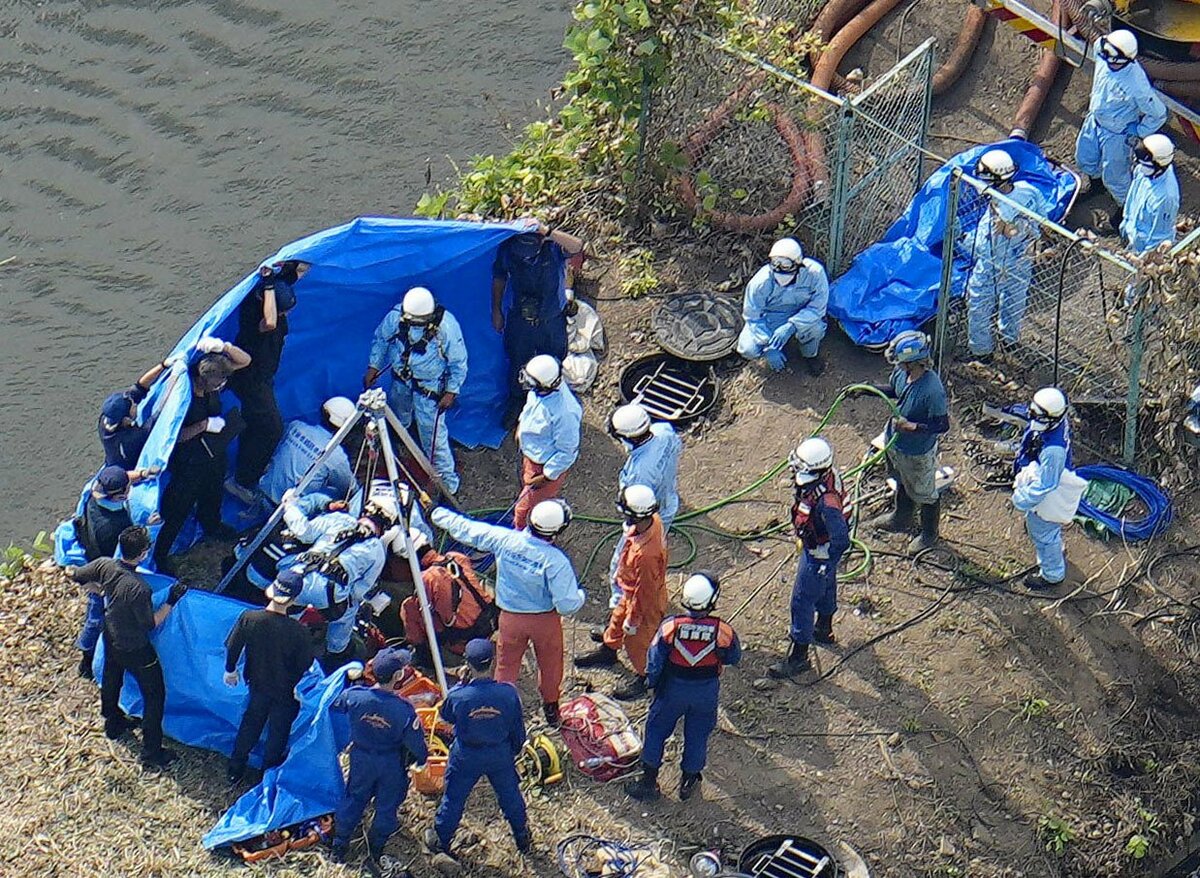

At the time of the accident, about seven workers commissioned by the city government were conducting drainage work in preparation for the inspection. The central government has asked municipalities to carry out emergency inspections of their sewage systems in the wake of a massive sinkhole that appeared at an intersection in Yashio, Saitama Prefecture, on 28 January. A city official said the inspection was being conducted following the appearance of the sinkhole that swallowed a truck and its driver, whose body was recovered in May. The incident, believed to have been caused by sewer pipe corrosion, drew public attention to sinkholes and prompted the government to focus on measures addressing aging infrastructure.

 
This is terrible to hear. What a tragedy.

This happens from time to time in agricultural settings where silage vats are inspected by farm workers and are overwhelmed by the hydrogen sulphide gas produces by the decomposing vegetation. Hydrogen sulphide has a very distinctive and noxious odour (bad eggs) and as soon as one smells its unmistakable stench one should get away quickly!
 
oh that's awful, especially if they got fumigated. I'm having a hard time picturing four guys falling into the same manhole by chance alone. I've seen several videos of spelunkers or cave divers who have died because they trusted the air in the wrong chamber.

I was just listening to an episode of (I think it's the BBC's) "13 minutes" about the space shuttle, and how the first deaths in the program were technicians who entered an area that had been flooded with nitrogen gas to purge the oxygen and avoid a fire. This was a standard procedure, but the purge lasted longer than normal and it wasn't properly communicated to the ground crew. Nitrogen isn't a toxic gas (the air we breathe is like 70% nitrogen) but 100% nitrogen can asphyxiate you quite quickly, and FIVE technicians were unconscious before they realized anything was amiss. One died en route to the hospital, and another a week later.

Paywall-free article about the incident: RemovePaywall | Free online paywall remover
 
oh that's awful, especially if they got fumigated. I'm having a hard time picturing four guys falling into the same manhole by chance alone. I've seen several videos of spelunkers or cave divers who have died because they trusted the air in the wrong chamber.
I bet one went in to rescue the other and then another etc. Brave people.🙁
I was just listening to an episode of (I think it's the BBC's) "13 minutes" about the space shuttle, and how the first deaths in the program were technicians who entered an area that had been flooded with nitrogen gas to purge the oxygen and avoid a fire. This was a standard procedure, but the purge lasted longer than normal and it wasn't properly communicated to the ground crew. Nitrogen isn't a toxic gas (the air we breathe is like 70% nitrogen) but 100% nitrogen can asphyxiate you quite quickly, and FIVE technicians were unconscious before they realized anything was amiss. One died en route to the hospital, and another a week later.

Paywall-free article about the incident: RemovePaywall | Free online paywall remover
Nitrogen gas seems to purge O2 out of your lungs and blood rather quickly leading to rapid hypoxia without any sensations or additional respiratory drive from the hypothalamus since the hypothalamus is only sensitive to blood CO2 concentrations (or in people with COPD, O2 concentrations). Hypoxia is often accompanied by feels of euphoria! This is one of our ex-MPs, Michael Portillo…
 
I bet one went in to rescue the other and then another etc. Brave people.🙁

Nitrogen gas seems to purge O2 out of your lungs and blood rather quickly leading to rapid hypoxia without any sensations or additional respiratory drive from the hypothalamus since the hypothalamus is only sensitive to blood CO2 concentrations (or in people with COPD, O2 concentrations). Hypoxia is often accompanied by feels of euphoria! This is one of our ex-MPs, Michael Portillo…

yeah the gas mixture they had in that chamber supposedly can knock you out in two breaths. In diving we have to deal with nitrogen narcosis, a form of hypoxia that has lead divers to act drunk and make stupid mistakes like taking off their mask to kiss the fishes. Even experienced and professional divers have succumbed to getting "narc'ed" and most don't even realize they're impaired
 
yeah the gas mixture they had in that chamber supposedly can knock you out in two breaths.
I suppose it just a very steep concentration gradient ("ALL HAIL THE GRADIENTS" )
In diving we have to deal with nitrogen narcosis,
Oh yes! 'Raptures of the deep' as they were once referred to.
a form of hypoxia that has lead divers to act drunk and make stupid mistakes like taking off their mask to kiss the fishes. Even experienced and professional divers have succumbed to getting "narc'ed" and most don't even realize they're impaired
It's meant to pleasantly euphoric. Interestingly, several gases can cause narcosis if breathed under pressure; argon, krypton and xenon for example, which are inert!But helium doesn't cause narcosis which is why it's used in deep sea diving. The narcotic effects of gases are related to their solubility in the lipid components of body tissues, particularly neurone membranes. When a gas dissolves in these membranes, it can interfere with the transmission of nerve impulses, leading to impaired neurological function.

Goodness I love physiology! 🤓
 
I bet one went in to rescue the other and then another etc. Brave people.🙁

According to the morning news, this is precisely what happened. Reportedly, they weren't equipped with "safety equipment," which probably translates to oxygen masks. What a tragedy. :(


Back
Top Bottom