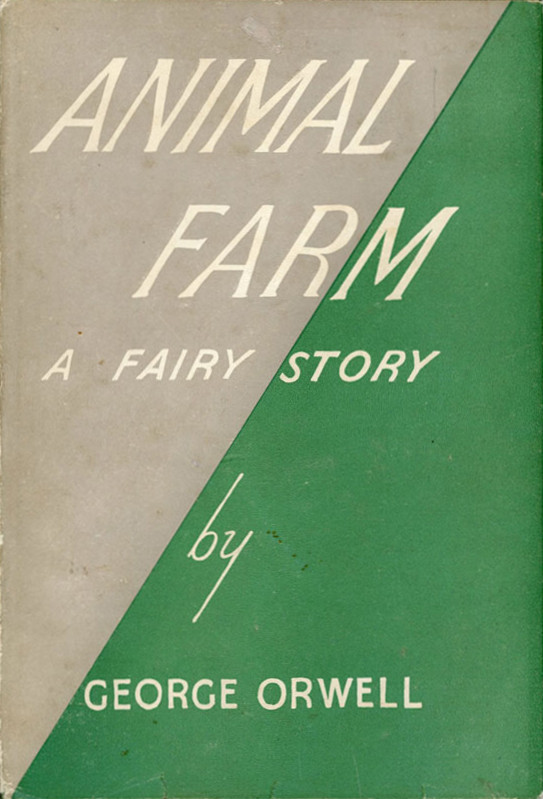
Animal Farm book by "George Orwell"

Kulern

Sempai
Joined
26 Feb 2026
Messages
184
Reaction score
192
I have listened to the 3 hour audiobook on YouTube. And watched the 1954 cartoon.

I eventually came to this conclusion and morality of the story

Animal Farm book by George Orwell? Its the idea that altruism starts it off, but (Road to hell is paved with good intentions). And generally, is likely a satirical outlook on what a poor managed community looks like.

Overall, a very intellectually written book. Since the characters "farmer Jones" is likely depicting the Tsarist of Russia. And the Pigs that forms this new society would be Soviet Union.
So i think this is a very thought provoking piece of literature. The question? Do you go from bad to worse?
 
Or from bad to better to bad (or even worse) again. Rooting for Hungary as they are in the bad to better part of the cycle.
The U.S. has been going from bad to worse for a while now. Time for the rabbits to take over and kick the pigs out.
Chilling
helpurseif-knfedoll.gif
 
The book is about communism, rather than altruism, with direct correspondences between some of the pigs and some of the leaders in Russia.

Edit: This is an AI overview.

  • Napoleon (Pig) → Stalin: Ambitious, intimidating, and power-hungry, Napoleon represents Stalin, who uses the dogs (secret police/KGB) to exile his rival and rule as a dictator.
  • Snowball (Pig) → Leon Trotsky: Intelligent, eloquent, and a talented organizer, Snowball represents Trotsky, who was intellectual and favored expanding the revolution but was ultimately exiled by Stalin.
  • Old Major (Pig) → Karl Marx/Vladimir Lenin: The visionary who inspires the rebellion with his dream of equality, representing a mix of Marxist ideology and the pioneering revolutionary role of Lenin.
  • Squealer (Pig) → Vyacheslav Molotov/Propaganda Machine: A persuasive speaker who turns "black into white," Squealer represents Stalin's loyal propaganda minister, Molotov, and the state-controlled media (like Pravda) that manipulated the public.
Other Key Correspondences:
  • Mr. Jones (Farmer) → Nicholas II: The incompetent and cruel owner who is overthrown, mirroring the last Tsar of Russia.
  • The Dogs → KGB/Secret Police: Napoleon's personal guard, raised from puppies, who enforce his rule and dispose of opposition.
  • Boxer (Horse) → The Proletariat (Working Class): Strong, dedicated, and loyal, the hardworking class that is betrayed by the leaders they support.
 
Last edited:
The book is about communism, rather than altruism, with direct correspondences between some of the pigs and some of the leaders in Russia.

Edit: This is an AI overview.

  • Napoleon (Pig) → Stalin: Ambitious, intimidating, and power-hungry, Napoleon represents Stalin, who uses the dogs (secret police/KGB) to exile his rival and rule as a dictator.
  • Snowball (Pig) → Leon Trotsky: Intelligent, eloquent, and a talented organizer, Snowball represents Trotsky, who was intellectual and favored expanding the revolution but was ultimately exiled by Stalin.
  • Old Major (Pig) → Karl Marx/Vladimir Lenin: The visionary who inspires the rebellion with his dream of equality, representing a mix of Marxist ideology and the pioneering revolutionary role of Lenin.
  • Squealer (Pig) → Vyacheslav Molotov/Propaganda Machine: A persuasive speaker who turns "black into white," Squealer represents Stalin's loyal propaganda minister, Molotov, and the state-controlled media (like Pravda) that manipulated the public.
Other Key Correspondences:
  • Mr. Jones (Farmer) → Nicholas II: The incompetent and cruel owner who is overthrown, mirroring the last Tsar of Russia.
  • The Dogs → KGB/Secret Police: Napoleon's personal guard, raised from puppies, who enforce his rule and dispose of opposition.
  • Boxer (Horse) → The Proletariat (Working Class): Strong, dedicated, and loyal, the hardworking class that is betrayed by the leaders they support.
The allegory is communism for sure.

But the failure is the result of how badly organized the community is. However, the way a Strong Central Government works. Whether violent or peaceful. Is the common nature of Marxism/Socialism and Communism.
And they usually infiltrate religious or traditional cultural values, and replace them with what is approved by the government. (Which often leads to conflicts, so buzzwords like racist, sexist blablabla is thrown around. Or as some guy told me "To be a Marxist, you need to create a problem, in order to sell a solution). So in that sense, its not ideal for sure. EU, CCP are modern day examples of this. Except China is protectionist censorship (So they won't have suicidal cultural empathy, the way its funded in EU. Which is through DEI ESG funding that China pays over here). Even Norway isnt immune to this influence.

The opposite of that, would be a Decentralized Government, one less likely to be heavily influenced by state level influence. Like USA for example. And while i don't like the war in Ukraine by Russia. They have however moved away from the USSR days of the past.
 
This book is basically the original diss track on communism. Might be an interesting read for, I don't know, Kim Jong Un? Just a thought.
 
It's been a minute since I read it, but pretty sure it was about the revolution and power-hungry individuals undermining the values they're selling to consolidate power for themselves, not the ideology itself
 
It's been a minute since I read it, but pretty sure it was about the revolution and power-hungry individuals undermining the values they're selling to consolidate power for themselves, not the ideology itself
I've never read it, but I've heard from multiple teachers (including my freshman and current sophomore english teacher) is that it's about communism
 
I've never read it, but I've heard from multiple teachers (including my freshman and current sophomore english teacher) is that it's about communism
You should probably read it yourself.

When I first read it we didn't have the Internet and it wasn't prefaced with "this is about this or that," we read the book without any spoilers and then afterwards had discussions about the themes and author's intentions. Everyone wants to skip to the conclusions without any of the process, which is a poor way to educate anyone.
 
You should probably read it yourself.

When I first read it we didn't have the Internet and it wasn't prefaced with "this is about this or that," we read the book without any spoilers and then afterwards had discussions about the themes and author's intentions. Everyone wants to skip to the conclusions without any of the process, which is a poor way to educate anyone.
We had to do the same with Lord of the Flies. Thats a collective twenty hours I will never get back.
 
It's been a minute since I read it, but pretty sure it was about the revolution and power-hungry individuals undermining the values they're selling to consolidate power for themselves, not the ideology itself
Yes and no. Because Collectivism = Strong Central Government. To a Marxist, that is the end result (Means of productions belongs to the workers). Which means, to seize the goods from private ownership, of people who has too much money over the others. (The problem with that is), the ones who becomes rich? Is the state? See the dilemma :) . Its no shock that most Communist leaders has had background in wealthy families, i doubt that is a coincidence.
But some of that cash goes to people without a job. (Making a system where the individual relies more on the state, rather than social responsibility)

However, in sense of satire, it pokes holes at the issues of future problems with usurpers? That was the issue for sure in the book.
 
Last edited:
Yes and no. Because Collectivism = Strong Central Government. To a Marxist, that is the end result (Means of productions belongs to the workers). Which means, to seize the goods from private ownership, of people who has too much money over the others. (The problem with that is), the ones who becomes rich? Is the state? See the dilemma :) . Its no shock that most Communist leaders has had background in wealthy families, i doubt that is a coincidence.
But some of that cash goes to people without a job. (Making a system where the individual relies more on the state, rather than social responsibility)

However, in sense of satire, it pokes holes at the issues of future problems with usurpers? That was the issue for sure in the book.
Someone just recently remarked to me that Marx was an excellent diagnostician but a terrible clinician. That is to say that his analysis and critique of capitalism was apt and insightful, but he fell short of prescribing a functional solution. In other words, he was too much of an idealist that did not account for the human capacity for greed, nepotism, and self-dealing, and so all subsequent efforts to instantiate communism fell victim to these unaccounted variables and were themselves corrupted to the detriment of the masses.
 
Someone just recently remarked to me that Marx was an excellent diagnostician but a terrible clinician. That is to say that his analysis and critique of capitalism was apt and insightful, but he fell short of prescribing a functional solution. In other words, he was too much of an idealist that did not account for the human capacity for greed, nepotism, and self-dealing, and so all subsequent efforts to instantiate communism fell victim to these unaccounted variables and were themselves corrupted to the detriment of the masses.
I would agree. The whole idea ignores human nature.
 
I would agree. The whole idea ignores human nature.
humans are game-playing creatures, and will always try to "game the system" to gain an edge. Very few people operate on a strict moral code and can resist the urge to cheat, the threat of punishment is completely insufficient to prevent this, especially when the chance of getting caught and held accountable are low enough, and/or the rules aren't evenly applied. I can think of too many anecdotes to count.

Knowing this, it's absolutely imperative that the systems we build take this into account and prevent, punish, and stamp out corruption, or--more realistically--accept that a certain level of corruption is inevitable, and find ways to minimize the harm it causes. Game theory and the kind of approach that game developers employ to make sure that the games they make are fair would actually be really helpful if you're trying to craft fair legislation, the problem we now have is when those crafting legislation are themselves corrupt and uninterested in what's "fair." And at a certain tipping point, the consolidation of power and embedded corrupt power structures take decades to dislodge. It's not impossible (go Hungary!), but much like the law mentioned in my signature, it takes an order of magnitude more effort to un-boil that egg.
 
Last edited:
All in all, on paper, communism isn't a horrible idea, but it is highly flawed once you read in between the lines, and even then, the elimination of private property isn't super appealing.
 
All in all, on paper, communism isn't a horrible idea, but it is highly flawed once you read in between the lines, and even then, the elimination of private property isn't super appealing.
What do you mean by "read between the lines"? I'm not defending or promoting communism here but it sounds like you're suggesting there are ulterior motives to the theory?

Do you know the difference between private and personal property? No cheating, I'm curious what your understanding is off the top of your head
 
Last edited:
What do you mean by "read between the lines"? I'm not defending or promoting communism here but it sounds like you're suggesting there are ulterior motives to the theory?

Do you know the difference between private and personal property? No cheating, I'm curious what your understanding is off the top of your head
I recommend "Deus Ex 2000" sci fi game". In lots of ways, our world now feels like it is sorta starting to resemble it. Which is a little frightening to be honest. But basically, in that game it discusses the issue of power imbalance of too much centralized control through government, including the control of corporations and the regime model is based on benefitting the Plutocrats.

Plutocrats means Society run by the rich. The sad reality is... you will never get rid of rich people. Like... ever. If it had worked? Then people would have figured it out long time ago. In USSR you had millionaires "Though they were heavily surveyed by the state" also (Including the state). And in CCP China you have Billionaires, Tencent for example. (Which is also heavily moderated by the CCP regime). Though i compare EU and CCP to be similar in their goals of Stong Centralized Power Structure. However, China has a more, Censorship Protectionism model, to protect their traditions and culture from suicidal empathy, thats the only difference. Whereas EU takes ESG money from China.


I think the closest to a solution. Is vote for a party who is pro Decentralization. In Norway i vote for Centre Party for that reason
 
Last edited:
What do you mean by "read between the lines"? I'm not defending or promoting communism here but it sounds like you're suggesting there are ulterior motives to the theory?

Do you know the difference between private and personal property? No cheating, I'm curious what your understanding is off the top of your head
Private property is something like a house, a business, farmland, etc. Personal property is stuff like your shoes, clothes, etc. at least, thats what i can come up with through what the adults in my life have told me and through process of elimination. What I mean by "Read in between the lines" is that you really have to pay attention to what all the words in The Communist Manifesto actually say and mean and understand what will actually happen. I'm not suggesting that there are ulterior motives, just that, not everything is as it seems, that you have to pay attention to truly understand what would happen.
 
I recommend "Deus Ex 2000" sci fi game". In lots of ways, our world now feels like it is sorta starting to resemble it. Which is a little frightening to be honest. But basically, in that game it discusses the issue of power imbalance of too much centralized control through government, including the control of corporations and the regime model is based on benefitting the Plutocrats.

Plutocrats means Society run by the rich. The sad reality is... you will never get rid of rich people. Like... ever. If it had worked? Then people would have figured it out long time ago. In USSR you had millionaires "Though they were heavily surveyed by the state" also (Including the state). And in CCP China you have Billionaires, Tencent for example. (Which is also heavily moderated by the CCP regime). Though i compare EU and CCP to be similar in their goals of Stong Centralized Power Structure. However, China has a more, Censorship Protectionism model, to protect their traditions and culture from suicidal empathy, thats the only difference. Whereas EU takes ESG money from China.
I played the original Deus Ex games when they first came out. It was a good series, but I remember the theme being more about conspiracy and corporatocracy than government overreach... may be time to revisit JC Denton.
I think the closest to a solution. Is vote for a party who is pro Decentralization. In Norway i vote for Centre Party for that reason
I think the answer lies somewhere in the balance of maximal freedom and self-determination, tempered by the maximizing of public good and minimizing harm. We need to agree on the values we wish to pursue, and then work backwards towards the policy directions that will get us there. I think decentralization (as I understand the term) is attractive because it limits the scope of a policy to avoid widespread unanticipated fallout, but it also fractures society into small fiefdoms and their idiosyncrasies will generally prey on the individual moving between them. An example of this can be seen in the US, where state laws can vary wildly, and ignorance of the law is not a generally accepted excuse. One could say that in America, the law doesn't really protect the rights of the individual so much as the interests of what Marx called the bourgeoisie, who do not wish for strong centralized policies, as decentralized policies can be generally easier and cheaper to influence (some jurisdictions are harder to corrupt, but maybe their neighbors will let you build that strip mine, fracking operation, or data center, without holding you accountable for things... just look at what's going on in Fayette County, Georgia)
Private property is something like a house, a business, farmland, etc. Personal property is stuff like your shoes, clothes, etc. at least, thats what i can come up with through what the adults in my life have told me and through process of elimination. What I mean by "Read in between the lines" is that you really have to pay attention to what all the words in The Communist Manifesto actually say and mean and understand what will actually happen. I'm not suggesting that there are ulterior motives, just that, not everything is as it seems, that you have to pay attention to truly understand what would happen.
I appreciate you taking an honest stab at it. Yours is a good guess, but it's missing a key distinction. The common understanding of "private" is usually anything that isn't owned by a public or governmental agency; after all, we call our homes and curtilage "private" property, as the term is commonly invoked in "no trespassing" signs, right?

But actually in this context, the big distinction is whether the property is used to generate revenue for its owners (which could be individuals or corporations), and property that is meant for individual use or consumption is "personal." So, in addition to obvious things like your personal effects and belongings, the house you live in is personal--not private--property, as is your car and just about any consumables you purchase for yourself or others without any profit motive.

While your primary residence is personal property, that second investment property is not. Things like rental properties, office equipment, wholesale goods, raw materials, and other gear, vehicles, and machinery used for business, and the buildings and land in and on which businesses operate are all examples of private property, as their primary purpose is to generate revenue for the private owners of that capital. This is what they mean when they say that in capitalism, the capitalists control the means of production; they hold ownership over the private property that generates revenue for themselves; the workers are paid for their labor at the lowest rate possible to ensure maximum margin of profit. The pressure of capitalism is always to concentrate wealth into fewer hands, at the expense of the larger populace (proletariat, aka working classes)

The line blurs slightly as people start using their personal property to make money for themselves, like renting out a room in your house, or using your lawn mower to earn money around the neighborhood. When I was young I was one of the first kids in school to get a CD burner, and I used it to make mix-tape CDs for my friends for a few bucks. This is why small businesses are allowed to deduct portions of their personal property as business expenses, like their home offices, personal vehicles, and utilities, so long as they are used for business purposes.

In fact, while he died before the invention of the automobile, Marx prophesied the advent of Uber and AirBnB. He anticipated that the dynamics of capitalism would lead to the conversion of personal property into private property, as the bourgeoisie would seek to control and monetize all aspects of life. He argued that this transformation would result in the exploitation of the working class and the concentration of wealth in the hands of a few. Sound familiar at all? Like I said, his criticisms of capitalism were absolutely spot-on.

This highlights one of the biggest (and most obnoxious) misconceptions I see when discussing macroeconomics: when talking about the elimination of "private" property, ill-informed or bad-faith interlocutors will quip that it would mean that we'd have to give the undeserving the shirts off our backs, or let the homeless move in with us, or have our personal property and wealth redistributed (Très injuste!). Americans have been deliberately miseducated, because it is in the best interest of the exploiting class that has captured our governmental, commercial, and media apparatus.
 
Last edited:
Back
Top Bottom