A scroll about Russian-Japanese war?

Ger

後輩
Joined
17 Jan 2018
Messages
190
Reaction score
95
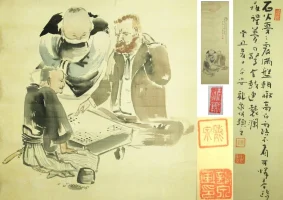
This Japanese scroll is dated 1913, 癸丑, 大正二年 .
I think it shows a Japanese playing a red haired westerner with a Chinese watching the game.
What does the text say?
Some one suggested the westerner is Russian and the scroll refers to the Russian-Japanese war that ended 8 years earlier.
It would be curious since the westerner plays white and is thus suggested to be the stronger player. But then the Japanese captured a lot of stones...
And doesn't red hair point more to British or Dutch?

Who would be the painter?

Thanks very much for giving it a try - partial results are very welcome too.
 

Attachments

  • pan1.webp
    pan1.webp
    150.8 KB · Views: 179
Partial results as follows. I can't make out anything. I mean I can pick out what each individual kanji are, but none of it makes sense to me.

石火之震満盤朝暾高白不着可囗囗囗
囗囗夢の

the date you already have 平姿? 龍泉囗題之

The artist is 龍泉 (Ryūsen, if in Japanese. But it could be a Chinese name, and therefore a different pronuciation).

The stamps say
龍泉 Ryūsen, and
龍泉画印 Painted by Ryūsen (stamp)
 
Red hair is almost a stereotype of any foreign person. I mean, foreigners are literally called "red hairs" in the Chinese-speaking world. I think red hair would also serve as shorthand/signifier of any western nation in Taisho-era Japan as well. I wouldn't necessarily equate it with Dutch or Irish or whatever.
 
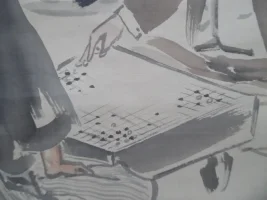
The picture is not not sufficiently detailed to show it, but in the attached close up it looks like the Russian plays white.

I think the white stones to the right of the Japanese are kept in the lid as prisoners.
The stones in the bowl next to it are not visible but would then be black.
 

Attachments

  • SAM_6151.webp
    SAM_6151.webp
    56.7 KB · Views: 132
Ah, yes, I didn't realize, but indeed there's the lid under the white stones.
I knew the westerner took a white stone, but I (mis)interpreted that he would be removing a captured (white) stone from the board.
 
This Japanese scroll is dated 1913, 癸丑, 大正二年 .
I think it shows a Japanese playing a red haired westerner with a Chinese watching the game.
What does the text say?
Some one suggested the westerner is Russian and the scroll refers to the Russian-Japanese war that ended 8 years earlier.
It would be curious since the westerner plays white and is thus suggested to be the stronger player. But then the Japanese captured a lot of stones...
And doesn't red hair point more to British or Dutch?

Who would be the painter?

Thanks very much for giving it a try - partial results are very welcome too.
Cannot make out the poem, but 龍泉is a fairly common Japanese
Partial results as follows. I can't make out anything. I mean I can pick out what each individual kanji are, but none of it makes sense to me.

石火之震満盤朝暾高白不着可囗囗囗
囗囗夢の

the date you already have 平姿? 龍泉囗題之

The artist is 龍泉 (Ryūsen, if in Japanese. But it could be a Chinese name, and therefore a different pronuciation).

The stamps say
龍泉 Ryūsen, and
龍泉画印 Painted by Ryūsen (stamp)
龍泉 is a name used by a fair number of Japanese artists. Haven't been able to nail down a Taisho-period one or decipher the inscription.
But since the Japanese figure is wearing a chonmage hairstyle, which was banned in 1871, I suspect that the subject is earlier than the Russo-Japanese war. Probably the pre-Meiji threats by the Western powers and the pressure to open up Japan to foreign trade?
 
chonmage hairstyle, which was banned in 1871
The mage wasn't banned in 1871. Rather, various hairstyles, which were previously disallowed, were now allowed as of that date. In other words, the restrictions on hairstyles was lifted.

Plus, the image is literally dated to 1913, so I think we can be pretty confident in the date.
 
Interesting. No problem about the date of the painting, just its subject matter.

According to Why did samurai warriors adopt such a unique hairstyle? – 國學院大學 and https://www.jstage.jst.go.jp/article/ctr/11/1/11_1_4/_pdf/-char/en, the chonmage was indeed banned. Also, the 廃刀令 of 1876 eliminated public wearing of swords, except for certain people. The combination of chonmage and sword suggests a pre-Meiji subject--or a something current, presented allegorically through a reference to earlier struggles?

1913 seems kind of late for referring to the Russo-Japanese war in any case.
 
If you search, you can find numerous sources which correctly state that the danpatsurei allowed western style hair, rather than banning the chonmage. But the "ban" language has become entrenched in the western mind, leading to misunderstandings such as yours. I include the most obvious one for reference

In 1871, the government issued the Danpatsurei Edict, allowing samurai to cut their top-knots and wear their hair in the Western manner. However, this was not required, simply allowed and encouraged.

In the original Japanese
散髪制服略服脱刀共可為勝手事
但 禮服ノ節ハ帯刀可致事

I don't know if the painting is related to the Russo-Japanese War. That was the OP's speculation, not mine.
 
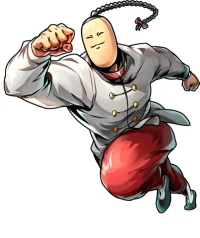
I think mage and katana are just items to explain that the man is Japanese, whether they are officially used at that time or not. It's like kimono is a symbol of Japanese even now, even though it's not common nowadays. In fact, the Chinese hairstyle (辮髪 benpatsu) was abolished after the Xinhai Revolution in 1911, but it's still sometimes used as a symbol of Chinese. The same goes with Chinese (Manchu) clothing.

The Xinhai Revolution in 1911 led to a complete change in hairstyle almost overnight.

a character appeared in a popular manga/anime Kinnikuman in 1980's
Ramenman.jpg
 
Having tried my luck at reddit with no success the question was posted on the asian art forum.
A full reply including its allusions and implications referring to the Russo-Japanese war was given there by I Nagy:

I would be curious to receive reactions to the solutions here or at the asianart forum.
 
That explanation from I. Nagy sounds plausible to me. I wasn't able to read the kanji 露 in the first line, but thanks to I. Nagy I can see it now. This kanji means dew in Japanese as well, and is also a kanji representation of the word "Russia", so I agree that this feels like an allusion or a "double-meaning" embedded into the writing (along with the kanji 満 which is the word "full", and is also the kanji representation for Manchuria).
 
Back
Top Bottom