Read a Japanese History Textbook!

Do Japanese textbooks “gloss over“ Japan's role in WWII?

  • Yes, they do a horrible job of teaching about Japan in WWII.

    Votes: 24 68.6%
  • Yes, but it’s not so bad.

    Votes: 2 5.7%
  • I don't know.

    Votes: 6 17.1%
  • No, they don’t.

    Votes: 3 8.6%
  • No, they do an excellent job of teaching about Japan in WWII.

    Votes: 0 0.0%

  • Total voters
    35

mad pierrot

I jump to conclusions
Joined
22 Nov 2003
Messages
1,453
Reaction score
85
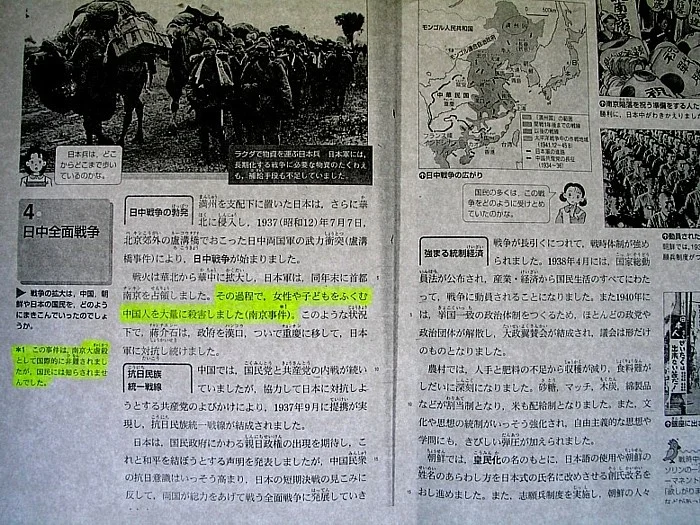
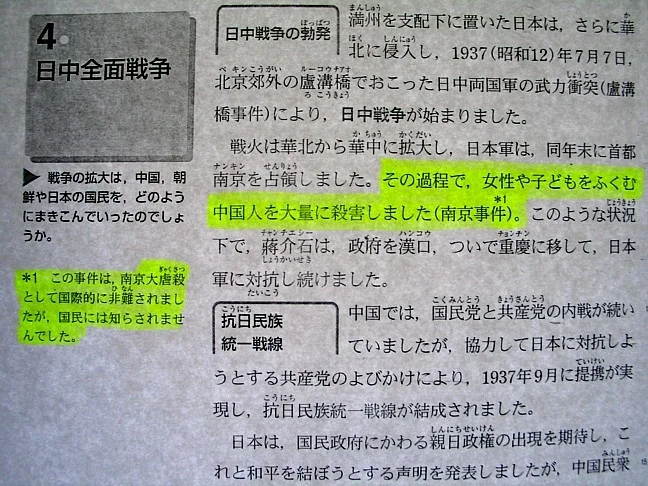
Lately, there have been a ton of threads about this. I had a J.H.S. textbook on hand and I thought I'd take a look for myself. Here's what I found: there was one chapter on the war in China, 2 pages long. It does mention the Nanking Massacre, but just how well it's presented is up for debate. Take a look and decide for yourself. I'd like to hear from other's who teach at schools, specifically high schools in Tokyo. The text I'm using here is the standard textbook used in Wakayama prefecture. Tell us what you think and post a page or two of the texts, if you can. I know Maciamo has read some, has anyone else? Also, I posted this LINK before, but it's worth taking another look at. It goes into considerable depth on the same subject.

Note on the highlighted text: Correct me if I'm wrong, but it states that a great number of women, children and innocent civilians were regrettably killed in the massacre. However, the note on the side states that people in Japan didn't know this happened…? (Although Japan is internationally blamed.)*

(All the grammar Nazis here can have a field day with my translation, I know it's not perfect but I'm just speaking generally.)

I'd love to get an actual look at this text that has been sparking so much controversy.
text1.webp


text2.webp
 
Here is my translation of the highlighted passage:

その過程で、女性や子供もをふくむ中国人の大量に殺害 しました(南京事件*)。
=> In this process, including women or children, many Chinese were killed (Nanjing Incident*).

*この事件は南京大虐殺として国際的に非難されました が、国民には知らされませんでした。
=> This incident has been internationally criticised as the Nanjing Massacre, but the public [in Japan] was not informed about it.

That's for the least a whitewashed version of the events. They don't mention the death toll (even the Japanese official one of 50,000). Don't talk of the estimated 80,000 women and girls raped, and the people beheaded, burned or buried alive, disembowelled or mutilated. As long as all the textbooks won't mention that (I think they do go into such details about concentration camps in German school books), Japan will be criticised by the international community, and make more enemies than it can imagine.

Also, note how little there is in the textbook about Japan's invasion of China. That is a sharp contrast to what I learnt at school about WWII. We had an entire book (about 100 pages) only for the 20th century, and half of it was about WWII.

Mad Pierrot, how many pages is there in total about WWII in this book?
 
I think this (posting sections from actual Japanese history textbooks) is a great idea and would be even better if there were a) More books covered.
and
b) Details of how many schools use which books - oh yes, and for which years.

P.S. What's are the correct kanji for the bit that looks like 虐溝橋事件 at the start? I can't quite make it out.

[EDIT] Never mind - I've found it.

The first kanji is .
 
Last edited:
教科書問題

History textbook thread, finally. I am 100% sure that NO ONE on JREF who has been talking about "distortion" "whitewash" ever reads textbooks by the eight publishers himself/herself, just expressing "opinions" based on because-they-said-so logic.
Hope this thread to grow toward whatever directions, English translation of the one by Fusosha is coming soon too.

Posters praising or criticizing the textbooks before the appearance of this thread have all failed to provide the quotes of the original paragraphs, which could suggest that they all blindly believe everything they are told.
 
Last edited:
I went to the bookshop today, looked for the 高校・社会 section and found the history textbooks used in Japanese high schools. Couldn't copy them though. I checked only 5 of them. Two briefly wrote about the "Nanjing Incident" (南京事件) like in Mad Pierrot's picture and without any death toll or description either. I couldn't even find a mention of Nanjing in the three others, although I checked the pages around 1937 carefully. One of them was 早わかり日本史, which is described as a best-seller, but I don't know if it is among the approved textbooks used at school.

I have just found this article : The Japanese Textbook that Gets American History Wrong

Recently, Koreans and Chinese have protested the misrepresentation of history in Japanese textbooks. In particular, scholars have objected that the textbooks ignore the Rape of Nanking and the enslavement of thousands of Korean women as sex slaves during the 1930s. Now, it is Americans' turn to take umbrage. The authors of a Japanese textbook have used a phoney document to mischaracterize Commodore Matthew Perry's famous expedition. On July 10 Japanese scholars released the following statement to protest the textbook's misuse of history.
 
This isn't a "public" vote poll but I'm going to say which way I voted anyway.

On the basis of evidence available to date, I overcame my reluctance to vote the same way as Maciamo, and went for "Yes, they do a horrible job of teaching about Japan in WWII."

My only caveat is that I don't really know how thoroughly WWII is covered in equivalent courses of other countries.
 
Maciamo said:
Here is my translation of the highlighted passage:

その過程で、女性や子供もをふくむ中国人の大量に殺害 しました(南京事件*)。
=> In this process, including women or children, many Chinese were killed (Nanjing Incident*).

*この事件は南京大虐殺として国際的に非難されました が、国民には知らされませんでした。
=> This incident has been internationally criticised as the Nanjing Massacre, but the public [in Japan] was not informed about it.
Is Nanking related to the Manchurian Incident (満州事変) in any way?
I have the Japanese world history text 世界史 (sorry not sure about the grade level or if it is still being used) that devotes around a page to the Rise of Japanese militarism and that event; another page to 抗日民族戦線の成立と日中戦争 (Formation of anti-Japanese racial battle line ? and Sino-Japanese war) sparked by the 盧溝橋事件, but no mention of 南京事件。

None of this can really be put into context without having more of a grounding in it myself, although Japanese textbooks have apparently been this way for at least the last decade or two. So these demonstrations alone won't change world opinion of it as a model country. I agree, though, that there needs to be much greater openness and confidence in acknowledging past wrongs. The comparison ought to be with Germany, not Chinese or Korean distortions about their own atrocities.
 
名無し said:
which could suggest that they all blindly believe everything they are told.
What you wrote could suggest that you have a rather short memory. Forgot this post by Iris?


Elizabeth said:
Is Nanking related to the Manchurian Incident (満州事変) in any way?
The Manchurian Incident most probably refers to the invasion of Manchuria in 1931. Allegedly Chinese blew up a railway & Japan took that as an excuse for invasion (similar to WWII in Europe, it seems).
 
bossel said:
The Manchurian Incident most probably refers to the invasion of Manchuria in 1931. Allegedly Chinese blew up a railway & Japan took that as an excuse for invasion (similar to the start of WWII in Europe, it seems).

I thought it was Japanese dressed as Chinese who did it, and the Japanese government set the whole thing up so that they could invade China. Am I confusing that with Hitler and Poland?
 
They do tend to gloss over it however.

I learnt about world war 2 in my history lessons, however we mainly focused on one area rather then every bit of the war. We mainly focused on the bombing raids taken place over london, rationing and some about concentration camps.

However this was not the whole of world war 2 and schools can not possibly cover the whole area of world war 2, war areas schools focus on is up to the Japanese government and teachers not the chinese government.

In English history classes we never learnt about the Dresden incident.
 
Glenn said:
I thought it was Japanese dressed as Chinese who did it, and the Japanese government set the whole thing up so that they could invade China. Am I confusing that with Hitler and Poland?
Hmm, maybe I wasn't clear enough.
You are absolutely right. Both events look very similar.
 
名無し said:
History textbook thread, finally. I am 100% sure that NO ONE on JREF who has been talking about "distortion" "whitewash" ever reads textbooks by the eight publishers himself/herself, just expressing "opinions" based on because-they-said-so logic.
Hope this thread to grow toward whatever directions, the English translation of the one by Fusosha is coming soon too.

Posters praising or criticizing the textbooks before the appearance of this thread have all failed to provide the quotes of the original paragraphs, which could suggest that they all blindly believe everything they are told.


Actually, I have read the WW2 part of the new revisioned Japanese history textbook.
it is totally whitewashed, it claims that it was the Chinese who fired guns at the Japanese first, it also claims that Japan was 'pulled into' the war by the Communists
 
With all of this debate about Japan's new textbooks, I would also like to point out that China is just as guilty if not worse. Their history books are horrible. They center it mostly around the Communist Revolution, and various heated debates like the Nan King Massacre. One high school teacher said they spend maybe ten minutes about Hitler making fun of WWII in that respect, and then spend the rest of the class hour on talking about nothing but China v.s. Japan. It's rather sad. However, China is starting to get better. Historians from China are happy to report they're starting to put more in the text book about the world, and more about China's history than mostly modern things and Commmunism in general. There are huge holes in their textbooks, and they're finally starting to fix that. That said it'll take years, but hopefuly in my lifetime there should be a decent textbook in China. Maybe Japan should follow suit ne?

Doc:ramen:😄
 
Compared to other countries, I don't think they do so bad about teaching, but improvement is necessary because more than 70-80% under the 20 don't know what happens... ( am I right?)
 
Elizabeth said:
I have the Japanese world history text 世界史 (sorry not sure about the grade level or if it is still being used) that devotes around a page to the Rise of Japanese militarism and that event; another page to 抗日民族戦線の成立と日中戦争 (Formation of anti-Japanese racial battle line ? and Sino-Japanese war) sparked by the 盧溝橋事件, but no mention of 南京事件。

The Marco Polo Bridge Incident (盧溝橋事件) is not directly related to Nanjing. Japanese troops engaged in minor skirmishes with Chinese soldiers near this bridge in Southern Beijing on 7 July 1937. The situation degenerated, and the Japanese got back-up from Manchuria and Korea and quickly occupied Beijing and Tianjin. That is how the invasion of China started.

I found mentions of this in the 5 history textbooks I checked, although 3 of them also had no mention of Nanjing at all.

Isn't it shocking that Japanese textbooks talk about the 南京事件 (Nanjing incident) as if it was on the same level as the Marco Polo Bridge or Manchurian incidents, and omit to talk about the massacre (let alone the details !)?
 
bossel said:
The Manchurian Incident most probably refers to the invasion of Manchuria in 1931. Allegedly Chinese blew up a railway & Japan took that as an excuse for invasion (similar to the start of WWII in Europe, it seems).

That's right, except that it was Japanese dressed in Chinese as Index corrected. The events are even depicted in the comic book Tintin and the Blue Lotus, which was written soon after. That's how I know about it since I was about 6 years old. :p

More details on Wikipedia
 
How is WWII taught in Germany or Austria ?

Just a question to Bossel and other German/Austrian members; how is WWII really explained in German textbooks and schools ? Do they talk about the details of the concentration camps (gas chambers, slave labour, biological warfare experminents, etc.) or do they just tell about the outline of the military invasion of the various countries (eg. invasion of Poland, Battle of England, Stalingrad, Leningrad, operation Barbarossa, Khursk, El-Alamein, D-Day, Battle of the Ardennes, etc.) ?

In my case, we learned all the details, saw videos of the concentration camps, of Hitler's speeches, of the some battles, learned about the pre-war anti-semitic, propaganda, etc. We even read "Mein Kampf" (although it was difficult to find the original book, as only the censored version is now sold in bookshops, so I had to get an old edition from the 1930's on yellowish paper with pages that were not properly cut).
 
dutch baka said:
comparing to other country's I don't think they do so bad about teaching, but improvement is necessary because I think that more than 70-80% under the 20 doesn't know about what happened... ( am I right?)

Pretty much. There are gaping holes in important dates and events in Chinese history textbooks. Instead of a worldly point of view with the gaps, they have the PRC point of view. Most history is centred around the education of Marxism or is just not broad enough to go fully in-depth on other major and important historical events. Most Chinese history majors and scholars have complained to the PRC's nationalistic and isolated perspective in history textbooks. Even history teachers don't like teaching the subject because of the massive holes. Hell one textbook was missing well over 250 pages worth important information on World War II alone.

However, as I said, the PRC is starting to weaken in some aspects with their control of certain institutions, and education is one. The people of China want to know more of an open and in-depth view of their own history and the rest of the world. Some say it may take another 20 years before there is an open-minded history textbook in students' hands. However, they are making way for a better education for their people. The reason why I was pointing this out is in the fact that China is trying to correct its misdeeds to the world. At least they're trying to let their people know more about the world, and the truth in major historical events.

Considering that, I think it's an outrage that the Japanese would try to gloss over the truth with their new textbooks. As the Chinese are getting better and more opened-minded, the Japanese are becoming more isolated and closed-minded about education. I think it's offensive that they would gloss over their wrongdoings, and teach modern society not to care about the past. We need the past and need to understand it and know the ill-fated deeds that have been done to other people and prevent that kind of hardship to happening again. I think the Japanese government needs to grow up and take responsibility, instead of acting like children and not admitting when they're wrong on something. Not doing so causes the problems that we have now. How in the hell do these morons get in the office anyway? Never mind, probably the same way they do here in the States. :eek:

Doc 😄
 
bossel said:
名無し said:
Posters praising or criticizing the textbooks before the appearance of this thread have all failed to provide the quotes of the original paragraphs, which could suggest that they all blindly believe everything they are told.
What you wrote could suggest that you have a rather short memory. Forgot this post by Iris?
Oh, I never checked out that post.

I should have written "posters criticizing the textbooks before the appearance of this thread have all failed to provide the quotes of the original paragraphs" then.
 
Maciamo said:
That's right, except that it was Japanese dressed in Chinese as Index corrected.
That's why I said it's similar to the start of WWII in Europe. Germans dressed up as Poles attacked a German radio station. Hitler took that as an excuse to attack Poland.


Maciamo said:
Just a question to Bossel and other German/Austrian members; how is WWII really explained in German textbooks and schools ? Do they talk about the details of the concentration camps (gas chambers, slave labour, biological warfare experminents, etc.) or do they just tell about the outline of the military invasion of the various countries (eg. invasion of Poland, Battle of England, Stalingrad, Leningrad, operation Barbarossa, Khursk, El-Alamein, D-Day, Battle of the Ardennes, etc.) ?
We learned much more about German atrocities than about anything else. How Hitler came to power, what happened in Germany until WWII, which countries were attacked & occupied, a.s.o. Pretty much everything was covered (how detailed depended on the school you attended, though), but the main focus was on the Holocaust.

The events in Asia were only of minor interest, though.
 
the contents in the new revisionist Japanese history textbook are extremely misleading

http://www.tsukurukai.com/05_rekisi_text/rekisitext_index.html

for example
Chapter 5, page 270, Sino-Japanese war

1937(昭和12)年7月7日夜,北京郊外の盧溝橋で,演習していた日本軍に向けて何者かが発砲する事件がおこった。翌朝には,中国の国民党軍との間で戦闘状態になった(盧溝橋事件)。現地解決がはかられたが,やがて日本側も大規模な派兵を命じ,国民党政府もただちに動員令を発した。以後8年間にわたって日中戦争が継続した。

Translation: on the night of July 7th 1937, at the Lugou Bridge in Beijing. Someone fired shots at the Japanese army. The next morning, the Japanese army was in war with the Chinese Nationalist army. (Lugou Bridge Incident) Although they wanted to solve the matter at the place, Japan dispatched troops on a large scale. The Nationalist government immediately issued the mobilization order. Hereafter entered the 8-year long Sino-Japanese war.


the truth:
the Japanese army was illegally stationing in China. Of course, the Chinese army had to defend the land. Also, before the July 7th of 1937, the Japanese soldiers had fired guns. There is no evidence to indicate the Chinese soldiers fired guns first.
 
Nangking and Auschwitz

<On World war II>
Japan:
Japan regained its independence by signing
the San Francisco Peace Treaty in 1952.
And have concluded a treaty with Korea and
China.
German:
German has not concluded any peace treaty
with United nations and her neiboring countries.

<Nangking and Auschwitz>
Nangjing:
United nations treated Nangjing "as warcrime".
Nangjing have not been carried out
any scientific and historycal research by any
countries except Red china.
Auschwitz:
This case had been treated as "Ethnic cleanzing",
not Warcrime.
This case had been carried out much scientific and
historical research by other countries includes
German, Israel.

<Others>
During World War II, United states had cracked down
"only japanese-american" as the enemy.
German-american was not suffered such a suppression.
 
Wow! This certainly got more replies than I expected.

Anyways, good idea Paul. I'm not sure what other books are used or how long the current one has been used for, but I'll find out tomorrow. Since I didn't bring the text home with me today, I can't properly answer your question either, Maciamo. If my memory serves me right, 8-10 pages? Regardless, I'll get answers to these questions and copy some more pages from the book.


Let's not judge all the people of Japan for the inadequacies of their school books. Instead, let's find out who's writing them and criticize them!

Btw, nice link DreamTime.

:sorry:
 
The revisionist Japanese history textbook has a heavily distorted history. It also glorifies war, my advice to the Japanese people who understand English, is that, go pick up a history textbook that in English, and read about what Japan had done in WW2 and colonialism.

Actually, I think it was in 2003, a Chinese-produced movie about the Sino-Japanese war was shown in Japan, it shocked the audience, a Japanese female was in tears when she was coming out of the theatre, and she said she never knew that her country had committed such horrible crime.
 
Does any Japanese history textbook mention the 'hundred people cut'?

The Japanese soldiers turned killing into a sport. The contest was to determine who could kill the fastest and be the first to reach one hundred people.

this was actually was the first-page headline news of Yomiuri Daily newspaper, there is an image of this news report somewhere on the internet, I lost the link, and I don't want to look at the picture again.
 
Last edited:
Back
Top Bottom