- 14 Mar 2002
- 21,050
- 18,903
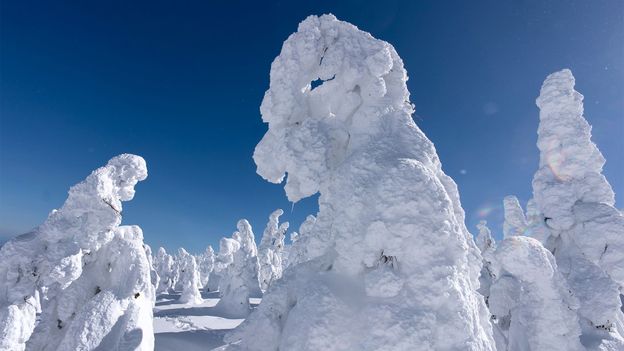
Mount Zao's famous "snow monsters" are extraordinary ice sculptures that form naturally during the brutal winter months when freezing winds from the Sea of Japan slam into the mountain's Aomastu fir trees, coating them layer by layer with rime ice until they transform into towering, ghostly figures that can reach several metres in height. These bizarre formations, called juhyō (樹氷) in Japanese, take on shapes so strange and humanoid that visitors often feel as though they're walking through an alien landscape populated by white sentinels - some resembling crouched giants, others looking like hooded spectres or mythical beasts frozen mid-stride across the mountainside. The phenomenon peaks between late December and February, when thousands of these ice-encrusted trees create one of Japan's most surreal winter spectacles, accessible via the Zao Onsen ski resort's ropeway system that carries visitors up into this otherworldly frozen realm where nature has turned an entire forest into what looks like an army of sleeping monsters.
The Snow Monsters (樹氷 juhyō) of Mount Zao.
A new survey by Yamagata University has revealed that Zao's celebrated "snow monsters" are slowly losing their majestic form, eaten away by insect infestations that have spread across the mountain range. These otherworldly figures, known in Japanese as juhyō (樹氷), appear each winter when freezing winds from Siberia and deep mountain snows coat the Maries' firs (Abies mariesii), turning them into ghostly sculptures of ice. For decades, they have stood as a symbol of the region, drawing travellers to the border of Yamagata and Miyagi prefectures.
That spectacle is now under threat. Since around 2013, caterpillars have been feeding on the branches and needles of the firs, stripping away the dense greenery that is needed for the icy forms to cling to and grow. Without foliage, the snow monsters cannot take shape.
To measure their decline, Juhyo no Kai (society for the study of frost-covered trees), a research group led by Fumitaka Yanagisawa, professor emeritus of environmental science at Yamagata University, examined photographs of Mount Jizo, one of the prominent peaks of the Zao range, taken from identical vantage points as far back as 1933. The team assessed the ice formations using a six-point scale of thickness. According to the findings, the ice monsters often stretched 5 to 6 meters across before World War II. As postwar warming took hold, they dwindled to 2 to 3 meters, and sometimes to only a single meter thick. Since 2019, the dominant forms have withered further to just 0.5 to 1 meter, and in some cases, a spindly 20 to 30 centimetres. Driving this decline is a cascade of ecological damage.