History Japanese history and archaeology: articles, news, and comments

Archaeologists uncovered an estimated 100,000 ancient coins, some of which are of Chinese origin and are more than 2,000 years old. The coins were tied together in bundles with a straw rope passed through a hole in the middle. The haul was unearthed in the Sojamachi district of Maebashi City, Gunma Prefecture, at a construction site of a factory. Only a small sample of the coins could be analyzed for dating, and the oldest was believed to be a Ban Liang coin from 175 B.C. Those were the first coins minted in a unified China.


626c7a9af52943d711e9411339ee03d3.jpg


3d48492ae7b04f587f15c53dd8a73d29.jpg


8f838181ba8dbb9face51c23a639bc5a.jpg


7ebf6e711863d2ea8d02ff903eddccde.jpg

All photos provided by Maebashi Municipality (via Asahi)

So far, 334 of the coins have been examined. At least 44 types were confirmed, ranging from those made in 175 B.C. to as recent as 1265. One confirmed Ban Liang coin had a diameter of 2.3 centimetres and was 1 millimetre thick. The square hole in the middle measured 7 millimetres on each side. The characters for "Ban" and "Liang" were engraved on the surface. Because the newest coin dates to 1265, the trove is believed to have been buried during the Kamakura Period (1185-1333). However, the date of burial could change after more coins are analyzed. The site where the coins were dug up has a large number of relics, leading experts to surmise it was a central part of Kozuke province, the predecessor to Gunma Prefecture, from around the time of the Kofun (burial mounds) Period between the late third century to the late seventh century.

 
For a minute , I thought they found my early days covid toilet paper stash. Would have liked to find something like that with my metal detectors.
 
Renovation work on a local historical landmark has revealed a sign and illustration thought to be from the time the building was requisitioned by the U.S. military following World War II.

6.webp

The discovery was made at the Yokohama City Port Opening Memorial Hall, now affectionately known as Jack's Tower. Removal of plaster from a basement wall revealed the word "barbershop" and an image thought to be of a man wearing a suit, both reportedly unknown before now.

9.webp

Completed in 1917, the structure was built using donations from city residents to commemorate 50 years since the opening of the Port of Yokohama. With its extravagant red brick exterior featuring lines of white granite and a clock tower, the hall was a symbol of the city. It was almost destroyed in the 1923 Great Kanto Earthquake six years later, with only the clock tower and one wall still standing. Rebuilt in 1927, the building survived the U.S. military's intensive firebombing of the city in 1945. Following the war, the building was confiscated by U.S. forces and used to host movie screenings and other activities. While unclear due to a lack of records, part of the building may have also been used as a barbershop. Following its return to Japanese control in 1958, the building became a venue for concerts, lectures and other events. In 1989, it was designated as a national important cultural property.

 
Samurai armour given to Malta as diplomatic gifts in the 19th century returned to Japan for repair work ahead of their exhibition at the 2025 Osaka Kansai Expo. Although kept in boxes, the three armour sets have been severely damaged, sitting in the corner of a military basement storage for decades, eroded by the salty air of the Mediterranean island country.

c3dd08e2bcefc87d1e9f155a8f2f577e.webp


One of the artifacts, a steel suit of armor from the mid-Edo Period (1603-1867), is of excellent quality, comparable to those worn by top-ranking samurai who served Daimyo feudal lords of the time, according to those in charge of restoring it. "Being entrusted with such historical treasures gives me a great sense of awe and responsibility," said Harumasa Miyashita, the president of Miyaobi, a Kyoto-based antiques dealer and repairer commissioned to restore the armor suits. "We'll do our best with all of our artisan skills and expertise," Miyashita added. The restored samurai armor suits will be on display at the expo along with armor suits of the Sovereign Order of Malta. The artifacts were gifted in 1862 by a Japanese delegation to Europe during a stopover on the strategically important island, then under British rule. The Japanese mission included Yukichi Fukuzawa (1835-1901), an influential author and educator, who later played a key role in the country's modernization.

 
At an archaeological site in Saga, stone moulds for making bronze objects, which may be the oldest ones in the country, have been found. The local government said that one of the moulds could be from around 200 BC. The stone moulds were discovered at the Yoshinogari ruins in September and October after a stone coffin tomb was unearthed in April in the same area. The tomb is thought to have belonged to someone of high rank.

photo_l.webp

Photo credit: Kyodo

The mysterious coffin raised curiosity among experts and archaeology enthusiasts about who was buried there, a question that could have implications for a long-standing debate over the location of the ancient Yamatai kingdom. However, in June, it was revealed that no human bones or burial items were found that could provide clues about the identity or the exact time of the burial.

 
The former British Embassy site in Tokyo has revealed traces of an ancient village dating back to the Yayoi Period (200 B.C. to A.D. 250), according to an announcement by the Chiyoda Ward office on Thursday. The excavation has uncovered 28 structures, of which 21 belong to the Yayoi Period , three to the earlier Jomon Period (10,000 to 200 B.C.), and four are undetermined. One of the Jomon Period structures contained shells, valuable relics for historical research. The dig has only covered about 3,700 square meters of the total 7,700 square meters, so there is a high chance of finding more evidence of the past.

267890.jpg

Photo credit: Chiyoda Ward Office


Last Friday, the Archaeological Institute of Kashihara unveiled a reproduction of a coffin found in Nara. The occupant of an ornate stone tomb here 1,300 years ago was buried in an elaborate lacquer-coated wooden coffin with gold fittings, say researchers who used computer graphics for the task. Only fragments of the coffin, as well as decorative fittings, were found in 1972 during excavation work of the Takamatsuzuka burial mound, which dates back to the late seventh to early eighth centuries. Almost all of the attention back then was on the murals painted on the interior of the stone chamber, including one called the "Asuka Beauties." The murals have since been designated as national treasures.

8e9b88adb8f7057127c4b0d197eedeff.webp

Photo credit: Toshiyuki Hayashi

Institute staff began the project in 2022, which marked the 50th anniversary of the discovery of the murals in the burial mound. The replica coffin made from cedar planks measures about 2 meters by about 60 centimeters with a depth of about 50 cm. The exterior is coated in black lacquer while red pigment mixed with traces of mercury was used on the interior. Gold-copper alloy fittings have been attached to the coffin which sits on a gold-plated lacquer stand.

 
Last Thursday, for the 48th consecutive year, members of the GSDF stationed at Camp Himeji recently scaled the keep of Himeji Castle for a cleaning operation.

9.webp

Photo credit: Mainichi - Nobuya Muramoto


The operation was conducted for the 48th time as part of the camp's training, and about 500 GSDF members took part. During the cleanup, members scaled the castle's nearly vertical stone walls and removed weeds, and also travelled by boat around the moat removing waterweeds and garbage. On the keep of the castle, commonly known as "Shirasagi-jo" or "white heron castle," GSDF rangers secured with safety lines some 50 meters above the ground used long-handled brooms to remove dust that had accumulated under the eaves.

 
Yamatorige/Sanchōmō-Ichimonji, a legendary sword registered as a priceless national treasure, has gone on display at the Bizen Osafune Sword Museum.

dac1592057425fa321fb742c22ffb350.jpg

A fundraising campaign by the city government brought the blade home after more than 700 years. The sword is commonly known as "Sanchomo," or feather of the copper pheasant, and is on show at the Bizen Osafune Sword Museum. It is regarded as the finest example of Bizen-style blades forged by the Fukuoka Ichimonji school of swordsmiths that was based in areas surrounding the city's Osafune district. The sword is believed to have been wielded by powerful warlords Uesugi Kenshin (1530-1578) and his adopted son Kagekatsu. The weapon acquired its name due to the complex elegant pattern on the blade that resembles dancing feathers or mountains and fields on fire.

Admission is 800 JPY for adults, 500 JPY for senior high school and college students and free for junior high school students and younger children. From 6 January, admission is 500 JPY for adults and 300 JPY for senior high school and college students. Reservations must be made in advance. Viewing is restricted to 40 people each hour.


Here's an excellent article on the blade:

 
Setting the ceiling straight: even the smallest of shrines often have amazing stories to tell.

Ever since Koshiba Shoko became the head priestess of Suwajinja in Kumagaya, Saitama, in the 1980s, she felt that something was wrong with the ceiling of the haiden worship hall that features 15 paintings placed like panels in a wooden grid consisting of three rows of five pictures each. The paintings seemed out of place, and the rectangular display looked like an unfinished edge-match puzzle.

Before:

54f2520c52d2c499c5bd14764951d88f.webp


After:

343e808eb39b33f5a747855ab917cf98.jpg

Photo credit: Yokoyama Lab


The ceiling art was blown away when a typhoon obliterated the shrine's roof in September 1966. The paintings were all recovered and reinstalled the following year. About 20 years after that, Koshiba, now 78, became head priest of the shrine. Koshiba's grandfather was the shrine's chief priest when the destructive typhoon hit. But he never told her about the original arrangement of the pictures, and no photos of it remained, either. [...] Koshiba immediately saw that some images were lined up vertically while others were arranged horizontally. In addition to this inconsistent pattern, the painting bearing the artist's signature was oddly located at the centre of the grid.


In 2016, the Suwajinja shrine's main hall was named a tangible cultural asset of Saitama Prefecture. This year, the shrine wanted its haiden worship hall listed as a designated cultural property of Kumagaya city. A team headed by Shinichi Yokoyama, a professor of historic architecture studies at the Institute of Technologists in Gyoda, Saitama Prefecture, visited the Suwajinja shrine in May to study and assess the haiden. After reviewing the ceiling art, Yokoyama concluded that the paintings were placed incorrectly. He agreed with Koshiba's assessment that a picture with the artist's signature is rarely exhibited in the middle.

The answer was found a few months later:

Botanical species depicted in the illustrations represent seasons. For example, the camellia-starling painting and the "ume"-bush warbler image refer to January and February, respectively, in the old calendar. The bamboo tiger painting was deemed to symbolize the months of July and August. Another painting with a wave and plover, which showed no plants, indicated October. The pictures were reordered based on the perceived time elements. The team also placed four pictures of sacred beasts at the corners. With the image bearing the painter's signature in one corner, the researchers felt the paintings were back in their original positions.

When the team studied the back of the centrepiece, they discovered the names of nine individuals and the era name for 1862, 10 years after the worship hall was built. According to Yokoyama, the nine are believed to have been Suwajinja parishioners who donated the images to express gratitude for their safe visit to the renowned Ise Jingu shrine in what is now Mie Prefecture . The Suwajinja haiden is ordinarily inaccessible to the public. But the shrine is now allowing tours of the hall.

 
Perhaps you could add the image of the original erroneous layout from the article so that readers can see the 'before' and 'after'.
 
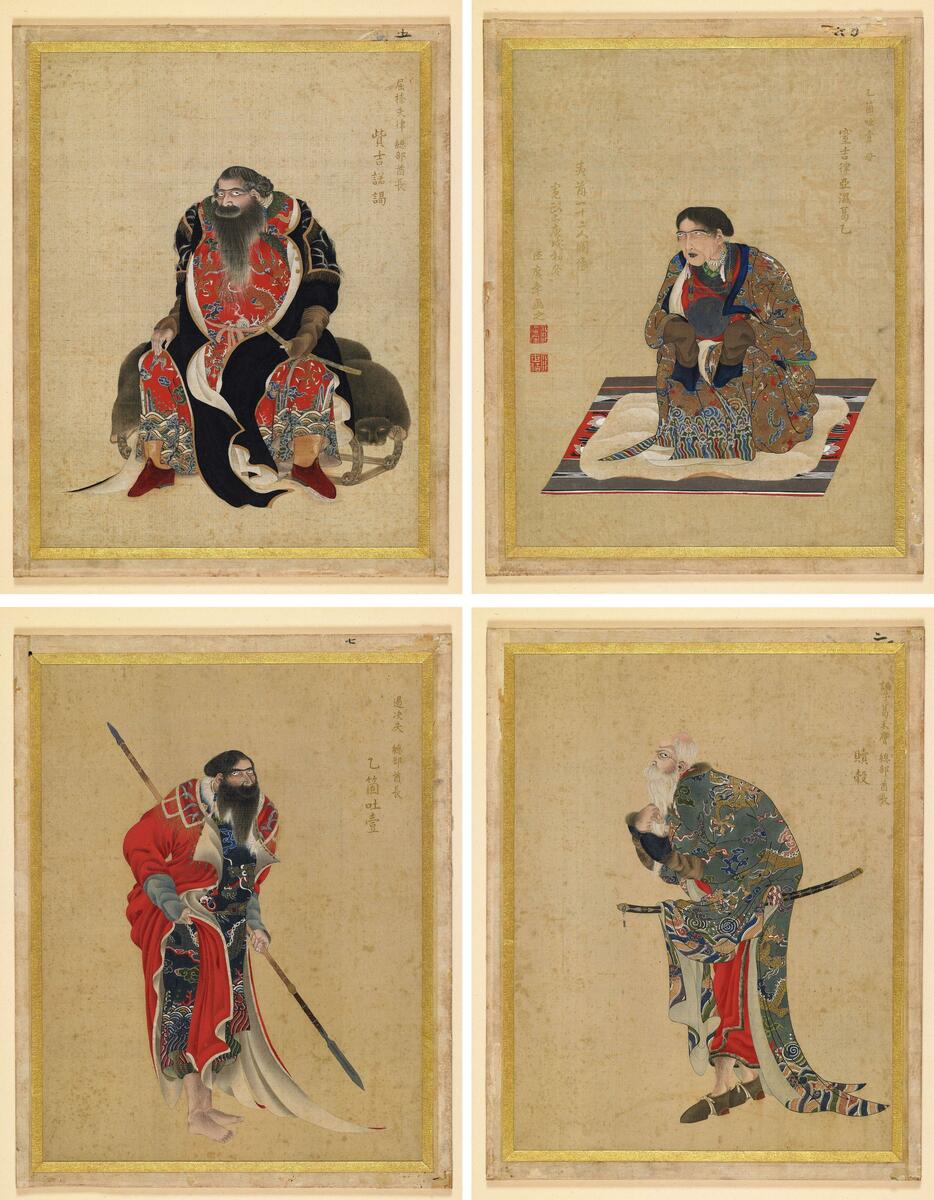
Riki Kato, a 67-year-old former journalist, is on a quest to solve the mystery of how a series of famous paintings of Ainu leaders from the late 18th century ended up in eastern France. He hopes that the authorities in Hokkaido will investigate the history of the "Ishuretsuzo" paintings, which are more than 140 years old.


iIshuretsuzo-ainu-chieftains.jpg

Photo credit: Musée des Beaux-Arts et d'Archéologie de Besançon


The masterpieces were completed in 1790 by Hakyo Kakizaki, a painter and retainer of the Matsumae domain on Japan's northernmost main island, and form a series depicting 12 chieftains who helped Japanese forces suppress Ainu uprisings during the Menashi-Kunashir rebellion in 1789. In 1933, the series, minus one painting that had gone missing, surfaced in a warehouse at the Museum of Fine Arts and Archeology of Besancon, France. The paintings were proven to be authentic in the 1980s through analyses. Kato says there are numerous theories about how the paintings got there from Japan, including that they were brought back by a French soldier who fought in the 1868-1869 Battle of Hakodate or by Kakizaki's eldest son.

Kato thinks that Eugene-Emmanuel Mermet-Cachon, a French missionary who lived in Hakodate, is the most probable person behind the paintings' journey. The paintings are thought to have been present from the Hakodate Magistrate's Office to Mermet-Cachon, who then gave them to a fellow missionary from Besancon, who handed them to his brother, a museum curator. Kato discovered the paintings in 1984 when he was a journalist for the Hokkaido Shimbun newspaper and saw them on the front page. He got a chance to view the paintings up close in 1987, even though they were not exhibited to the public, and was amazed by their intricate details and bright colours.

When he became the paper's Paris correspondent in 1994, Kato interviewed many art experts and relatives of military officers, looking for clues, but could not crack the case. Kato retired in 2021 but still has a burning curiosity and continues talking to curators and teaching at French language schools.


The Sumida Hokusai Museum is currently holding a special exhibition displaying paintings by Katsushika Hokusai (1760-1849) and his pupils, along with Japanese swords, depicting the society in which samurai lived in the Edo Period.

kamakura-no-gongoro-kagemasa.jpg

Hokusai, Kamakura no Gongoro Kagemasa

The "Hokusai and the Samurai World" exhibition, running at the Sumida Hokusai Museum in Tokyo's Sumida Ward until Feb. 25 features ukiyo-e woodblock prints vividly depicting the ordinary lives of samurai -- similar to salarymen in present-day Japan -- and feudal lords traveling to Edo under a system requiring them to spend every other year in residence in the capital in principle. It also portrays historical sagas in the form of eye-catching "musha-e" samurai paintings featuring the brave battles of legendary warriors from the Genpei War (1180-1185) and the Nanboku-cho era (1336-1392). [...] In collaboration with the nearby Japanese Sword Museum in the ward, cultural assets from the sword museum's collections, such as the "tachi" long-sword created by swordsmith Nobufusa, are also on display. Efforts have been made enhance the impact of the collaboration, such as by placing a sword with its blade pattern reminiscent of ocean waves next to Hokusai's "Under the Wave off Kanagawa" from the series "Thirty-six Views of Mount Fuji."

For the first time, the museum also provides audio guides in foreign languages.


Sumida Hokusai Museum
 
More sword news: Kitano Tenmangu Shrine in Kyoto launched a crowdfunding campaign for a project to use rare metals from discarded computerware to create modernistic mountings for a legendary sword known as Onikirimaru (鬼切丸, ogre slasher), aka Higekiri (beard cutter). The campaign started on 29 November and reached more than double the 15 million JPY (USD 104,400) target amount in ten days. As of 19 December, the amount stood at more than 36 million JPY. The demon-slaying sword, preserved at the shrine, is an important state-designated cultural property.

onikirimaru.jpg

Photo credit: Kensaku Nishida via Asahi

Forged in the Heian Period (794-1185), the blade is the oldest among the 100 or so that are housed at the shrine in the ancient capital's Kamigyo Ward. Legend has it that the warlord Watanabe no Tsuna used the sword to sever the arm of an "oni" ogre that tried to seize him. Onikirimaru was also owned by renowned warlords Minamoto no Yoritomo and Nitta Yoshisada before it was passed down in the Mogami family for generations, according to shrine officials. When it was relinquished by the Mogami family in the Meiji Era (1868-1912), the Shiga governor at the time suggested the blade be dedicated to the shrine. Officials said the "Touken Ranbu Online" video game that features a character inspired by Onikirimaru has helped fuel a growing sword boom and rising interest in the collection at Kitano Tenmangu shrine. The scabbard, hilt and handguard of Onikirimaru, along with other "koshirae" mountings, were lost long ago.

 
As reported here, excavations at the former British Embassy revealed ancient pit dwellings dating to before Christ at a prime location in Tokyo. Still, the discovery won't stop the site from being developed for a luxury apartment building. Nearly 30 pit houses were discovered on a plot of land in Tokyo's Chiyoda Ward that was formerly leased to the British Embassy. The pit houses were found alongside earthenware and other ancient artefacts. However, the Chiyoda Ward office has stated that it does not expect to preserve the remnants at the current location due to a planned apartment building to be constructed there. An official handling the matter stated that it would be challenging to preserve the remnants as they are scattered across a broad expanse of land. The ward office will consult with the Tokyo metropolitan government, but it is most likely that only documentation on what has been discovered, such as photos and excavation drawings, will be retained, not the actual remnants, based on the Cultural Properties Protection Law.

ruins-of-yayoi-period-pit-dwelling.jpeg


The discovery involves the remnants of 21 pit dwellings dating to the Yayoi Pottery Culture Period (1000 B.C.-A.D.250), of three pit houses from the Jomon Pottery Culture Period (c.14500 B.C.-1000 B.C.) and of four pit dwellings of an unknown date. In addition to earthenware, wooden gutters for drinking water, a well and basement have also been dug up. All these have been found by October after the excavation began in June at a plot measuring 7,700 square meters, part of the land where Mitsubishi Estate Residence Co. plans to erect an upscale apartment building. The location, close to the Imperial Palace, commands a superb view of cherry blossoms along the Chidorigafuchi moat, a renowned cherry blossom viewing spot, making it one of the most coveted areas in Tokyo. The excavation is expected to continue through March, raising the possibility that more remains may be unearthed.

 
Some of you may remember Bertolucci's "The Last Emperor" (1987) on Puyi, China's last emperor and the ruler of Manchuko, a puppet state of the Japanese Empire from 1932 until 1945. Manchukuo, as the Japanese called it, was three times the size of the Japanese archipelago, its industry was largely based on the opium production.

Asahi has a special multimedia feature on "Manchuko" (満州国) with historical photos and manga-like storylines:


manchuria.webp


A "state" known as Manchukuo existed at one time in the northeastern area in China. While it proclaimed lofty ideals such as "Odo Rakudo" (A Utopian State under Benevolent Rule) and "Gozoku Kyowa" (Five Races Under One Union), Manchukuo was, in fact, a puppet state set up by Japan. An artificial state under the thumb of Japanese military officials, the foundation of the military and bureaucratic structure was supported by a cancer that still resonates in contemporary society. Based on recent research results and interviews with experts, this special feature will describe what actually lay within a dark side of history. This is a collaboration between The Asahi Shimbun and the popular manga series "Manshu Ahen Squad". Some of the photos of that time now in the archives of the Asahi Shimbun will be introduced after colorization using state-of-the-art technology and historical authenticity provided by experts.

 
A letter written by Date Masamune, the first head of the Sendai Domain, was rediscovered at the Hyogo Prefectural Museum of History in Himeji. Matsuo Kenji, a professor emeritus at Yamagata University specializing in medieval Japanese history, determined that the document was written by the famous daimyo from the Warring States period in the 15th-16th century, based on a seal he used in his later years, the content of the letter and records from other historical sources.

date-masamune-letter.webp


Matsuo estimated that the letter was sent to the hatamoto, or high-ranking samurai, Tsumaki Yoritoshi, in 1635. The document, in modern Japanese translation, reads, "On the morning of March 16, Hosokawa Tadatoshi (who was also a daimyo) will visit (Date Masamune's residence in Edo). Would you like to join if you don't have any prior engagements?" Professor Matsuo explained, "Tsumaki was not a daimyo but a hatamoto with a fiefdom of just 7,500 koku of rice, while Masamune was a daimyo with a fiefdom of 620,000 koku. Considering that Hosokawa was also the first lord of Kumamoto Domain with a fiefdom of 540,000 koku in Higo province, this historical source indicates that Masamune had built relationships with them regardless of the difference their social standings based on their family names."

 
The Myooin temple (円光寺) in Fukuyama, Hiroshima Prefecture, houses an ancient Buddhist statue with a fascinating secret. During the repair work, the hollowed-out head of this statue revealed a remarkable find: sheet after sheet of "washi" traditional paper adorned with images of the revered religious figure. But that's not all—there were also ink images of Bhaisajyaguru and Ksitigarbha.

Meticulously created with seal stamps, these images cover nearly every inch of space on the paper. The wooden seated Maitreya statue, the temple's principal object of worship, resides in a five-storied pagoda erected in 1348 during the Northern and Southern Dynasties period. This pagoda holds national treasure status. The sheets of paper were discovered this past summer as the statue underwent repair. The fragile sheets were carefully removed to prevent further deterioration, allowing for a closer examination of the intricate images. These findings have raised expectations that they will shed light on the circumstances surrounding the construction of the wooden pagoda 676 years ago.

Maitreya


The wooden seated statue sculpture is the temple's principal object of worship. Located in the Kusadocho district, the temple belongs to the Shingon sect of Buddhism. The statue is venerated at a five-storied pagoda erected in 1348 during the period known as the Northern and Southern Dynasties with national treasure status. Temple officials believe the seated statue was created around that time and delivered to Myooin to celebrate its completion. The sheets of paper were uncovered this past summer as the statue was being dismantled for repair work. The fragile sheets of paper were removed to prevent further deterioration so the images could be examined more closely. This led to expectations the discovery would shed light on the circumstances behind the construction of the wooden pagoda 676 years ago.


Link:

Myooin temple (円光寺) Fukuyama
 
At the site of the castle once belonging to the 16th-century samurai general Akechi Mitsuhide , a remarkable discovery has been made. A 30-meter-long stone wall and a moat were unearthed in Otsu. Akechi Mitsuhide is infamous for betraying the feudal warlord Oda Nobunaga (1534-1582). The city government officially announced the unearthing of Sakamoto Castle on 7 February.

1dbba72b38bdf7a65e19543ce369b2e3.jpg

Photo credit: Yuhei Nakahodo

This castle, often called the "phantom castle," lacks visible remnants on its grounds and has no pictorial maps. Consequently, the accurate scale of the castle remains shrouded in mystery. Notably, the stone wall's size is miraculous and is expected to be pivotal in the castle's restoration. Sakamoto Castle, constructed in 1571, was commissioned by Nobunaga after he defeated the warrior monks of Mount Hieizan. The castle boasted a main building extending into Lake Biwako and secondary and tertiary enclosures on the land side. Portuguese missionary Luis Frois described its splendour as second only to Nobunaga's Azuchi Castle. Unfortunately, Sakamoto Castle met its fiery demise following Mitsuhide's coup in 1582.

Although Mitsuhide succeeded in driving Nobunaga to suicide, his rebellion was swiftly quelled. The recent survey by the Otsu city government, covering approximately 900 square metres, led to the discovery of the stone wall, which stands at 1 meter in height and spans 30 meters. The wall, constructed from natural stones without shaping tools, was originally around 1.5 metres high. Additionally, an 8-metre-wide moat was found. These remnants lie about 300 meters west of the estimated lakeshore location of the castle's main building. The wall likely belonged to the sannomaru (tertiary enclosure), with the moat as its outer defence.


Hitoshi Nakai, professor emeritus of the history of Japanese castles at the University of Shiga Prefecture, said, "It is miracle that a stone wall of this size was unearthed." [...] The examination unearthed the stone wall, measuring 1 meter in height and 30 meters in length. The wall was stacked using natural stones unshaped by tools. It is said to have originally been about 1.5 meters in height. The discovered moat was confirmed to be roughly 8 meters in width. The remnants were found about 300 meters west from the lakeshore of the estimated location of the main building.


The reopening of Okayama Castle in western Japan after extensive renovations has had a remarkable economic impact. The benefits, estimated at 11.37 billion JPY (approximately USD 75.56 million), exceeded the renovation costs by more than six times. This positive ripple effect has been observed since the castle reopened in November 2022. The municipal government's announcement highlights the significant contribution of this historical landmark to the local economy.

Okayama Castle, also known as "Ujo" (crow castle) or "Kin-ujo" (golden black castle) due to its distinctive black outer walls, holds a rich history dating back to the Nanboku-cho Era. Visitors can explore its six-story tower, each floor offering unique themes and exhibits related to the Sengoku period , feudal lords, and the castle town. From the battle of Sekigahara to panoramic views from the top floor, Okayama Castle stands as a symbol of the region's cultural heritage and economic prosperity.

okayama-castle.jpg

Okayama Castle during a visit in 2014


The direct economic effects of the roughly 1.8 billion JPY (some USD 11.96 million) renovation alone, including visitors' transportation, food and beverage expenses, were 7.023 billion yen (approx. $46.67 million). "The outcome was better than expected. It's brought a major economic benefit to Okayama," the city's Mayor Masao Omori said at a Feb. 9 regular press conference. The castle in Okayama's Kita Ward was built in 1597 by Ukita Hideie, an essential vassal of 16th-century Japanese leader Toyotomi Hideyoshi. Its keep was destroyed by fire in an air raid in 1945 but was rebuilt in 1966. Since the castle was feared to collapse in an earthquake measuring upper six or stronger on Japan's 7-level seismic intensity scale, it underwent significant renovations starting in June 2021.

 
The Fukuda Art Museum in Ukyo Ward, Kyōto, recently made an exciting discovery. They found a coloured scroll by the renowned 18th-century Japanese painter Ito Jakuchu . This remarkable scroll, which measures over 3.3 meters long, is now housed in the museum. The scroll is a vibrant depiction of approximately 40 varieties of fruits and vegetables. Among the colourful subjects are a grape, an apple, a pumpkin, and a white gourd. The intricate details and vivid colours showcase Jakuchū's artistic skill.

Interestingly, a signature on the scroll suggests that Jakuchu created this work when he was 76 years old. This masterpiece was discovered in Western Europe after the museum received a tip. After confirming its authenticity, the museum aptly named the scroll "Kaso Zukan," which translates to "picture book of fruits and vegetables".

Kaso Zukan


Until this discovery, the only colored scroll by Jakuchu that existed was the one housed at a museum in Tochigi Prefecture. The piece was designated as a national important cultural property. Hideyuki Okada of Fukuda Art Museum said he was surprised to find that a work not even familiar to researchers was discovered outside of Japan and yet kept in an extremely good condition. He said, "The work feels so fresh that it's hard to believe it was produced 200 years ago." Tsuji Nobuo, a professor emeritus at the University of Tokyo who has studied Jakuchu for many years, said the work makes people feel Jakuchu's affection for plants and gives an impression that he produced the work freely. He added that the piece will help researchers understand how the painter was working in his later years.


Kaso Zukan


Last edited:
Asahi on Kawahara Keiga (川原慶賀, 1786–1860), a Japanese painter of plants, fishes, birds, reptiles, crustaceans, social scenes, landscapes and portraits at the Dutch Factory of Dejima, and at Edo, Kyoto and Nagasaki, whose works can be found in museums in Japan and the Netherlands. His paintings are triggering new interest on the 200th anniversary of the arrival of German physician and botanist Philipp Franz von Siebold, who employed Kawahara to illustrate his findings.


Unlike Katsushika Hokusai and other ukiyo-e artists of his generation, Kawahara (1786-1860s?) learned the fundamentals of Western painting techniques from a Dutch painter and mixed them with traditional Japanese methods. His unique realist style was fostered in Nagasaki, which was the only window to the West during the Edo period (1603-1867). Kawahara studied under painter Ishizaki Yushi, a master of the Nagasaki painting style. In a time that preceded the development of photography, Kawahara's paintings were more realistic than his contemporaries, providing snapshots into the lives and times of the era.

9.webp
9.webp

Although Siebold was funded with subsidies by the Dutch government for his research in natural science that included studying Japanese flora and fauna, one may wonder why he allowed Kawahara to draw ordinary people for purposes outside of work. According to Miyasaka Masahide, a visiting professor at Nagasaki Junshin Catholic University, Siebold wrote in an unpublished letter addressed to his family, "This civilization will disappear sooner or later and must be recorded." Miyasaka said Siebold possibly feared that Japan would lose its culture to the impending influx of Western civilization, which was made irresistible through the Industrial Revolution.

 
A colossal, serpentine "dako" iron sword (蛇行剣 dakōken) discovered in Japan's ancient capital of Nara exhibits a unique "hybrid" design. This design merges elements of a single-edged katana and a double-edged sword. The sword was unearthed from the largest circular burial mound in Nara.

The Archaeological Institute of Kashihara, Nara Prefecture, and the Nara Municipal Board of Education announced this discovery on March 26. This unparalleled artefact is considered to be the prototype of ceremonial blades produced under the Yamato Kingship's authority. The dako sword, with dimensions of 2.37 metres in length and 6 centimetres in width, is the oldest in Japan. It is also the most enormous iron blade discovered in East Asia from the Kofun period (approximately the third to seventh century). In an undisturbed burial facility, the sword was found in December 2022 alongside a shield-shaped bronze mirror. The discovery was made during an excavation survey conducted by the municipal education board at the Tomiomaruyama Kofun burial mound. This mound dates back to the late fourth century and has a diameter of 109 metres.

Dako iron sword (蛇行剣 dakōken)


Sword mountings weren't in their original forms at the time of the excavation, but were almost completely reconstructed via microscopic observation and non-destructive scientific analysis. It was found that the hybrid blade was bent six times, and in total measured 285 centimeters with the "tsuka" handle and the "saya" scabbard attached. Its handle is approximately 38 centimeters long, and is entirely coated with black lacquer, except for the grip where the cloth and cord are wrapped. An L-shaped decoration called "kusabigata-tsukagashira," commonly seen on katana, was found protruding from its tip. It is the oldest example of an iron katana with such a creative design, and the first ever sort of the decoration found on a double-edged sword. On the other hand, the hybrid blade also has a "tsukabuchi-tokki" protruding from the part that comes in contact with the scabbard -- unique to double-edge swords.


Five years following a catastrophic blaze, the restoration of Shuri Castle's principal structure is advancing, with the distinctive hall's roofs now visibly forming. These elegantly curved roofs are anticipated to be ready for tiling and painting by June. The entire restoration is slated for completion by 2026. Encased within a safeguarding structure, the castle's Seiden main hall is undergoing restoration. The site remains partially accessible, allowing tourists to witness the reconstruction firsthand.

Shuri Castle renovation


"This is a rare opportunity to witness the reconstruction of the building," said Hiroyoshi Aragaki, head of the government office that oversees the national park where the castle complex is located. "I hope the public viewing of this site offers insight into the heritage and spirit of the people who built the Ryukyu Kingdom." The early morning blaze on Oct. 31, 2019, destroyed seven buildings including the Seiden main hall, and damaged two more. The reconstruction of the three-story main hall started in 2022. Featuring a complex framework of 513 pillars and beams, the building will measure 29 meters in width, 21 meters in depth and 15 meters in height. The castle served as the royal palace of the Ryukyu Kingdom (1429-1879) and the headquarters of its government. Learning from its history of repeated blazes, the new building will be equipped with sprinklers, fire doors, and other fire protection measures. A team of 35 heritage building specialists is leading the reconstruction project. The team includes carpenters in their 20s, still learning the craft, and three women, who are the first female carpenters to work on the castle's reconstruction.


Tanaka Zensuke (田中善助, 1858-1946)
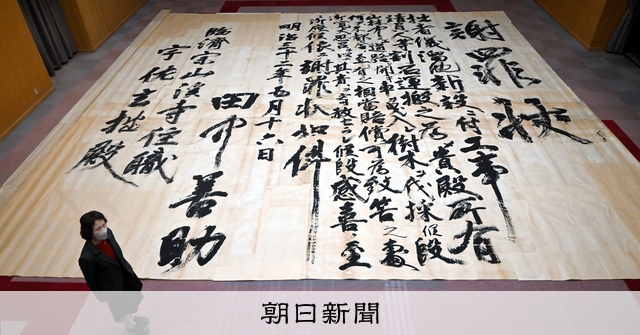
Starting on 11 May, an exhibition will feature a giant letter penned by Meiji-era entrepreneur Tanaka Zensuke (田中善助, 1858-1946), a key figure in the modernisation of the Iga region during the late 19th century. The letter, which spans 9x9 metres and weighs four kilograms, showcases Tanaka's business acumen and unconventional personality.

The letter of apology was written in 1899 when Zensuke destroyed a forest owned by a neighbouring temple while constructing a reservoir in connection with the reclamation of new fields. This became an issue at a general meeting of parishioners, and the head priest of the temple asked Zensuke for an apology and presented it to him. Zensuke is said to have written the letter in large letters on a straw broom dipped in ink.


AS20240508003333.webp

Tanaka spearheaded the construction of railways and hydroelectric power plants while also engaging in landscape preservation efforts. He also built sewage systems in Ueno, now part of Iga, when he served as its mayor. The letter, penned in 1899 and addressed to the chief priest of a local Buddhist temple, apologises for inadvertently encroaching upon the temple's premises while constructing a reservoir for a new rice field development project. Written in a mixture of about 130 kanji and hiragana characters on large sheets of paper joined together, the letter humbly requests forgiveness, using phrases such as, "If you would grant me your merciful pardon, I would be overwhelmed with gratitude." It appears to have been written with a straw broom dipped in ink. The three characters "Sha-zai-jo" (apology letter) at the beginning are each over a meter long. According to a biography of Tanaka, the temple's parishioners were enraged by the encroachment on the temple's land and demanded an apology letter from Tanaka. The sheer size of the letter left the chief priest and the parishioners utterly speechless, and the matter was resolved peacefully. The Maeda Education Foundation has been restoring and preserving the letter since 1999 when it held an exhibition showcasing the letter and other items that highlight Tanaka's legacy.


Back
Top Bottom