History Japanese history and archaeology: articles, news, and comments

Strangely, Tōkyō's old castle grounds feel to me like one of the most neglected and underdeveloped bits of historical architecture in the country. There are still a few buildings and gates that survived the war, but they somehow feel remote, and even the signage around the structures is very obtuse and, in a way, unhelpful.

I couldn't agree more and tend to believe it's a historical aftereffect of the Tokugawa-Satsuma /Choshu rivalry. There were plans to reconstruct the donjon of Edo Castle but, sadly, they never materialised.


Daisanbunmei-sha published the Japan diary of German archaeologist Heinrich Schliemann (1822-1890), who visited the country for one month in June 1865 while travelling the world. He briefly visited the western Tokyo suburb of Hachioji before he turned to archaeology and discovered the ancient city of Troy, known as a setting for Greek mythology.

His diary offers rare insights into life in Tokyo in the mid-19th century.


Heinrich Schliemann in Japan


Initially written in French in pencil and pen, the diary provides a glimpse of Hachioji, one of the few places foreigners had access to at the end of the Edo Period (1603-1867), including how he interacted with locals and described the architecture of the time. Takao Ito, 49, a professor at Soka University's Faculty of Letters who resides in Hachioji, translated it last summer with the help of students whose native language is French after obtaining permission from the American School of Classical Studies at Athens (ASCSA) in Greece, where the diary has been kept.

 
During excavations between January and March, researchers uncovered evidence of a prominent imperial residence dating back 1,300 years, most likely related to Prince Toneri (676-735), one of Emperor Tenmu. The excavations revealed an architectural method known as "hottate-bashira," consisting of sinking massive timber pillars into the ground to erect a single structure. The site, which dates to the early Nara Period (710-784), is slated for the construction of an apartment complex.

heijo-kyo.jpg

Prince Toneri is known for compiling "Nihon Shoki" (The Chronicles of Japan), the second oldest book in Japanese classical history. The site measures around 370 square meters and seems to have comprised three main buildings, the Nara City Board of Education said April 3. The three buildings are aligned in a north-south configuration. The northern building, which seems to have been the largest, measures around 20 meters east to west and more than 10 meters north to south. Square holes dug to erect the pillars were also massive, measuring 1.5 meters on each side. Heijo-kyo, the capital of Japan here in the Nara Period, was built according to a grid pattern. The basic unit of land was the "town," a square area measuring 130 meters on each side. Imperial family members, aristocrats and bureaucrats were granted residential land, the size of which was decided according to their rank. Aristocrats ranked fifth or lower are thought to have been granted one town, while those in ministerial positions, such as Prince Nagaya (676?-729) who served in a key position as Minister of the Left, were granted four towns. The foundations of his residence were discovered in 1988.


An almost perfectly preserved wooden mask from around the early third century that likely featured in important farming festivals was uncovered at the Nishi-Iwata site in Osaka Prefecture.

Wooden mask found at Nishi-Iwata site in Osaka Prefecture

The Osaka Center for Cultural Heritage announced the find at the Nishi-Iwata ruins in Higashi-Osaka on 24 April. It marks the third time a wooden mask from the period was discovered in Japan. Experts believe the artefact played a crucial role in important agricultural festivals organized by influential people of the time. The mask, hewn from a cedar tree and up to 2 centimetres thick, measures around 30 cm from head to chin and is about 18 cm wide, according to the Osaka Center for Cultural Heritage. It has three holes to represent the eyes and mouth and a projected part in the center for the nose. Experts noted that the holes for the eyes in the mask are similar to another discovered at the Makimuku ruins in Nara Prefecture, which dates from the same period. The latest discovery, made last June, was prompted by extension work of the Osaka Monorail. The mask was uncovered in flood sediment 2.9 meters beneath the ground surface. Part of a wooden water bucket and a hoe-shaped wooden object charred in a fire were found alongside it.


A rare illustration depicting a harpooned whale on earthenware pottery from the Yayoi period was discovered in Itoshima, Fukuoka.

Harpooned whale on earthenware pottery

Photo credit: Mainichi/Masanori Hirakawa

It needs a bit of imagination to interpret it as a harpooned whale, as it looks more like a catfish to me, or rather, an attempt at an amoeba. 😄

Fascinating. The only other depiction of a whale on pottery was found in Iki, Nagasaki Prefecture.

The illustration measured 8 centimetres long and 1.3 cm wide. It was depicted on a pot (60 cm high, 40.4 cm wide) excavated in January 2022 from the remains of what is believed to be a community base during the Yayoi period. The whale has a total of six lines, appearing to be harpoons stuck on its sides. Whale bones have also been found in other sites in Itoshima and the one in Iki, from which the first whale illustration was found, apparently suggesting that people ate whales they captured during the Yayoi period. A city representative said, "People around the area of Tsushima Strait, which was along whales' migration routes, may have shown their prayers to receive the blessings of nature, like whales, through illustrations."


In a rare find, researchers in Tondabayashi, Osaka Prefecture, unearthed various haniwa in the shapes of humans, animals and houses from a newly discovered kofun burial mound dating to the late fifth century here. The Tondabayashi Board of Education announced on 1 May that 17 figurines of at least seven types had been found. It is rare for so many styles and pieces of haniwa from that ancient time to be discovered.


haniwa-osaka.jpg

Photo credit: Toshiharu Morishima


"A powerful person who ruled the Minami-Kawachi area is believed to be buried there, given the size of the tomb," said a board official. "This person could have obtained information on the shapes and usage of haniwa from people close to the kingship, suggesting the person had such connections." The large keyhole-shaped tomb mound, which is around 20 meters in length, was discovered after artefacts were found in a survey conducted in October 2021 for a land development project. Researchers unearthed more than 1,000 pieces of clay from ditches surrounding the mound and have been working to restore the haniwa.

 
The Saga Prefectural Nagoya Castle Museum recreated Toyotomi Hideyoshi 's famed portable golden tearoom. Completed at 36 million JPY (USD 268,000), it offers visitors a rare glimpse of late 16th-century Momoyama Period culture.

Toyotomi Hideyoshi's famed portable golden tearoom


The replica was created based on historical records kept by the Karatsu-based museum. The project took about six months until March 2022. According to the museum, Hideyoshi (1537-1598) first used the room for a tea ceremony at the Imperial Palace in Kyoto in 1586, where he made and served tea to Emperor Ogimachi. Hideyoshi hosted the event to express gratitude for his inauguration as "kanpaku," a title given to an individual who serves as chief adviser to the emperor. The assembly-type tearoom was taken to Nagoya Castle, which had been built in the city of Karatsu as a base for Hideyoshi's invasion of the Korean Peninsula. It was used four times for tea ceremonies with feudal lords and to welcome foreign envoys, records show. While Hideyoshi was reputed to have flamboyant tastes, the golden tearoom was also a way for him to enhance his own authority in politics and diplomacy. It is said the tearoom was later brought back to Osaka when Hideyoshi returned there and was destroyed by fire during the Summer Siege of Osaka Castle in 1615. Officials said about 16,500 sheets of gold leaf were used for the replica. Following historical accounts, craftsmen used silk fabric instead of "shoji" screen paper and woollen fabric to cover the tatami mats. Both fabrics are bright red.

 
Scholars were amazed by the recent discovery of three letters that were written by Julia Ota (ジュリアおたあ), a Korean woman who achieved a high position in 17th century Japan but was labelled the "tragic Christian" due to her refusal to renounce her faith. The Hagi Museum in Yamaguchi Prefecture announced on 19 April that Ota's younger brother's descendants donated the letters and a garment worn by Tokugawa Ieyasu . The museum officials described these items as precious historical artefacts. Jesuit priests' records from the 17th century also mentioned Ota.


letter-julia-otaa.webp


Details of her early life are sketchy, but it is believed Ota was 14 years old when she was seized as a hostage in Korea and taken to Japan during the invasion of the peninsula by the warlord Toyotomi Hideyoshi (1537–1598). In Japan, she was raised by Konishi Yukinaga, a Christian feudal lord who took part in the invasion and was baptized as a Christian. Julia was her Christian name, and her Japanese name was "Taa." After Yukinaga was defeated in the historic 1600 Battle of Sekigahara and executed, Ota became a lady-in-waiting to Tokugawa Ieyasu. But it is believed she was banished to Izu Oshima island south of Edo (modern-day Tokyo) for refusing to abandon her faith after Ieyasu banned Christianity in 1612 and lived the rest of her life in exile. Her tragic life was made into a musical and a novel. The three hand-written letters were passed down in the Murata family, a retainer family of the Choshu Domain (modern-day Yamaguchi Prefecture).


A relic from the time of "hidden Christians" in Japan centuries ago is causing a stir after the family that handed it down over generations allowed the artefact to be examined. The item is a simple vase; however, it is a word painted on the base, causing a fuss. The term suggests the vase held fragrant oil used during Catholic Mass, likely for a significant person.


escencia.webp


The item is owned by a family that lives in the Sotome district, where Japanese Catholics were driven underground to avoid persecution during the Edo Period (1603-1867). Hidden Christians continued to practice their faith secretly at a high cost to themselves. The Nagasaki prefectural government speculated on 16 May the vase might have been used in a ceremony for Konishi Yukinaga, a Christian feudal lord in the 16th century. The prefectural government labelled the vase an important item, saying it offered an insight into how Christian churches in Japan operated, as few records from the period survive. The artefact is 25 centimetres tall and painted in three colours. It was made in China around 1600 and kept in a storage room. As a "treasured item," only the head of the household historically was allowed to view the vase, the owner said. The vase was dubbed "Yokahito-sama" and used as an object to venerate when saying prayers. Until now, the owner said it had not been known what the vase was for. While studying the vase, the prefectural government last year noticed that a foreign word, "Escencia," is written in ink on the base. The word means "fragrant oil."
The prefectural government concluded the artefact was used for holy. This suggests that the vase featured in ceremonies such as consecration or celebration at Mass that only bishops are allowed to perform, experts said. Luis de Cerqueira was the bishop of Japan back then. He is said to have conducted a "confirmation" ceremony in the Amakusa Islands in 1599 to affirm Yukinaga's religious faith. The bishop arrived in Nagasaki in 1598. The vase was likely secretly moved somewhere after the Edo Shogunate banned Christianity in 1614, resulting in the expulsion of missionaries from Japan and the destruction of churches, said Yohei Kawaguchi, an official with the arts and culture division at the prefectural government who is also an archaeologist.

 
Another sensational historical letter has recently surfaced in Yamagata, written by Oda Nobukatsu , the second son of Nobunaga, urging Tokugawa Ieyasu to submit to Toyotomi Hideyoshi and become his vassal. What's sensational is the fact that the letter conflicts with the accepted version of history. It was written in October 1585 following the Battle of Komaki and Nagakute the previous year, during which Ieyasu fought against Toyotomi Hideyoshi, who later unified Japan.


ieyasu-letter.jpg


It is believed that Nobukatsu, the second son of powerful warlord Oda Nobunaga, sent the letter to Ieyasu in an attempt to mediate between him and Hideyoshi. Experts labeled it a discovery of huge historical importance because it showed that Nobukatsu tried hard to persuade Ieyasu to become subordinate to Hideyoshi. Ieyasu eventually founded the Tokugawa Shogunate that ruled Japan from 1603 to 1867. The Battle of Komaki and Nagakute refers to a series of confrontations that broke out in March 1584 after Nobukatsu killed retainers whom he suspected were secretly associated with Hideyoshi and broke off relations with the warlord. The forces of Hashiba Hideyoshi (later known as Toyotomi Hideyoshi) and those of Nobukatsu and Ieyasu fought in the northern Owari region (in the vicinity of present-day Komaki in Aichi Prefecture), the Mino region (present-day Gifu Prefecture) and elsewhere from that same month to November. Nobukatsu fought alongside Ieyasu. However, he was unable to withstand fierce attacks from Hideyoshi's forces. As a result, he later forged a separate peace pact and became a "daimyo" lord obedient to Hideyoshi. The letter is thought to have been written while tensions continued between Hideyoshi and Ieyasu. It shows how Nobukatsu was trying to mediate between the two, encouraging Ieyasu to make peace with Hideyoshi and become his retainer. "Hideyoshi is well aware of your (Ieyasu's) thoughts and I am certain that he will work things out in a careful manner, so you should rest assured," he wrote.


Hideyoshi was such a hopeless poseur: parts of his famous golden tea set were now auctioned off for some 300 million JPY in Tokyo:


Hideyoshi's golden tea set


It is believed in some circles that Hideyoshi (1537-1598) used the set in his famed golden tearoom. It is also said the warlord gifted the utensils to Todo Takatora, a master of castle building, as a reward for his services. However, Shinwa Auction Co. warned bidders the auction house would not guarantee the authenticity of such claims before the set went under the hammer on 27 May. Hirosawa Museum of Art, based in Chikusei, Ibaraki Prefecture, and outbid its competitors, said it bought the set to revitalize the neighbourhood. The tea ceremony set, formerly owned by Count Takatsugu Todo (1884-1943), consists of 10 items, including a cup, a kettle, a brazier and a tea container. It is unknown who produced the items or when, but records show the set was displayed at an exhibition in 1929. A survey conducted during World War II showed that the set was made of gold-silver alloy with a gold content of 80-88 per cent.

 
A grave with a stone coffin around 2.3 metres long and dating to the latter part of the Yayoi Period (c. 1000 B.C.-250 A.D.) was unearthed at the Yoshinogari Ruins in Saga Prefecture.

Yoshinogari Ruins in Saga


It is believed the grave was created between the latter half of the second century and the mid-third century, when the Yamatai state existed. Announcing the find on May 29, the prefectural government said it might be the grave of someone who was in power when the Yoshinogari settlement was at its peak. The Yoshinogari Ruins refer to a large, moated settlement that existed from around the fifth century B.C. to the mid-third century A.D. The site is regarded as typical of a moated settlement from the period when Yayoi culture flourished. The stone coffin is closed and covered with four stone lids. The grave measures about 3.2 meters. It is around 1.5 times the diameter of a typical grave pit for stone coffin graves that have previously been unearthed at the site. The coffin was buried in a hill by itself, which suggests it is the grave of an influential figure, the prefectural government said.


It's rare for archaeological news to make national headlines. However, the Yayoi coffin's opening (above) was widely reported even on TV news. The lids of a stone coffin, which may contain the remains of an influential person from the latter part of the Yayoi Period , were lifted on Monday.


yayoi-coffin.webp

The inside of the coffin was covered with soil, which will later be carefully removed to reveal what exactly is inside, officials said. Red pigment was discovered in the upper part of the soil. [...] He also pointed out that in the Yayoi Period, red pigment was used for graves of influential people. The insides of jar coffins found in the North Tumulus in the Yoshinogari Ruins were painted red, Shirakihara said. The jar coffins contained burial accessories, such as copper swords with handles. "Not everyone's coffin was painted red inside. So (the red pigment found in the stone coffin) gave us a hint as to the rank of the person who was buried in the coffin," he said. The stone coffin is around 1.92 meters long and about 40 centimeters wide, Shirakihara said. The lids were placed on the side panels of the coffin apparently while it was underground. Officials said white clay was used to seal the gap between the lids and the side panels to prevent mud from entering.


A statue of renowned feudal warlord Tokugawa Ieyasu in a seated position, one of the hidden treasures of Nikkozan Rinnoji temple here, has gone on public view for the first time.

seated-ieyasu.jpg


The artifact is on display in the temple's Sanbutsudo main hall, designated as an important cultural property by the central government and part of a World Cultural Heritage site, until the end of March 2024. The wooden statue is 9.8 centimeters tall and modeled after the founder of the Tokugawa Shogunate in formal attire. It is believed to have been carved in the late Edo Period (1603-1867). The inside of the outer "zushi" miniature shrine made of plain wood that houses the statue reads, "Tosho Daigongen-gu." A "kakebotoke" votive plaque of the Yakushi Nyorai Buddha is featured in the central uppermost position of the inner zushi. It shows how the statue had been worshipped not as an individual but as Daigongen, a Buddhist deity in the form of a Shinto god. The statue was previously owned by the chief priest of Senryuin, a sub-temple of Toeizan Kan-eiji in Tokyo's Ueno district.


Nikkozan Rinnoji Temple (日光山 輪王寺)


On 9 June, kindergarteners in Fukuyama, Hiroshima, had the opportunity to see a 400-year-old hourglass reportedly sent by Tokugawa Ieyasu , the first shogun of the Edo period (1603-1867), to his cousin Mizuno Katsunari, the first feudal lord of the Fukuyama domain (now part of Hiroshima Prefecture).

Ieyasu's sand clock


The sand clock, measuring approximately 21 centimeters tall and 10 centimeters wide, has been kept at Kenchuji temple here, which was Katsunari's family temple. The hourglass frame is a wooden hexagon covered with leather decorated with a gold arabesque pattern. It is believed to have been made in the Netherlands roughly four centuries ago, and can still measure about 100 minutes. The clock is not often on public display, but is shown annually to children at local Kanariya Kindergarten to mark Japan's "anniversary of time" on 10 June.


The ancient stone coffin unearthed at the Yoshinogari Ruins in Saga Prefecture (see above) has not revealed any human remains or burial artefacts. Researchers will now check for DNA in the soil that filled the coffin, which could reveal the sex of the buried person.

stone-coffin-saga.webp

Photo credit: Satoshi Juyanagi


"It's regrettable that we didn't find either burial accessories or human bones, which would have given us the best hint as to who was buried in the coffin," said Takashi Shirakihara, director of the prefectural government's cultural property protection and utilization department. However, researchers have not given up on the identification study. The central government has designated the Yoshinogari Ruins as a site of special historic interest. It is located in Yoshinogari town and Kanzaki, both in Saga Prefecture. The stone coffin was unearthed there in April. Baseless stone coffins were typical during the second half of the Yayoi Period. Shirakihara said that if human bones or organic burial accessories had been in the coffin, the soil that entered the coffin might have caused them to decompose. The researchers also found red pigment in a 4- to 5-centimeter-long portion located at the northwest side of the coffin base.

 
A replica of the ship used by the royal court of Korea's Joseon Dynasty for "Joseon Tongsinsa" diplomatic missions to Japan during the Edo Period (1603-1867) will arrive in Japan in time for the Tsushima Izuhara Port Festival to be held in the city from 5-6 August. The vessel is 34 metres long, 9.3 metres wide and 3 metres high. It weighs 149 tons and can carry a maximum of 69 people.


Joseon Tongsinsa


South Korea's National Research Institute of Maritime Cultural Heritage (NRIMCH) relied on historical documents when building the vessel. Launched in October 2018, it was scheduled to be unveiled in Tsushima the following year, but that was scrapped due to plummeting relations between Japan and South Korea. A ceremony to mark the signed agreement was held June 17 at the city government building here. Representatives from both the Tsushima city and South Korea attended. They included Mayor Naoki Hitakatsu and Takanori Harima, who serves as head of the festival promotion association; Kim Seong-bae, general director of the NRIMCH; and Lee Mee-yeon, head director of the Busan Cultural Foundation.


Spanning from the 17th to the 19th century, these missions were aimed at mending the strained ties between the two nations, which had been affected by the Japanese invasion of Korea between 1592 and 1598. Through the Tongsinsa missions, the Joseon court sought to rebuild trust, promote cultural exchange and establish a foundation for peaceful coexistence between Korea and Japan. From 1607 to 1811, Joseon dispatched envoys on 12 separate occasions, with each expedition involving a convoy of six ships. Approximately 400 to 500 participants on the ship were government officials, interpreters and medical experts. The envoys embarked on an arduous journey covering a distance of some 2,000 kilometers. Initially, the envoys traveled overland from Seoul to the coastal city of Busan in South Korea, where they set sail for Japan, marking the official commencement of their diplomatic mission.

 
Last Saturday, Sensoji's iconic painting of a ferocious dragon suddenly started peeling off the ceiling:

sensoji01.jpg
sensoji02.jpg


The picture of a dragon, painted on traditional "washi" paper, partly came off at around 11 a.m. and dangled from the 9.5-meter-high ceiling of the main hall of the Buddhist temple, a popular tourist destination. The picture didn't fall to the floor and no one was injured. The temple remains open to worshippers and tourists. Visitors were temporarily kept out of the area directly beneath the damaged ceiling before the painting was removed. Temple officials said the painting came off apparently due to aging. "The picture is more than a piece of art, it means a lot to us religiously," said Shojun Shimizutani, a priest at the temple. He said he wants to have the painting repaired as soon as possible.

The picture, 6.4 meters long and 4.9 meters wide, was created by the master painter Ryushi Kawabata (1885-1966) to adorn the hall, rebuilt in 1958 after destruction in the war.

 
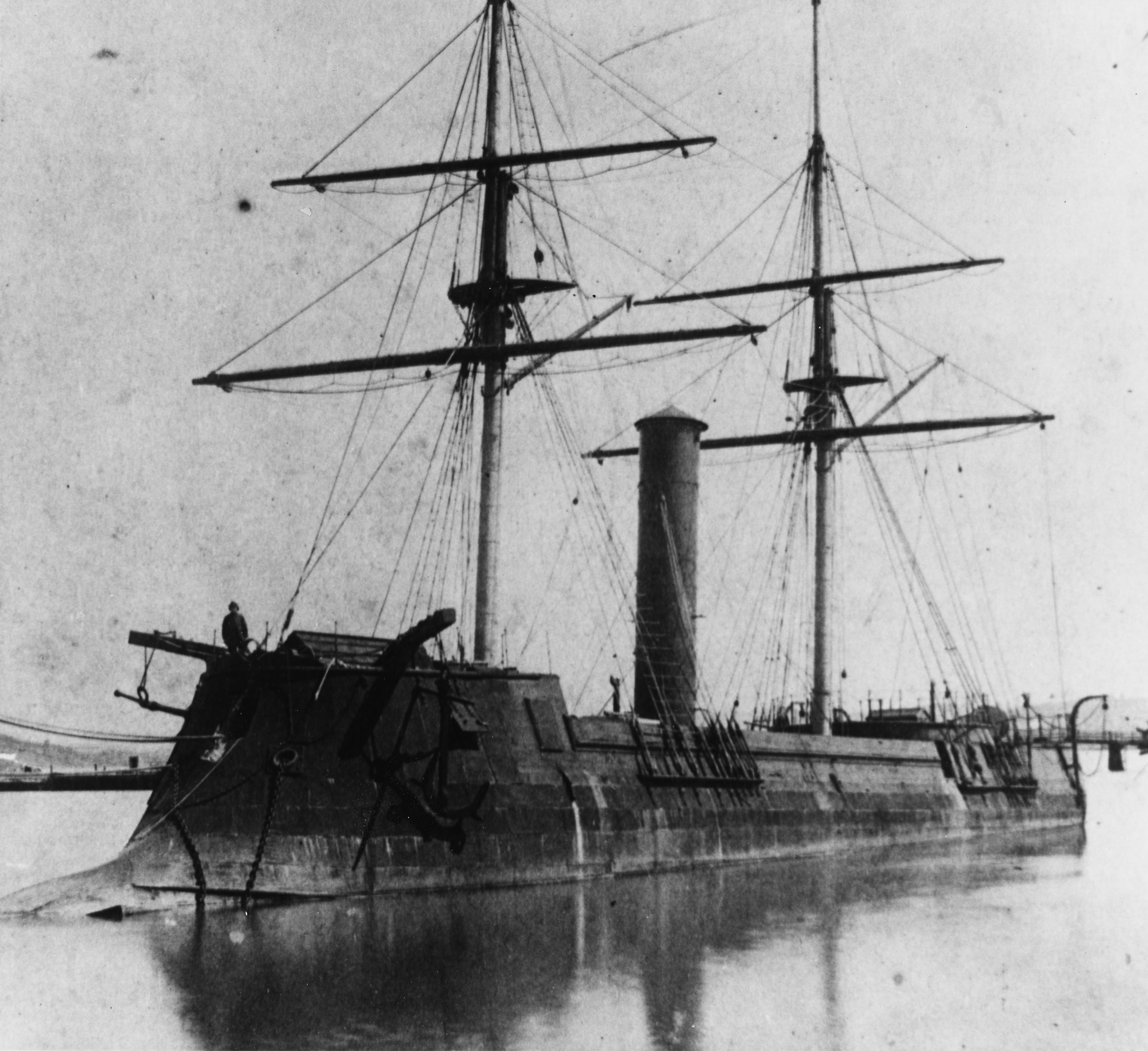
The exciting story of the last Confederate Ironclad, the CSS Manassas that later became the Japanese Imperial Navy's first Ironclad, the Kōtetsu (甲鉄, literally "Ironclad"), renamed Azuma (東, "East").

kotetsu.webp

Photo via Wikipedia (public domain)


Stonewall was turned over to the Spanish government in Cuba, who then turned her to the U.S. The ironclad arrived at the Washington Navy Yard on November 24, 1865. Two years later, seeking to modernize their navy, representatives of the Tokugawa shogunate in Japan purchased Stonewall from the U.S. for $400,000. She was renamed Kōtetsu in Japanese service, which translates to "Ironclad." When the ship arrived in Japan in March 1869, the new Meiji government took possession of Kōtetsu. Sailed by the Imperial Japanese Navy, Kōtetsu was the flagship of a task force dispatched to engage the remnants of the Tokugawa Navy that remained loyal to the shogunate. On March 25, 1869, Kōtetsu repelled a surprise night attack at the Battle of Miyako Bay with her Gatling gun. She also supported the Imperial invasion of Hokkaidō and fought in the Naval Battle of Hakodate Bay.


kotetsu-hakodate.webp


On November 15, 1871, Kōtetsu was reclassified as a third-class warship and renamed Azuma the next month. With her fighting ability assessed as low compared to newer and better-armed ships, she was relegated to naval guard duty. Azuma was struck from the IJN register on January 28, 1888, and sold for scrap on December 12, 1889. In 1895, her armor plating made armature shafts for electric generators in Tokyo's Asakusa Thermal Power Station.


New research sheds light on an architectural mystery, indicating that the famed hall at Byodoin temple looked significantly different when it was initially built in the 11th century. While the top roofs of the Phoenix Hall were covered with weighty tiles as they are currently, lower ceilings were once made of lighter timber in an eclectic mix of architectural styles, officials of the Buddhist temple said on 31 August. The findings were announced to coincide with the 970th anniversary of the building's construction.

a46094cc2480efebb331582df41a4dc5.webp

With its image engraved on the nation's 10-yen coin, the iconic hall was built in 1053 by Fujiwara no Yorimichi, a powerful political figure from the Heian Period (794-1185). The temple complex is a World Heritage site. While experts have long disagreed on what material was originally used for the hall's roofs, recent studies have suggested that the entire roof was initially covered with wooden panels, which were later replaced by tiles during a major renovation in 1101. However, restoration work carried out a decade ago found around 280 clay tiles that had survived from the time the hall was originally built, meaning its top roofs at least were covered with tiles from the beginning. Meanwhile, part of the timber materials now used for the interior of the building appear weathered by rain and wind, suggesting they were initially used to cover roofs. Temple officials believe that, for technical reasons, the low-sloped lower roofs were better served with wooden panels instead of clay tiles.


Byōdōin (平等院) temple in Uji


Byodoin Temple

Byodoin Temple

Byōdō-in (平等院) is a Buddhist temple in the city of Uji in Kyoto Prefecture, Japan. It is jointly a temple of the Jōdo-shū (Pure Land) and Tendai-shū sects.
 
An ancient tomb was discovered under parking lot shrubbery in Ikaruga, Nara, near the World Heritage site of Horyuji temple.

639c2fd2ecd90e935b8d5e9dabc634f4.webp


Archaeologists uncovered numerous artefacts after removing centuries of soil from the stone burial chamber, including two iron swords, arrowheads, items associated with horse riding, amber jewellery and clay pots. The chamber, which is about 3.8 meters long, 1.6 meters wide and 1 meter high, dates to the late sixth century, according to researchers from Nara University and the Ikaruga Municipal Board of Education. The stone ceiling was missing, prompting the team members to speculate the stones were used to build the Horyuji temple, which was completed in the early seventh century.


An area in Kyoto 's Kamigyo Ward believed to be the former site of Toyotomi Hideyoshi 's sumptuous palace and seat of government, the Jurakutei, has been excavated with researchers discovering a place filled with fist-sized stones and tile fragments amongst other relics, believed to have been part of the mansion of Tokugawa Ieyasu .

237A5OEVNZLYHNSIGFEGJRFIFA.webp


Reported by Samurai History & Culture.
 
AI has found its way into archaeological discovery: Japanese researchers reported that a new method to locate ancient burial mounds by exploring 3D terrain maps using artificial intelligence has led to the identification of 34 probable ancient burial mounds in Japan. Most burial mound excavations are associated with development projects, such as public works or private constructions, except for some academic surveys. However, in mountainous regions, where development opportunities are scarce, research is more challenging and many archaeological remains remain unexplored. A method called "digital exploration" was applied by Yuichi Takata, the chief researcher of the Nara National Research Institute for Cultural Properties (Nabunken), and his colleagues in a study in Hyogo Prefecture.


9.webp

Photo credit: Yuichi Takata, Nara National Research Institute for Cultural Properties


The program offered 1,342 places possibly hiding unknown burial mounds. This year, on-site surveys were conducted in the cities of Tatsuno and Toyooka, where the AI showed a concentration of sites with particularly high potential. The team reportedly confirmed 34 new sites, including some with inner stone chambers determined to be burial mounds and others suspected to be ancient tombs due to their raised shape. In another development, a site in Tatsuno until now considered a circular burial mound was determined by AI to have been keyhole-shaped, the type of mound where chiefs are thought to have been buried. The researchers want to move ahead with further AI-based "excavations" of burial mounds and the like in other regions. Takata noted, "This will allow us to find archeological remains more efficiently. If AI can reveal the possibility of many such sites being hidden nearby, it might boost interest in their preservation."

 
Back
Top Bottom