Need a word or phrase translated?

Did I translate those sentences correctly? Please correct it if I translated it wrongly:

"アフレコなんてパパっとこなしてくれればいいから"
About dubbing, it will go well if you can handle it quickly/well.

そんな事より、今後宣伝で番組出演が増えるから、頑張って
Futhermore, from now, by advertising, your appearance in TV show will increase, so do your best

彼女じゃ力不足ってことじゃないの?
I heard that she doesnot have enough skill to do this works, right?"

Those sentences is from a manga, if you need, I can upload the whole page.
Thanks in advance.
 
よくはわからないが, 何かこう, 我々の知っている自然というものが無理にゆがめられているような...

"While I don't know much about it, it's something like, nature as we know it is being distorted by force..."

Is that at all close?

I'm unclear on why の is being used after 我々instead of が. Googling gives me the impression that that 'no' has a limiting effect here and means something like "As per my understanding."
 
Seems like a good translation to me. 我々の知っている自然 is basically the same as 我々が知っている自然 - の sometimes replaces が in modifying clauses.
 
"アフレコなんてパパっとこなしてくれればいいから"
About dubbing, it will go well if you can handle it quickly/well.
~ば in ~ばいい is not conditional. ~ばいい means "It's OK ~" here.

彼女じゃ力不足ってことじゃないの?
I heard that she doesnot have enough skill to do this works, right?"
This is not hearsay.
 
I don't understand the meaning of 度々 in this sentence. If I remember correctly 度々 means "to repeat something, again and again", so how does it works with 近付いてくる?

"Looks like a few years ago a giant lump of rock got on the heliocentric orbit, and it's getting closer to the earth."
何年か前に太陽の周回軌道に乗った巨大な岩塊が度々地球に近付いてくるのだという。
 
The orbital periods of Earth and the rock are different. Think of Earth and Mars. These two planets are getting closer (and going away) repeatedly, right?;)
 
Hey, If possible I would like to ask the meaning of
  • そろそろ我々は物事を終えた方がよさそうです。
Thanks.
 
Have you learned the structures ~方がいい and "adjective + そう"?
 
Further Wikipedia diving.

冒険心を抑えることの出来なかったアドルは周りの人々の制止も聞かずに単身エステリアに乗り込もうとするが、やはり嵐に巻き込まれてしまう……。

Adol, unable to suppress his sense of adventure, (without even asking for restraint? without listening to the objections?) from anyone around is about to embark alone for Esteria but, in any event, is swallowed up by a storm.

周りの人々の制止も聞かずに <- This bit in particular is giving me trouble. 周りの人々の seems to be "everyone in the surrounding area," but what does 制止 mean here? Also what's the 'mo' doing there?
 
周りの人々 just means "people around him" (friends, family). Not necessarily everyone in the area.

Consider it like 人の注意を聞かずに 制止 here is not a physical restraint (although it can be in other contexts), but their attempt to restrain his behaviour - since it's something you can 聞く here it must have been something verbal (e.g. warnings, advice, they ordered him not to). 聞くis listen, not ask, in this case. も could just be emphasis (without even...)
 
Hello! :)
Could you help me decipher this text?

Giga_009.webp

ごめんなさい is pretty obvious, but I only get the kana ending of the second word めです...
 
I have a question about the translation of 「そんなことを考える余裕さえあった。」, I can't understand who exactly is the speaker talking about with it, if I'm guessing correctly, about Ein? "She even had a luxury/composure(?) to think about it."

吾妻玲二「これ一冊があるかないかで、そんなに考え方の筋道が変わるもんなのか?」
アインは無言だった。すべてを拒むように俯いて、膝頭を見つめていた。
吾妻玲二「だがな、こいつにはもう、意味がないんだぜ」
アイン「……え?」
吾妻玲二「君と一緒に逃げるって決めたんだ。だから一人分じゃ、意味がない」
そう言い終えると同時に……吾妻玲二のパスポートを真っ二つに引き裂いて、窓の外に捨てた。
アイン「何を……何てことするの!?」
すっかり慌てて声を荒げるアイン。芝居抜きでは、初めて見る表情だ。
……そんなことを考える余裕さえあった。
アイン「あなた……何をしたか、解ってるの?」
アイン「あれが、あなたの身元の、裏付けだったのに……」
 
How do you understand that 吾妻玲二 is the subject? I thought it is Ein only because he was talking about her in the last sentence.
 
「すっかり慌てて声を荒げるアイン。芝居抜きでは、初めて見る表情だ」 is about Ein, but it's the thoughts of 吾妻玲二 . Presuming only the two of them are there, and nobody's looking in a mirror, 初めて見る表情 is the expression that Ain has, so the one thinking it must be 吾妻玲二. Hence in そんなことを考える, そんなこと refers to the line just previous - not whatever Ein was saying/doing before that.

For another thing, 慌てて and 余裕 (something like composure here) don't go together. They're practically opposites. One person is flustered about the passport getting torn up and tossed out a window. The other is sufficiently composed to sit there thinking about they've never seen the other person look this way before, rather than worrying about the situation.
 
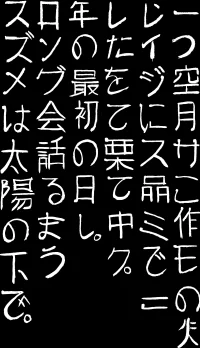
Hello, could you please help me with translation of following text.
IMG_1361.webp
Found this in a local restaurant. I think it can be some japanese saying, but it may be just random letters. I tried to recognize characters and use google for translation, but didn't succeed much :)
Here is image recognition results:
ーっ空月[?]こ作モの[?]
レイジにス[?]ミでこ
レに乞乙栗乙中ク。
年の最初の日し。
ロング会話るまう
スズメは太腸の下で。

Thank you for your help.
 
Hello, could you please help me with translation of following text.
View attachment 17457
Found this in a local restaurant. I think it can be some japanese saying, but it may be just random letters. I tried to recognize characters and use google for translation, but didn't succeed much :)
Here is image recognition results:
ーっ空月[?]こ作モの[?]
レイジにス[?]ミでこ
レに乞乙栗乙中ク。
年の最初の日し。
ロング会話るまう
スズメは太腸の下で。

Thank you for your help.

It is gibberish.
 
Hi,

I'm trying to simply say "Merry Christmas from Germany", but I'm a bit confused since Google spits out two different things depending on whether I use punctuation or not:

ドイツ から クリスマスメリー and ドイツ から メリークリスマス!

is the one saying の correct or the other? Also is 書き込み ムーン ルーン 難しいです a good translation of "writing moon runes is hard!"?
 
I'm trying to simply say "Merry Christmas from Germany", but I'm a bit confused since Google spits out two different things depending on whether I use punctuation or not:

ドイツ から クリスマスメリー and ドイツ から メリークリスマス!

is the one saying の correct or the other?
ドイツからメリークリスマス
or
ドイツよりメリークリスマス
or
メリークリスマス ドイツより

ドイツからのメリークリスマス is not wrong, but this is more likely a noun phrase rather than greetings.

Also is 書き込み ムーン ルーン 難しいです a good translation of "writing moon runes is hard!"?
What do you mean by "moon runes"? "Moon" written in runic alphabet?
 
Back
Top Bottom