

Navigation
Install the app
How to install the app on iOS
Follow along with the video below to see how to install our site as a web app on your home screen.
Note: This feature may not be available in some browsers.
More options
Style variation
System
Light
Dark

You are using an out of date browser. It may not display this or other websites correctly.
You should upgrade or use an alternative browser.
You should upgrade or use an alternative browser.
Need a word or phrase translated?
- Thread starter Buntaro
- Start date

abhishek
先輩
- 22 Apr 2014
- 53
- 1
Can this sentence work:Hey, Can anyone translate "All I know is nothing" in Japanese for me?
Thanks.
"I don't know anything" = "何でも知りません"。

- 22 Feb 2008
- 18,266
- 4,926
Very close, but 窶ーツス窶堙?窶冦窶堙ィ窶堙懌?堋ケ窶堙ア is correct.;-)

- 22 Feb 2008
- 18,266
- 4,926
Seems like 高峰 [Takamine]. That would be the name of the potter, pottery or the location of the pottery.

Elizabeth
先輩
- 22 Apr 2003
- 9,839
- 135
How about something like 進歩するために、毎日を生かして、挑戦しなければならない。Unless this is ultimately for a tattoo of course, Hmmmm...../:Hi, if anyone can spare a minute for me,
How would you say "Everyday must be a challenge to become better"?
Thank you.

I Am A Baka
先輩
- 5 Apr 2012
- 69
- 3
EDIT: My bad, this is supposed to be in the "Need a word or phrase translated?" thread. :sorry: (all good now, thanks nekojita!)
I have a question about this sentence that I heard;
"ママは戻ってきたんだよ。"
ママ in this context meaning mama or mother.
Does 戻ってきた mean "to have come back"? In the context that I heard this though, it didn't really make too much sense. Ultimately, I suppose what I'm asking is can 戻ってきた mean something else? I saw that 戻る can also have the meaning, 'to recover' or 'to rebound', so could it mean anything along the lines of "to have recovered" or something like that (only problem with that is that きた, the past tense of くる is here, so I'm really not sure).
Thanks in advance!
I have a question about this sentence that I heard;
"ママは戻ってきたんだよ。"
ママ in this context meaning mama or mother.
Does 戻ってきた mean "to have come back"? In the context that I heard this though, it didn't really make too much sense. Ultimately, I suppose what I'm asking is can 戻ってきた mean something else? I saw that 戻る can also have the meaning, 'to recover' or 'to rebound', so could it mean anything along the lines of "to have recovered" or something like that (only problem with that is that きた, the past tense of くる is here, so I'm really not sure).
Thanks in advance!
Last edited:

nekojita
先輩
- 14 Jan 2009
- 1,660
- 444
@I Am A Baka : /waves magic wand.
〜てくる is not just for physical movement, but for a change over time, often a steady change (だんだん) rather than a sudden jump between states. As with the physical movement case, it implies movement towards the speaker, thus change from the past up to the present (hence the past tense). Similarly 〜ていく can be used for an ongoing change into the future.
〜てくる is not just for physical movement, but for a change over time, often a steady change (だんだん) rather than a sudden jump between states. As with the physical movement case, it implies movement towards the speaker, thus change from the past up to the present (hence the past tense). Similarly 〜ていく can be used for an ongoing change into the future.
Elizabeth
先輩
- 22 Apr 2003
- 9,839
- 135
What was the context if not a physical return ? You can use it in the sense of economically or psychologically be back in circulation or come back to form as in "Japan is back !" (日本は戻ってきた) but I don't think that is the predominant meaning.EDIT: My bad, this is supposed to be in the "Need a word or phrase translated?" thread. :sorry: (all good now, thanks nekojita!)
I have a question about this sentence that I heard;
"ママは戻ってきたんだよ。"
ママ in this context meaning mama or mother.
Does 戻ってきた mean "to have come back"? In the context that I heard this though, it didn't really make too much sense. Ultimately, I suppose what I'm asking is can 戻ってきた mean something else? I saw that 戻る can also have the meaning, 'to recover' or 'to rebound', so could it mean anything along the lines of "to have recovered" or something like that (only problem with that is that きた, the past tense of くる is here, so I'm really not sure).
Thanks in advance!

- 13 Apr 2012
- 23
- 0
Hello!
I'm having a problem with a fragment of a manga I'm reading. The fragment is a kind of preface to the story which doesn't seem to have much to do with it. I managed to translate it more or less but it's still confusing, as I still have no idea who is even the narrator here. Let me quote the fragment and then I'll ask my question:
傷つけながら砕ける筈の一生を
無器用に 終わり損ねて
自ら傷つき
傷つけた手に復元されて
不具の姿をさらす
そして云ふ
こんどこはすなら 粉みじんに と
ああこの
裂けた肩 ちぎれた腕は
何もでもありませぬ
こころが重すぎて
わたしに 肌の痛みはわかりませぬ
それよりも
あなたのその
かすかに血のにじむ指さきは
その痛みは
その重みは
なまじ見える そして
もう死ねないことが 苦しい
So I'm not really asking for help in translating, but I'd rather like to know what's your general impression of this text – do you think it's a coherent narration, done by one person, does it sound homogeneous to you?
Some of the grammatical forms used here, like: 云ふ, こはす(instead of こわす?), わかりませぬare somewhat obsolete, am I right? So would you say the whole text sounds "old"?
I'd like to mention that in the actual story neither narration, nor dialogue parts use similar forms and generally sound quite informal. The comic book is actually a doujinshi, so this fragment may be as well a reference to one of the characters' backstory or some events from the past, but I can't identify them at this point.
I'm also a bit confused about the usage of pronouns: especially わたし. In the story there is no-one who uses it, all the guys use 俺 and the two women appearing don't have many lines and somehow manage not to use any pronoun at all… ^^'
My question is: does わたしnecessarily suggest a woman character or could it be just a polite form? Also, do you get a "woman vibe" from this text?
I'll be very grateful for any help!
I'm having a problem with a fragment of a manga I'm reading. The fragment is a kind of preface to the story which doesn't seem to have much to do with it. I managed to translate it more or less but it's still confusing, as I still have no idea who is even the narrator here. Let me quote the fragment and then I'll ask my question:
傷つけながら砕ける筈の一生を
無器用に 終わり損ねて
自ら傷つき
傷つけた手に復元されて
不具の姿をさらす
そして云ふ
こんどこはすなら 粉みじんに と
ああこの
裂けた肩 ちぎれた腕は
何もでもありませぬ
こころが重すぎて
わたしに 肌の痛みはわかりませぬ
それよりも
あなたのその
かすかに血のにじむ指さきは
その痛みは
その重みは
なまじ見える そして
もう死ねないことが 苦しい
So I'm not really asking for help in translating, but I'd rather like to know what's your general impression of this text – do you think it's a coherent narration, done by one person, does it sound homogeneous to you?
Some of the grammatical forms used here, like: 云ふ, こはす(instead of こわす?), わかりませぬare somewhat obsolete, am I right? So would you say the whole text sounds "old"?
I'd like to mention that in the actual story neither narration, nor dialogue parts use similar forms and generally sound quite informal. The comic book is actually a doujinshi, so this fragment may be as well a reference to one of the characters' backstory or some events from the past, but I can't identify them at this point.
I'm also a bit confused about the usage of pronouns: especially わたし. In the story there is no-one who uses it, all the guys use 俺 and the two women appearing don't have many lines and somehow manage not to use any pronoun at all… ^^'
My question is: does わたしnecessarily suggest a woman character or could it be just a polite form? Also, do you get a "woman vibe" from this text?
I'll be very grateful for any help!

- 15 Mar 2002
- 16,758
- 2,298
It does sound "old" and from the 死ねない I get the mores soon this is some character who for some reason physically can not be killed. Perhaps addressing the reader in his "natural" (old) speech but interacting with other characters in the speech of their own era. Is there a character like that?
It isn't particularly hard to avoid using pronouns in Japanese. I practically never use second or third person pronouns, and avoiding even first person isn't uncommon.
It isn't particularly hard to avoid using pronouns in Japanese. I practically never use second or third person pronouns, and avoiding even first person isn't uncommon.

- 17 Sep 2005
- 6,017
- 1,970
I personally don't get a woman vibe from this text. Sounds like a vampire or some other sort of undead lamenting his (or her) unending "life" of pain. The archaic use of words gives me a feeling that this guy has been around for a long time, as one might expect with the undead.
- 15 Mar 2002
- 16,758
- 2,298
Depending on the situation, 私 is used by everybody in Japan at some point.
I work with a bunch of truck drivers and the default is 俺 and plain form, but when the situation calls for it they shift to 私 and 敬語
Japanese pronoun choice isn't a matter of what the speaker thinks of himself or the other person (as many beginning learners seem to think) so much as it is a matter of the situation/circumstances. The undead dude is making a speech here (to the readers), so 私 is just a sign of cultivated speech appropriate to the situation and no reflection on his gender or manliness.
I work with a bunch of truck drivers and the default is 俺 and plain form, but when the situation calls for it they shift to 私 and 敬語
Japanese pronoun choice isn't a matter of what the speaker thinks of himself or the other person (as many beginning learners seem to think) so much as it is a matter of the situation/circumstances. The undead dude is making a speech here (to the readers), so 私 is just a sign of cultivated speech appropriate to the situation and no reflection on his gender or manliness.
- 22 Feb 2008
- 18,266
- 4,926
All yes.do you think it's a coherent narration, done by one person, does it sound homogeneous to you?
Grammatically, it's more likely "written language" rather than "old/classical Japanese". That's written in modern Japanese except those few examples of the historical kana orthography.Some of the grammatical forms used here, like: 云ふ, こはす(instead of こわす?), わかりませぬare somewhat obsolete, am I right? So would you say the whole text sounds "old"?
Last edited:

DWolfs
先輩
- 21 Jan 2013
- 78
- 0
Hi again!
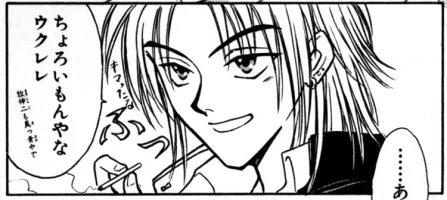
The main character in this manga is playing ukulele and convinced of his own genius, he says the following: 牧伸二も真っ青やで
He's talking about Shinji Maki, who was a Japanese comedian playing the ukulele, but I'm not sure what 真っ青 refers to. Could it possible mean something like: "Maki Shinji won't know what hit him"?
The main character in this manga is playing ukulele and convinced of his own genius, he says the following: 牧伸二も真っ青やで
He's talking about Shinji Maki, who was a Japanese comedian playing the ukulele, but I'm not sure what 真っ青 refers to. Could it possible mean something like: "Maki Shinji won't know what hit him"?
- 22 Feb 2008
- 18,266
- 4,926
(An expert)も真っ青だ is a set phrase to express the one the speaker refers to is very good at doing something. I.e., he is saying that he can play the ukulele so superbly as to make Maki Shinji turn pale with his skill.
This expression can be used also for negative meaning "to be worse than ~" (e.g. 彼らが犯した犯罪には悪魔も真っ青だ).
This expression can be used also for negative meaning "to be worse than ~" (e.g. 彼らが犯した犯罪には悪魔も真っ青だ).
letianchen
先輩
- 17 Jun 2013
- 560
- 25
Whats the commonly used word for self defence? I have always been familiar with the word 自衛, but today in a drama I heard 正当防衛, is the latter more common?
- 15 Mar 2002
- 16,758
- 2,298
Whats the commonly used word for self defence? I have always been familiar with the word 自衛, but today in a drama I heard 正当防衛, is the latter more common?
That's justified use of violent means in self-defense.
防衛
letianchen
先輩
- 17 Jun 2013
- 560
- 25
Thanks, is 自衛 ever used?
- 15 Mar 2002
- 16,758
- 2,298
Thanks, is 自衛 ever used?
I've only ever heard it in terms of national defense.
Hi! I'm having trouble with the following sentence:
さあ...
またせっと
The context is a girl is hurriedly sliding down her underpants in preparation of using the bathroom.
I'm certain that さあ... = Hurry up..., but I'm not entirely sure about the second part. また could be 'thighs' and せっと means 'to set,' so is it saying something like "set (put) them on my thighs"? Any and all help is appreciated. Thanks!
さあ...
またせっと
The context is a girl is hurriedly sliding down her underpants in preparation of using the bathroom.
I'm certain that さあ... = Hurry up..., but I'm not entirely sure about the second part. また could be 'thighs' and せっと means 'to set,' so is it saying something like "set (put) them on my thighs"? Any and all help is appreciated. Thanks!
- 22 Feb 2008
- 18,266
- 4,926
Isn't there a typo, for instance おまたせっと?Hi! I'm having trouble with the following sentence:
さあ...
またせっと
The context is a girl is hurriedly sliding down her underpants in preparation of using the bathroom.
I'm certain that さあ... = Hurry up..., but I'm not entirely sure about the second part. また could be 'thighs' and せっと means 'to set,' so is it saying something like "set (put) them on my thighs"? Any and all help is appreciated. Thanks!
Isn't there a typo, for instance おまたせっと?
Whoops, my bad! Yeah, it's supposed to be おまたせっと. I had removed the お because I was thinking it might just be there for politeness, lol.
- 15 Mar 2002
- 16,758
- 2,298
Whoops, my bad! Yeah, it's supposed to be おまたせっと. I had removed the お because I was thinking it might just be there for politeness, lol.
It is....kinda.
Have you learned the polite expression お待たせ致しましました yet?
No, I haven't. I looked it up and found that it means "I'm sorry to have kept you waiting." お待た(せ) is a short version of it.It is....kinda.
Have you learned the polite expression お待たせ致しましました yet?
I'm not sure how that helps me though because I'm certain that the girl is talking to herself and that someone else isn't talking to her. I'm not really good when it comes to Japanese slang. What I think would work best is something like "I can't wait anymore." Is this close?
Similar threads


- Replies
- 11
- Views
- 115K