Need a word or phrase translated?

Another one, seems like every other page I need something translated from this manga. >_>';
apaato_sutoreeto.webp

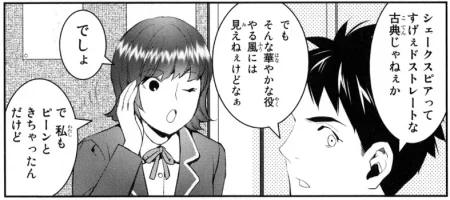
Context is that they're talking about the new teacher being a weirdo, and having done drama in his college days.

I know ド is an intensifier, but I'm not sure what he means with ストレートな古典 (a straightforward classic sounds a bit off I think?).

And I have no clue about ピーンときちゃった.

Thanks in advance.
 
Sort of, Shakespeare is not just 古典 but kind of orthodox 古典. It's the straight-and-narrow of 古典. Don't know how to translate it well, but that sort of feeling.

ピーンときちゃった is from ピンとくる.
 
Hi, I got 1 question.

I saw this example sentence given in 大辞林 for にやにや - 「何がうれしいのか―している」.
I was wondering if "何がうれしいのか" is an embedded question, e.g. 「何がうれしいのか分からない」? Found a similar example 「何が嬉しいのか、(someone)は笑っていた。」Also, could 何が嬉しいのか in both cases be interpreted as lit. "what is (thing) that's happy/pleasant, is grinning" or "what is (thing) that the subject of the にやにやしている/笑っていた is happy/glad about, was laughing"?

I guess it's a bit odd to me since I haven't seen a whole lot of embedded questions that don't have verbs like 分かる、聞く, 考える etc. after it.

At first I thought it was "数詞につけて概数を表す" usage, because I kind of see the "何が嬉しいのか" as the speaker/writer's "wondering what" while "にやにやしている" is someone else's action. However, I don't think it can be used with wh-question like 何 (e.g. よほど怖かったのか真っ青な顔をしていた).

Thank you in advance.
Yes, that's an embedded question the verb 分からない or 知らない is considered to be omitted from, as you interpreted correctly.

何が嬉しいのか(分からないが / 知らないが)、彼は笑っていた。
I don't know what he was happy about, but he was laughing.
 
this phase : 許しておかん。
like あの人にたてつくやつは許しておかん!
hmm 許して~許す, おかん might be 悪寒 here. What's the combined meaning of last two words?
 
It seems like Kansai dialect. Unlike Standard Japanese, ~ておく doesn't have a meaning "to do something previously for a purpose" in Kansai dialect. It's just saying 許さない.
 
It seems like Kansai dialect. Unlike Standard Japanese, ~ておく doesn't have a meaning "to do something previously for a purpose" in Kansai dialect. It's just saying 許さない.

覚えておく!
 
Good afternoon folks,

I'd like to get a small confirmation regarding this phrase:

既に政府の名でも出頭命令を出しています。

出頭命令 is the same as a subpoena, yes? In that case, is the speaker, a government official, saying that he's used his position to issue the subpoena?

Thanks for the input.
 
I don't know the background of the story, but that sentence means "the summons is issued also by the government".
 
Hi, I'm having trouble with the meaning of しょうちゅう here. Does it have to do with the fact that she's drinking shochu (even though it looks more like beer)? Can't give much more context, sorry. In the scanlations it was translated as "often", but I'm not sure if that's correct.

May be a bit nsfw!

skimpy.webp
 
Hi, I'm having trouble with the meaning of しょうちゅう here. Does it have to do with the fact that she's drinking shochu (even though it looks more like beer)? Can't give much more context, sorry. In the scanlations it was translated as "often", but I'm not sure if that's correct.

That's しょっちゅう (shocchuu) which, indeed, means always/constantly/often

しょっちゅう薄着で現れる。 = She always shows up lightly dressed.

しょうちゅう, as you wrote, is shouchuu (which is japanese liqour and some other things).
 
Last edited:
Man, what a beginner's mistake! How tired must I have been, huh >_>'; Thank you for the reply, Brunom1!
 
I'm trying to figure out the summary of a light novel, but with the lack of context, there's one part I cannot figure out:

小さな先輩。
身体が小さくてオッパイも小さい先輩。
時と場所をわきまえて、体裁も気にして、お約束も守る小さな先輩。
いつも強がっているけれど、たまに弱いところも見せる小さな先輩。
高校を卒業する先輩へのプレゼントとして、僕は一泊二日の小旅行を計画する。
欲しいものは大抵見つかる。
多すぎて逆に見つからない。
現実とはかけ離れている。
東京、秋葉原。
僕と先輩はそこに足を踏み入れる。
そこで出会うのは、フリフリのエプロンに身を包んだネコ耳メイド、ネコミさんだった。
僕と先輩はネコミさんに誘われてアキバの奥深くへと導かれる。
そこにあるのは古風でお洒落なアキバのメイドカフェ。
ネコミさんはそこで、僕と先輩に一つのゲームを提案する。
「ご主人様の探し物を見つけ出してきて欲しいにゃん」
僕と先輩は有象無象の溢れるアキバで、自らの探し物を見つけに行くが……。


The part I have trouble with is this one:

欲しいものは大抵見つかる。
多すぎて逆に見つからない。
現実とはかけ離れている。

I (or is this about Senpai?) usually find what I want.
But if there is too much, I can't find them.
It is quite different from reality.

This is what I guess it means, but it seems so out of place.
 
Need a few sentences translated into Japanese if anyone can help:

"I'm not in a rush to get the image, so whenever you are ready is fine. I just wanted to make sure you understood the situation. I have left my information for you in case you would still like to do a wire transfer."
 
@DWolfs

Those are not referring to her or him, but descriptions of the place where he's planning to take her:
欲しいものは大抵見つかる。
多すぎて逆に見つからない。
現実とはかけ離れている。
東京、秋葉原。

Mentally add "A place (where)..." in front of each and it should make sense.
 
My interpretation is that the first three lines are descriptions of Akihabara; a place where..., where..., where..., thus, Akihabara, Tokyo.

欲しいものは大抵見つかる場所、
多すぎて逆に見つからない場所、
現実とはかけ離れている場所、
つまり東京、秋葉原。
 
僕は素直にそれに着いてゆこうと足を踏み出す。

The それに着いてゆこう in here totally confuses me. :s I get the feeling it's supposed to be 付いて行く?
 
僕は素直にそれに着いてゆこうと足を踏み出す。

The それに着いてゆこう in here totally confuses me. :s I get the feeling it's supposed to be 付いて行く?

Could be. What's the context?

行く can be read as both いく and ゆく.

ゆこう and いこう are equivalent.
 
Back
Top Bottom