Need a word or phrase translated?

4shared playlist - Minna chuukyuu II

I need help with 1-12.

at 0:14 what do the instructions say? I can't pick up the last word which is depressing. is it 注意してください?

0:26 - was it 新宿の本屋?

around 0:48 - 安定 something, what was said? しょこば or something of the sort


at 1:28, what is said after benkyou? something mo.
 
注意して聞いてください

Yes for 新宿の本屋

安定した職場

勉強し直す
 
merci, also here is another thing im having trouble with
pic.webp
the quotations after hirogoro. Would it be alright to translate that as
"The thief has been hunted down. Without any money they cannot leave the country"

its a bit confusing since i thought the subject of お金がなく is the person who got scammed, but it im not sure if it is directed towards the robber.
 
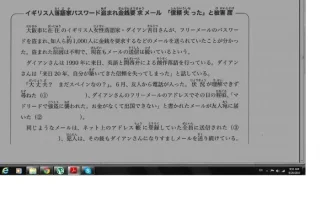
強盗襲われた means "attacked by a mugger" (suffering passive + に), and the full sentence is basically saying "I was mugged in Madrid. I have no money and can't get home."

This is about those scam emails where someone steals a password, logs into someone else's webmail and sends a fake "help me" email to everyone in the address book. In this case it was sent from ダイヤんさん's mail to the friend (友人宛), by the unknown scammer (犯人). The thief/mugger ("強盗") is made up.
 
That's right.


いい加減にせんか = いい加減にしないか = いい加減にしろ

~ないか is for a strong order here, as similar to this case (negative + negative = affirmative).
That is interesting about って~-の I was just thinking of いい加減にしろよ、 いい加減にせんかよ、。。。してくれよ to emphasize the command or add a tone of criticism. 本当に怒っているひとですね。So「かげんにせんかいっ」is what to yell at yourself in a fit of rage which means it need not be demeaning as such, just intended as an insult when you don't get along with someone which usually implies you don't like his/her words or actions. And it any event originally the message behind いい加減 was a literal one, it used to have a positive connotation of "good" or "enough" which still gets me hugely turned around with the whole phrase. :)
 
Hi guys! Can anybody help me translate it this in Japanese? ''I will be very glad to help you learn Greek (language) and I will also be very glad if you assist me with my Japanese.''
Me and her just met, so politely will be the best. Thank you.
my attempt

ギリシャ語の勉強の手助けができたらうれしいし、ついでに僕の日本語の勉強も手伝ってもらえるとすごく助かります。
Girishago no benkyō no tedasuke ga dekitara ureshii shi, tsuide ni boku no nihongo no benkyō mo tetsudatte moraeru to sugoku tasukarimasu.
 
thanks elizabeth
酒くさ, could the kusa, be a short form of kusai? I heard this in an anime

edit:

might as well add another question, heard this from an anime as well

俺には 家畜でも平気でいられる人間のほうが
よっぽどマヌケに見えるね
Im not sure how to translate this/ interpret it.

The context is a boy wants to do something but his mother is opposed to it, someone gives him hope that he can become such and he becomes happy but his mom says its a bad idea again, the boy proceeded to say the two lines above.
 
Last edited:
Yes for the former question.

What part don't you get in that phrase?
 
He is speaking to his mom in that scene.

So is he trying to say his mom sees him as a big idiot? ( Because he wants to do something his mom is opposed to)?
 
The core of the sentence is 人間のほうが(subject)マヌケに(complement)見える(verb) (or 俺には(actual subject)人間のほうが(object)マヌケに(objective complement)見える(verb)).
 
Last edited:
それゆえ、首謀者探しも、グレプ国内で勝手になすりつけ合ってくれることだろう。
勝手に means "already determined" in this case, right?
I'm not seeing the purpose of 合って in the sentence. Could it possibly be to limit 探し to only グレプ国内で?

Also, a question about the email response for Yaranaika. ついでに僕の日本語の勉強も手伝ってもらえるとすごく助か ります.
Is it possible to replace すごく助か ります.with 喜んでくれます? I never see ~てくる used when referring to oneself, so I was curious.

Thanks.
 
The core of the sentence is 俺には(actual subject)人間が(object)マヌケに(objective complement)見える(predicative).

I see, what do you think about the translation. "To me humanity living as livestock so calmly is even more stupid!"
 
それゆえ、首謀者探しも、グレプ国内で勝手になすりつけ合ってくれることだろう。
勝手に means "already determined" in this case, right?
I'm not seeing the purpose of 合って in the sentence. Could it possibly be to limit 探し to only グレプ国内で?
勝手に means "by themselves / without being forced by others" there.
The sentence says that they will put suspicion (of who the mastermind is) on each other in the country.

Also, a question about the email response for Yaranaika. ついでに僕の日本語の勉強も手伝ってもらえるとすごく助か ります.
Is it possible to replace すごく助か ります.with 喜んでくれます? I never see ~てくる used when referring to oneself, so I was curious.
~てくれる can't be used when the speaker is the doer(= the person who is glad), except an insulting usage, similar to ~てやる (e.g. 返り討ちにしてくれるわ = 返り討ちにしてやるわ).


I see, what do you think about the translation. "To me humanity living as livestock so calmly is even more stupid!"
👍
 
Would this translation be correct?
しがみついていた重力からの自由裏の裏に潜む盲点に気付いただけさ
It's only because I realized the blind spot of the gravity-bound freedom is hidden at the bottom of the bottom.

Also for this; 信じて心奪われよう
Can someone explain to me the usage of 奪われよう?
奪う = to snatch away
奪われる = to snatch by... (passive form according to my understanding)
奪われよう the よう addition is confusing to me.
 
Would this translation be correct?
しがみついていた重力からの自由裏の裏に潜む盲点に気 付いただけさ
It's only because I realized the blind spot of the gravity-bound freedom is hidden at the bottom of the bottom.

I'm translating it as "I only realized the deeply concealed blindspot of gravity-bound freedom,(ya' know?)"

Also for this; 信じて心奪われよう
Can someone explain to me the usage of 奪われよう?
奪う = to snatch away
奪われる = to snatch by... (passive form according to my understanding)
奪われよう the よう addition is confusing to me.
If i've been paying proper attention to what Toritoribe has been posting, then よう is most likely the classical auxiliary presumptive form of "でしょう"
奪われよう = 奪われるでしょう
 
Would this translation be correct?
しがみついていた重力からの自由裏の裏に潜む盲点に気付いただけさ
It's only because I realized the blindspot of the gravity-bound freedom is hidden at the bottom of the bottom.

Also for this; 信じて心奪われよう
Can someone explain to me the usage of 奪われよう?
奪う = to snatch away
奪われる = to snatch by... (passive form according to my understanding)
奪われよう the よう addition is confusing to me.
L'Arc~en~Ciel/歌詞:birth!/うたまっぷ歌詞無料検索

You should give us the whole lyrics. Japanese is a context-driven language. The meanings differ depending on the context.

The former one is not a single sentence, but a single phrase + a single sentence.

~よう means "let's", "let yourself do / allow yourself to do" here.
 
Oh, I was hesitant to post the whole lyrics because I thought it was the rule to not post lyrics here. So I only took out the parts where I understood and asked the parts that I didn't understand. So, the phrase translates to: Let's be snatched by the heart that we trust.
 
You can post the link to the lyrics, as I did.

The former one refers to しがみついていた重力からの自由裏の裏に潜む盲点に気付いただけさ in my previous post.

心 is not the object of 信じて. (~に)心(を)奪われる is an idiom, meaning "to engross oneself in~ / to be obsessed by~".
 
Hi everyone!
Is it possible for someone to translate this company name below? any help is appreciated!
ec76733a46454752a2e16d3836052fc8-1.webp
 
Hi everyone!
Is it possible for someone to translate this company name below? any help is appreciated!
ec76733a46454752a2e16d3836052fc8-1.webp

The company name is トウショク (toushoku), it's the small logo in green at the bottom.
There are too many companies handling food under this name, hard to tell which one without other information.
 
しかし、人々の生活に深く関っている暦であるにもかかわらず、政府は十分な準備期間もおかず、明治5年12月に突然改暦を実施した。

What does okazu mean here, doesent seem to mean "side dish"..
 
~ず negative form of おく (you should be able to spot it's a verb, not a noun, from the surrounding grammar)
 
The context is a man is talking about someone else who pretends to know everything, but actually knows nothing.
言えばいいのです、思ったことすべて。

I can't quite figure out this sentence. Are these two independent clauses? Or is it trying to say "He always thinks he can say anything."?
 
Back
Top Bottom