Need a word or phrase translated?

Thank you for your help, Toritoribe!
But i didn't actually want another interpretation of the lyrics but an explanation of the words "omoidoori", "nozomidoori" and "omitooshi" i just gave you the rest of the lyrics to make it easier for you. I found out and admittedly feel a bit stupid that in "omitooshi" the "o" is acutally not a part of the word. So now i understand at least "mitooshi". But i just don't get the words "omidoori" (the "o" is part of the word right?) and"nozomidoori". I can't find those exact words anywhere only parts of it. Please explain only those words^^. I hope you understand my Problem.
As for the "butta" or "buru", is it acutally a suffix to the word "butterfly" and now a "part" of it?
The thing that confused me was that when i used a onlinetranslator (because i couldn't and still can not find it in my dictionary at home which has about 22000 words) it just translated it to "hump" :D
And just for the record: i started learning japanese about 3 months ago, so even if it's too complicated for me, please try explaining it to me. :)
Thank you! :p
 
Most of Japanese including me don't know the reason.
Basically we use「う」for this kind of pronunciation, but we use「お」for some exceptional words.
I've heard young pupils used to use the following sentence to remember such exceptional words.
「遠くの大きな氷の上を、多くの狼、十ずつ通った」
「とおくの おおきな こおりの うえを、おおくの おおかみ とおずつ とおった」
現代仮名遣い

第1 語を書き表すのに,現代語の音韻に従って,次の仮名を用いる。
5 長音
(5) オ列の長音
オ列の仮名に「う」を添える。
例 おとうさん とうだい(灯台)
わこうど(若人) おうむ
かおう(買) あそぼう(遊) おはよう(早)
おうぎ(扇) ほうる(抛) とう(塔)
よいでしょう はっぴょう(発表)
きょう(今日) ちょうちょう(蝶々)

第2 特定の語については,表記の慣習を尊重して,次のように書く。
6 次のような語は,オ列の仮名に「お」を添えて書く。
例 おおかみ おおせ(仰) おおやけ(公) こおり(氷 ・郡) こおろぎ
ほお(頬・朴) ほおずき ほのお(炎) とお(十)
いきどおる(憤) おおう(覆) こおる(凍) しおおせる とおる(通) とどこおる(滞) もよおす(催)
いとおしい おおい(多) おおきい(大) とおい(遠) おおむね おおよそ

これらは,歴史的仮名遣いでオ列の仮名に「ほ」又は「を」が続くものであって,オ列の長音として発音されるか,オ・オ,コ・オのように発音されるかにかかわらず,オ列の仮名に「お」を添えて書くものである。


quoted from 文化庁 | 国語施策・日本語教育 | 国語施策情報 | 内閣告示・内閣訓令 | 現代仮名遣い


I don't know if I'm in the minority or not, but I learned this in a Classical Japanese class(古文) in high school.
 
なるほど。ちゃんと理由があるんだ。知らなかった~。(勉強してなかっただけ?)
 
Thank you for your help, Toritoribe!
But i didn't actually want another interpretation of the lyrics but an explanation of the words "omoidoori", "nozomidoori" and "omitooshi" i just gave you the rest of the lyrics to make it easier for you. I found out and admittedly feel a bit stupid that in "omitooshi" the "o" is acutally not a part of the word. So now i understand at least "mitooshi". But i just don't get the words "omidoori" (the "o" is part of the word right?) and"nozomidoori". I can't find those exact words anywhere only parts of it. Please explain only those words^^. I hope you understand my Problem.
As for the "butta" or "buru", is it acutally a suffix to the word "butterfly" and now a "part" of it?
The thing that confused me was that when i used a onlinetranslator (because i couldn't and still can not find it in my dictionary at home which has about 22000 words) it just translated it to "hump" :D
And just for the record: i started learning japanese about 3 months ago, so even if it's too complicated for me, please try explaining it to me. :)
Thank you! :p
通り(Doori/Dōri) is also a suffix, meaning something like "the state is just as the preceding noun". Thus, 思い通り and 望み通り roughly means (the thing goes) "just as my thought" and "just as my wish", respectively.

通り
通り - 和英辞書 - goo辞書

思い通り
思い通り - 和英辞書 - goo辞書

お in お見通し is indeed a polite prefix, but お見通し and 見通し have different meanings and are used in different context.

Butterflyぶった is a rather uncommon word. It's usually expressed as 蝶の振りをした.
 
In the phrase:
声をかけてくれたね
what does かけてくれた mean? and where does it exactly come from? I couldnt find it in dictionary. Does it have any kanji form?
 
通り(Doori/Dōri) is also a suffix, meaning something like "the state is just as the preceding noun". Thus, 思い通り and 望み通り roughly means (the thing goes) "just as my thought" and "just as my wish", respectively.

Thank you very much, Toritoribe!

This helped me a lot 🙂:
 
In the phrase:
声をかけてくれたね
what does かけてくれた mean? and where does it exactly come from? I couldnt find it in dictionary. Does it have any kanji form?

It's two words/verbs. かけて from かける and くれた from くれる (there are kanji but they're not usually used, especially not for くれる). For an explanation of the grammar see Giving and Receiving | Learn Japanese
 
Both of 「しっとりとした」 and 「不思議な」 are adjective of 「感触」, I think.
So something like "dewy and mysterious feeling".
Thanks!
But what about the first line in this?

驚くほど薄く
しっとりした
不思議な感触…

Was I right in assuming it means something like "it's surprisingly thin"? I'm confused by this line, because 薄く is in adverb form here. So, together with the 2nd line, could it rather mean "Surprisingly, it is a slightly moist [feeling]"?
 
Not adverbial but continuous usage, as same as 薄くて.

It's stunningly thin and...
 
Not adverbial but continuous usage, as same as 薄くて.

It's stunningly thin and...
Ah, thank you. :)
That idea also crossed my mind. But then why is it "薄く" and not "薄くて". Is that acceptable grammar, or colloquial or something else?
 
Here's something I don't understand. Especially the word つきあいかた.

ヨーロッパ圏内のエコノミー機内ベストワインの受賞ワインが発表されたそうです。日本またアジア圏内でもお茶バージョンがあれば面白いですね。そうすることでお茶への感心、つきあいかたも意識されるきっかけになりますよね。航空、鉄道、船、関係者いらっしゃいましたら是非!!
 
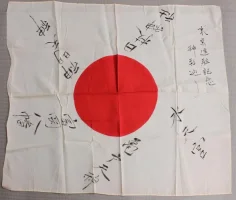
Japanese WWII Flag Translation Requested?

This is a WWII era flag from Japan. These were often signed by family members and given as good luck pieces for soldiers to carry with them. Other flags were signed by members of the same Japanese military unit and carried into battle. The flag is roughly 27 1/4" X 23 1/4" with two opposing sides having a small sewn hem.

j1.webp
 
Do you not know つきあい or the verb suffix かた? Given your advanced level I find that surprising.
 
Do you not know つきあい or the verb suffix かた? Given your advanced level I find that surprising.

I'm more uneven than advanced to be honest. Anyway, my first impression was this would be something "the way people get along with/use/come into contact with tea" etc but I'm not really sure if 付き合う can be translated with this meaning, and since it was written in hiragana I wasn't even sure it was this verb even though it seemed close at hand.
 
Ah, thank you. :)
That idea also crossed my mind. But then why is it "薄く" and not "薄くて". Is that acceptable grammar, or colloquial or something else?
It's quite common to use the -ku form of an i-adjective or the -masu stem of a verb for continuous usage. These forms sound more formal/written-language-like than the -te form.


Here's something I don't understand. Especially the word つきあいかた.

ヨーロッパ圏内のエコノミー機内ベストワインの受賞ワインが発表されたそうです。日本またアジア圏内でもお茶バージョンがあれば面白いですね。そうすることでお茶への感心、つきあいかたも意識されるきっかけになりますよね。航空、鉄道、船、関係者いらっしゃいましたら是非!!
付き合い方
how to treat tea (not physically, but more like when to drink, how to enjoy it in daily life or like that.)

EDIT:
You are no doubt in advanced level. :) "Use" is a good translation, I think.
 
Thank you very much, Toritoribe!
I got another short one:

上手いなおい!

A guy says this to another, apparently surprised at how good the other guy dances.
I think it means, "You're pretty good, oi!", but I wouldn't know.
I don't really get the なおい part. Is it just the explanation-expecting gobi な together with the interjection おい?
 
This is a WWII era flag from Japan. These were often signed by family members and given as good luck pieces for soldiers to carry with them. Other flags were signed by members of the same Japanese military unit and carried into battle. The flag is roughly 27 1/4" X 23 1/4" with two opposing sides having a small sewn hem.
The soldier visited some shrines in commemoration of being stationed in Tokyo. The names of the shrines he visited are written on the flag.

日枝神社 Hie Jinja
Hie Shrine

Hie Shrine | Japan Forum

水天宮 Suitengū
(I can't past the URL of this wiki page, probably due to a bug in this forum. Please search "Suiten-gū (Tokyo)" on wikipedia.)

亀戸天神 Kameido Tenjin
亀戸天神社 - Wikipedia (all in Japanese)

富岡八幡 Tomioka Hachiman
Tomioka Hachiman Shrine

神明天神 Shinmei Tenjin
(I can't figure out what shrine this name refers to.)


Thank you very much, Toritoribe!
I got another short one:

上手いなおい!

A guy says this to another, apparently surprised at how good the other guy dances.
I think it means, "You're pretty good, oi!", but I wouldn't know.
I don't really get the なおい part. Is it just the explanation-expecting gobi な together with the interjection おい?
Yeah, that's just 上手いな。おい!
 
Thanks so much for the information!

ツ神窶督セ窶弖ツ神 Shinmei Tenjin:

I see that this article from Wikipedia states that: "In Japanese mythology and folklore, Tenjin (窶弖ツ神?) is the Shinto kami of scholarship..."

"The main shrines to this kami are Kitano Tenman-gū in Kyoto and Dazaifu Tenman-gū in Fukuoka Prefecture, and the top three are rounded out by Egara Tenjin Shrine in Kamakura, but there are many other shrines dedicated to him across Japan. These shrines are called Tenman-gū (窶弖窶毒セ窶ケ{?)."

So perhaps the flag is referring to one of these many lesser known unnamed shrines to Tenjin as the closest one of the main shrines (Egara Tenjin Shrine) is 31 miles away from Tokyo.

Tenjin (kami)
 
Thanks again!

How would you call this in English?

記憶撮影

Commemoration photo? Memento photo? Souvenir picture? :?
In German, I'd call it "Foto zur Erinnerung" (photo for memory).
 
Thanks so much for the information!
神明天神 Shinmei Tenjin:
I see that this article from Wikipedia states that: "In Japanese mythology and folklore, Tenjin (天神?) is the Shinto kami of scholarship..."
"The main shrines to this kami are Kitano Tenman-gū in Kyoto and Dazaifu Tenman-gū in Fukuoka Prefecture, and the top three are rounded out by Egara Tenjin Shrine in Kamakura, but there are many other shrines dedicated to him across Japan. These shrines are called Tenman-gū (天満宮?)."
So perhaps the flag is referring to one of these many lesser known unnamed shrines to Tenjin as the closest one of the main shrines (Egara Tenjin Shrine) is 31 miles away from Tokyo.
Tenjin (kami)
He visited those shrines in commemoration of Tokyo and the rest four shrines are major, famous ones, so I don't think 神明天神 is a small, minor one. Here's shrines in Tokyo Metropolis.

東京都の神社一覧 (all in Japanese)

I think 芝大神宮 Shiba Dai-Jingū could be the one.

芝大神宮 (all in Japanese)


Thanks again!

How would you call this in English?

記憶撮影

Commemoration photo? Memento photo? Souvenir picture? :emoji_thinking:
In German, I'd call it "Foto zur Erinnerung" (photo for memory).
I don't know the context the word is used in exactly, but it seems like "shooting of memories" to me.
 
I don't know the context the word is used in exactly, but it seems like "shooting of memories" to me.
Ah, sorry. I wasn't fully paying attention when I posted this.
A couple mentions this while they're out on their first date and take a photo in memory of their date.
So I'm assuming 記憶撮影 refers to taking a photo that you'd probably frame or pin to your wall later and can reminisce about.
 
Did they only say 記憶撮影 in the scene? Were there any words preceding or following it?
 
I'm so sorry! :( I misread the Kanji! It was actually 記念撮影.

The guy says this, before taking several pictures:

せっかくだから
記念撮影といこうか
 
Ah, then that's a common word, meaning "taking a commemorative photo/photo for memory", as you interpreted correctly. (Incidentally, "commemorative photo/photo for memory" is 記念写真.)
 
Back
Top Bottom