Need a word or phrase translated?

Great, Thanks Mike.

One more, what's the difference between -San, -Chan, and -Kun ?

Setsumei shinikui desu.

Seriously, though, that's outside the scope of this thread.
 
Sorry for the mistake guys, I didn't really pay attention to the title of the thread. It's just like, you know, a kid brought to a toy store, and he just wants to know and gasping every toy he sees.
 
@Mike Cash,

I was wondering if you ever saw my reply to your post? On page 423, at the top of the page, I responded to your questions regarding the use of the saying
"Fair wind and following seas." You mentioned you might have the answer I am looking for but, I haven't seen another reply from you.

Thanks for your time.

Respectfully,
ET3 Wagner
 
Slipped my mind. I don't have the answer or the slightest idea if there even exists a Japanese equivalent.
 
New sentence to translate! hard?

Hi everybody!

My friend asked me to translate this sentence:

"I live as I believe to become what I want (to be)"

I don't know if the meaning of this sentence is clear but I think my friend means something like:

"I live the way I want to become who I wish to be" or "I live as I like to become who I want (to be)."


Could you give me a hand please?

PS Feel free to ask me anything!
 
If your friend asked you to translate it then you must have some Japanese ability. What is your best effort at it?
 
@Mike Cash,
I was wondering if you ever saw my reply to your post? On page 423, at the top of the page, I responded to your questions regarding the use of the saying
"Fair wind and following seas." You mentioned you might have the answer I am looking for but, I haven't seen another reply from you.
Thanks for your time.
Respectfully,
ET3 Wagner
Yeah, I, too, think there's no equivalent to that phrase in Japanese. A literal translation is 順風かつ追い波, but this doesn't make much sense. I've searched the phrase and found that the full version is "Fair winds and following seas and long may your big jib draw." So, 順風満帆 would be the closest one.

my attempt: 順風満帆な航海を[Junpuu manpan na koukai wo] "I wish you smooth sailing."
 
If your friend asked you to translate it then you must have some Japanese ability. What is your best effort at it?

Hi Mike,

Unfortunately I just know some kanji. I am trying to learn them using AnkiDroid but I am not able at all at translating sentences..
 
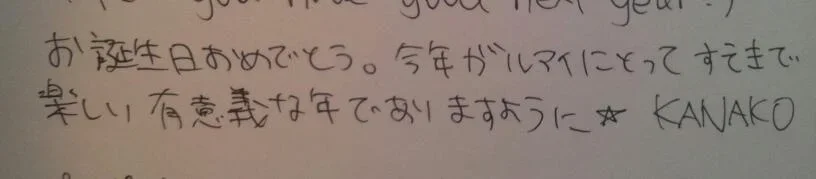
Hi, could anyone help me to translate this to English..? pleas..?!
20120527_125742-1.webp

Thanks so much..^^
 
It's happy birthday wishes. Whose mail are you trying to read?
 
あなたの町に日本のレストランがありますか

Not exactly sure what this means. Is it;

Is there a Japanese restaurant in your town/city?

Have you been to the Japanese restaurant in your town/city?

Or am I wrong on both counts?

any help is much appreciated :)
 
Your first thought was correct.

Why did you think it might have been the second one?
 
あなたの町に日本のレストランがありますか

Not exactly sure what this means. Is it;

Is there a Japanese restaurant in your town/city?

Have you been to the Japanese restaurant in your town/city?

Or am I wrong on both counts?

any help is much appreciated :)

Your first one was right :)
Is there a Japanese restaurant in your town?
 
あなたの町に日本のレストランがありますか

Not exactly sure what this means. Is it;

Is there a Japanese restaurant in your town/city?

Have you been to the Japanese restaurant in your town/city?

Or am I wrong on both counts?

any help is much appreciated :)
It is grammatically correct so I am not completely sure the context or emphasis you are trying to get across but for naturalness it seems there should be a は in there someplace, like あなたの町に日本のレストランはありますか?or あなたの町には日本のレストランがありますか? :?


The 日本のレストラン part is sort of textbookish too but that it OK for now. :)
 
@mike and @Toritoribe

Thanks for your help. I only have one more question. A friend suggested 公正な風と、次の海 when I asked her advice on the subject. I admit, I am not an expert at all but, I am curious; is she way off base? I want to know if she is a reliable source of information when it comes to questions regarding the use of the Japanese language.

Again, thank you,
ET3 Wagner
 
@Mike and @toritoribe

Thanks for your help. I only have one more question. A friend suggested 公正な風と、次の海 when I asked her advice on the subject. I admit, I am not an expert at all but, I am curious; is she way off base? I want to know if she is a reliable source of information when it comes to questions regarding the use of the Japanese language.

Again, thank you,
ET3 Wagner

That seems like a pretty literal translation to me. In the phrase "Fair winds and following seas" "fair" is meant to express "good" winds, for lack of a better word. 公正 has the meaning of fairness or justice. Also, "following seas" is supposed to mean that the waves flow with the boat and not against it. 次の海 quite literally means "next ocean/sea".

However, like Mike Cash I have no idea how to translate it or if there are any Japanese equivalents. I'm sure there is some old term sailors in Japan use to mean roughly the same thing, but I do not know of any.
 
@Mike and @toritoribe

Thanks for your help. I only have one more question. A friend suggested 公正な風と、次の海 when I asked her advice on the subject. I admit, I am not an expert at all but, I am curious; is she way off base? I want to know if she is a reliable source of information when it comes to questions regarding the use of the Japanese language.

Again, thank you,
ET3 Wagner
(海])追い風 (Tailwind)
順流の海 (Following sea). These are straight from the dictionary terms that you would still need to check on currant usage.
 
Your friend did you no favors by pulling crap out of the dictionary without knowing what it meant. She got the wrong meaning of both "fair" and "following".

Look...what you're asking for a translation of is a sort of idiom or "set expression" and those don't translate worth a damn. Even if you got something that is exactly right, it would still not be obvious to a Japanese speaker what the heck it means without an explanation, and probably not even then. How many American sailors even know what "fair winds and following seas" actually means and could explain it?

I have nothing against tattoos as a general thing, but I would suggest giving up this particular idea. There is just too much pounding required to jam that English square peg into a Japanese round hole.

Whatever rendition you choose, no English speaker is going to be able to read it without you telling them what it is, and no Japanese speaker is going to be able to tell what the hell you were trying to say anyway. So as far as that goes, it doesn't matter a hill of beans what you go with.

I know it is horribly out of fashion these days, but when I was in the Navy people still had their English expressions tattooed on themselves in English. Have you considered that horribly quaint and old-fashioned alternative?
 
Last edited:
@Mike and @toritoribe

Thanks for your help. I only have one more question. A friend suggested 公正な風と、次の海 when I asked her advice on the subject. I admit, I am not an expert at all but, I am curious; is she way off base? I want to know if she is a reliable source of information when it comes to questions regarding the use of the Japanese language.

Again, thank you,
ET3 Wagner
Your friend might make use of Google Translate to translate it. (The only difference between the two translations is "公正 vs 公平".)

Google Translate

This is a good example of how useless machine translators are.
 
Your friend might make use of Google Translate to translate it. (The only difference between the two translations is "公正 vs 公平".)

Google Translate

This is a good example of how useless machine translators are.
He should have used Niftygate which gives 順風追い波 that may be more precise than my previous attempt. 🙂:
 
Back
Top Bottom