Need a word or phrase translated?

Issyoni Ra-men Tabemasyou

Hello!
On my work we have a guest from Japan. I told him that I want to start to learn japanese language (probably next week starts my class). Well, I caught some phrases already, such as greetings and so on. He was excited, and maybe thinks, that I can already japanese very well. He wrote me more in romaji. The next two phrases I do not understand or do not understand completely.

Itsuka Nihon Ni Kitekudasai. - would mean for me "Please come visit to Japan" (correct me if I'm wrong)

Issyoni Ra-men Tabemasyou. - would mean for me "We will eat Ramen"? (is it correct?)

Thanks in forward!
 
Last edited:
Very close. 👍

Please come visit to Japan someday. Let's eat Ra-men together (when you come here).
 
Hello, I haven't seen these before and was hoping for some help.

あの服もはやツッコミ待ちっぽくてやだ

I looked up ツッコミ and got "straight man"
Everything I see with it has something to do with comedy, but I'm not sure how to use it in this sentence and have it sound natural in English.
When I looked up ぽくて, it had it paired with some other words, but I couldn't find an explanation for how it's used.

As always, any help is greatly appreciated. :)
 
first post - I need a translation as fast as possible * if possible ;)

Hi guys,
just wondering if you could possibly help me out with translating something for me I would greatly appreciate this!! From english-japanese to english.
please and thank you guys :)

Watashi wa inu o tabeta
Watashi wa itsuka anata no okāsan ni seikō ga arimasu
 
Hello, I haven't seen these before and was hoping for some help.

あの服もはやツッコミ待ちっぽくてやだ

I looked up ツッコミ and got "straight man"
Everything I see with it has something to do with comedy, but I'm not sure how to use it in this sentence and have it sound natural in English.
When I looked up ぽくて, it had it paired with some other words, but I couldn't find an explanation for how it's used.

As always, any help is greatly appreciated. :)
ツッコミ indeed means a roll "straight man", but also refers to a straight man's action/words to criticize a funny man. ツッコミ待ち is a funny man's state that he did/said a funny or strange thing and is waiting a straight man to criticize him.
っぽくて is from a suffix っぽい, meaning "to look like/seem"(e.g. 子供っぽい: childish).
Thus, the speaker of the sentence says that the cloth looks funny/strange as if a person wearing it is waiting someone to criticize how funny/strange it is.


Hi guys,
just wondering if you could possibly help me out with translating something for me I would greatly appreciate this!! From english-japanese to english.
please and thank you guys :)
Watashi wa inu o tabeta
Watashi wa itsuka anata no okāsan ni seikō ga arimasu
I ate a dog.

The second sentence doesn't make much sense.
 
ツッコミ indeed means a roll "straight man", but also refers to a straight man's action/words to criticize a funny man. ツッコミ待ち is a funny man's state that he did/said a funny or strange thing and is waiting a straight man to criticize him.
っぽくて is from a suffix っぽい, meaning "to look like/seem"(e.g. 子供っぽい: childish).
Thus, the speaker of the sentence says that the cloth looks funny/strange as if a person wearing it is waiting someone to criticize how funny/strange it is.

Ah, so that's it.
Thank you so much for the help! :)
 
I tried translating these sentences, but they sound a bit awkward, so I'm afraid that I may have misunderstood something.

彼はまるでこの世が地獄だったことを思い出したかのように落ち込んだ
"He became very depressed, as though remembering that his life was nothing but hell."

彼はまるでこの世が天国だったことを思い出したかのように泣いた
"He cried, as though remembering how life had been heavenly."

Any help is appreciated.
 
この世 would be more likely "the world/this world".

He cried, as though remembering this world were heaven.
 
hiyoujipng-1.webp

A screen shot from Facebook interface.
Can you please translate the word inside the red rectangle?
 
I tried translating these sentences, but they sound a bit awkward, so I'm afraid that I may have misunderstood something.

彼はまるでこの世が地獄だったことを思い出したかのように落ち込んだ
"He became very depressed, as though remembering that his life was nothing but hell."
I think the 地獄だった as a past tense verb in Japanese emphasizes some prior personal hell-like experience of the speaker that would trigger such a level of depression if recalled.
 
I hope somebody can help me with this line: 今つい旦那越しに名前を呼ばれたことに優越感を覚えなかったか

I know it's a strange line to ask, but thank you anyway.
 
I think the 地獄だった as a past tense verb in Japanese emphasizes some prior personal hell-like experience of the speaker that would trigger such a level of depression if recalled.
In that case, I would use 地獄だったときのことを instead.


I hope somebody can help me with this line: 今つい旦那越しに名前を呼ばれたことに優越感を覚えなかったか

I know it's a strange line to ask, but thank you anyway.
Have you felt a sence of superiority being called your name accidentally over your husband from the far side of him just now?

or something along the line. The subject could be the speaker "I", i.e., she might be asking to herself, though.
 
Ah, so 旦那越しに just means "from the other side of (your) husband". I was wondering exactly what that was. I get a sense that the question is based out of an assumption that the addressee did get a feeling of superiority here. Is that right? In that case I'd suggest something more like "you just got a feeling of superiority having your name called across your husband just now, didn't you?" Although 旦那越しに is pretty hard to put in to English I feel good about....
 
Yeah, 覚えなかったか actually means 覚えただろう?, 覚えたはずだ or like that.
Unlike 旦那の向こう側から, 旦那越しに has a nuance of "without via your husband (as if ignoring him)". Tough to translate, indeed...😌
:emoji_blush:
 
In that case, I would use 地獄だった
But the meaning is there and essentially unchanged in both cases, right ?


1. 彼はまるでこの世が地獄だったことを思い出したかのように落ち込んだ

2. 彼はまるでこの世が地獄だったときのことを思い出したかのように落ち込んだ
 
No. #1 is basically used as この世が地獄だったということ=実はこの世が地獄だということ. #1 has a sense of "actually", whereas #2 is for "temporal hell-like period".
 
Yes, if you want to say "What are you going to do to NY?". Are you asking to a terrorist or something?;-)

Maybe it's "What are you going to do in NY?"; ニューヨーク何をするんですか?
 
What is 朝ボンヤリして ?

ボンヤリした is just to be absent-minded or careless, right?
So would 朝ボンヤリ just be when someone who is daydreaming or careless in the morning, or does it have some other meaning?
 
朝ボンヤリ is not one word. That's 朝、ボンヤリして. ;)
 
朝ボンヤリ is not one word. That's 朝、ボンヤリして. ;)

Thank you. :)

Would you happen to be able to help me out with this as well?
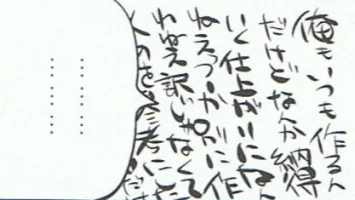
I'm having a hard time reading the attached image, so I'm afraid that I may have missed something.

This is what I got out of it:
俺もいつも作るんだけどなんか納得いく仕上がりになんねえっつか別に作れねえ訳じゃなくてくのさ考えにした

Context:
A makes B cookies, B asks A to teach them how to make them.
The text is A's thoughts after being asked.

I'm not completely sure on the translation either, but the problems I'm having with it may well be because I'm missing something.
 

Attachments

  • 24p.webp
    24p.webp
    16.3 KB · Views: 119
俺もいつも作るんだけどなんか納得いく仕上がりになんねえっつか別に作れねえ訳じゃなくてを参考にしただけ

俺もいつも作るんだけど、なんか納得いく仕上がりにならないっていうか、別に作れない訳じゃなくて、人(=他人)のを参考にした(=参考にしてクッキーを作った)だけ、、、

Does this make sense? ;)
 
Back
Top Bottom