倭人(wa-jin, Japanese)

Ancient indigenous islanders of Jeju-do 濟州島 very likely related to collective Wa-jins 倭人 ( Japanese tribal peoples ) identified in the Book of Wei 魏志倭人伝.

Jeju Island - Wikipedia

濟州島古國—耽羅 ( note: 耽羅國/儋羅國/州胡國 ancient Chinese names for Jeju-Do )

海島上有州胡國。其人短小 ( people of short stature ),髡頭 ( shaved heads ),衣韋衣,有上無下。好養牛豕。 乘船往來

* Source: Later Book of Han 《後漢書》"州胡國"

History of Jeju-Do 濟州的歷史 ( 耽羅的名稱 = '州胡' 與 '耽羅')

古代建有名為"耽羅國"的獨立王國,因此保有本島獨有的風俗習慣,方言與文化.
In ancient times,there was an independent island nation named 耽羅國,native population had indigenous culture & a distinctive language 州胡語.

中韓史學界多認為州胡族是屬於古代東夷部族的一支後裔,夏商時期由山東半島東遷至海上島嶼.州胡不同於於朝鮮半島和大陸上的任何民族,有自己獨特而復雜的語言-州胡語。

其根據是"州胡人" 的髡頭 ( 剃髮 頭髮樣式 )、其居民身材較短小 ( local islanders were short statured ),穿著獸皮衣、飼養家畜等與鮮卑、烏丸族相似。

According to recorded accounts,natives' shaved forehead hairstyle similiar to 鮮卑Xianbei & 烏丸 Wuhuan.

* Source: 《魏書·東夷傳》 Book of Wei - Dong Yi chronicle
 
Last edited:
the character of Wa-jin (Japanese) was tattoos on the face and body.

A lot of this customs were seen in Polynesia ?
http://www.webtelevi.com/yamataigisi.htm

I have answer for you caster51 🙂

刺青なんかの風習は,中国江南の古代百越族 Tattoo was a common custom among 百越族 of southeastern coastal China & also aboriginals of Taiwan ( formerly Formosa meaning beautiful in Portuguese ).

百越族刺青 - Google Search

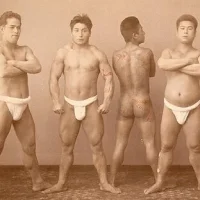
Hayato 隼人 & Kumaso 熊襲 were non-Yamato indigenous tribes of southern Kyūshū ,these ancient Japanese people tattoo'ed their bodies.This is the source of ( Austronesian or Malay-Polynesian ) SE Asian origin for pre-modern Japanese race.Oh,I think those were the naked men wore diaper-like underpants ( photo attached )

Source: http://books.google.com/books?id=u2...ig=Dr_FKWbQe6-fyZX38NozI1kS2-o&hl=en#PPA34,M1

The earliest immigrants to Japan came from the islands lying off the Southeastern coast of Asia.From the northern regions of Asia came different racial strains.They were the people of the vast grassland that spreads between Siberia,Manchulia,& Mongolia.However,majority of Japanese people belong to North and NE-Asian racial strains.
 

Attachments

  • 06.webp
    06.webp
    16.7 KB · Views: 224
I think Egami's ' Invading Horesriders Theory 故・江上波夫氏の唱えた騎馬民族征服王朝説 ' was just a fictionalized romantic notion of horse-riding warrior race conquest of Japan out of pure imagination.Both J. Edward Kidder, Jr & Walter Edwards rebutted Egami from archaeological standpoint.

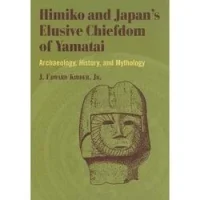
"Himiko and Japan's Elusive Chiefdom of Yamatai" is a good source ( book cover photo attached ).

http://www.buy.com/prod/himiko-and-...haeology-history-and/q/loc/106/204167011.html

caster51さん

現代の考古学では日本人種の二重性を唱えています.日本人のルーツは漢民族に追われた呉の辺りの民族と蒙古系と北方系とオーストロネシア系と任郡日本府のあったあたりの民族 (朝鮮族とは限りません) の混ざったものでしょう.高い技術は大陸から伝来したものですよ,ほとんど.

The dual-origins ( NE & SE Asian origins ) theory of Japanese race is the emphasis in modern archaeology.Japanese population is a mixture of ancient Wu people of SE coastal China & Mongol-stock & northern nomadic stock & SE Asian stock & Wa-jins of Mimana ( not limited to natives of K peninsula north of Japan islands ).Advanced culture definitely originally came from Asia mainland.

邪馬台とは当時の中国人が「ヤマト」に当て字をしたものだと思っています.「ヤマタイ」に近い発音の国があった.

Chinese at that time inaccurately used Kanji substitute 邪馬台 for transliteration of Yamato.邪馬台 Yamatai is close pronunciation to original Japanese word for the Kingdom of Yamato

注: "古代の南方系中国人 = 華南の百越系"
 

Attachments

  • 204167011.webp
    204167011.webp
    7.2 KB · Views: 178
Last edited:
刺青なんかの風習は,中国江南の古代百越族 Tattoo was a common custom among 百越族 of southeastern coastal China & also aboriginals of Taiwan.

Hayato 隼人 & Kumaso 熊襲 were non-Yamato indigenous tribes of southern Kyūshū,these ancient Japanese people tattoo'ed their bodies.This is the source of ( Austronesian or Malay-Polynesian ) SE Asian origin for pre-modern Japanese race.Oh,I think those were the naked men wore diaper-like underpants ( photo attached )

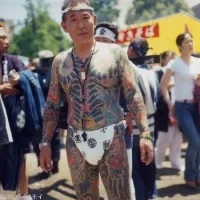
One example photo ( below ) of full-body tattoo'ed modern Japanese male wearing diaper-like underpants.NE Asian nomadic tribes had no such customs,not in ice-cold Siberia & Manchuria & Mongolia.

There is now a theory that present day South Pacific islander populations originally migrated from southern Asia continent ( Austronesian-stock inhabitants once populated China's southeastern coastal region & deep south & far southwestern area borders Burma ) many thousand years ago.
 

Attachments

  • b0036864_1591336.webp
    b0036864_1591336.webp
    36.1 KB · Views: 188
caster51,there have been ongoing debates among Japan's sinologists on Han Dynasty's bestowed golden seal's authenticity 漢"委"奴国王 ( not " 倭 " )

あ,やっぱり難しい問題ですね.詳しくはこちらから,にも掲載されております

@ 金印 | 福岡市博物館

OMG .. there is another twist concerning this matter 😌

Japanese historian named Tsunado suggested 奴国 referred to Nakoku ( Hakata-ku 博多区 of present day Fukuoka City 福岡市 ) not 倭奴国 Wa-Nu as disputed and the Chinese imperial golden seal was real.

Nakoku - Wikipedia

Wa - Google Search
 
任那日本府(mimana japan-G ) in korean peninsula was exsisted as wa-jin's militaly bases until AC 562

how about relation of japanese emperor and korea?.......

Correct,Wa militarily conquested and occupied 弁韓 territory which was the weakest of Samhan statelets.

I don't understand ( unless they're of peninular background ) WHY any native Japanese would think it was " the peninsular natives " gave birth to Yamato Dynasty or were the Yamato people.:eek:

I believe Wa-jin descendants were " capable " & torai-jins 渡来人 contributed significantly to Japan during those centuries.But,it doesn't erase the fact that majority population was indeed 倭人 heritage.
 
Chinese Wei-Zhi 魏志倭人伝 recorded " direct " contacts between Chinese dynasties & Wa Japan earlier on.No mentioning of language & cultural & ethnicity of collective Wa-jins 倭人 related to natives of peninular statelets.I don't think they were the same people as Samhan ( 辰韓 Chinhan, 弁韓 Pyonhan, and 馬韓 Mahan ),otherwise Japanese & peninsular languages would be intelligible because modern tongue in the peninsula is derived from Silla which is 韓-based language.

According to Chinese chronicles,there was a Han-Chinese 秦朝 Qin refugee settlement in 辰韓 ( peninsula history sources also confirmed it ).Japan's 秦氏 Hata clan ( 漢系氏族 ) most probably migrated from the peninsular's 辰韓 Chinhan statelet.I suspect Japan's 東漢氏 came from 馬韓 because Baekje had a mix population included Mahan & remnant Han-Chinese of 帶方郡 ( one of Han commanderies,when Han Dynasty lost control of peninsula ).

My conclusion is those 163 漢系氏族 ( Han-Chinese family registries ) documented in Shinsen-Syoujiroku ( 新撰姓氏録 ) actually from the peninsula NOT China mainland directly.

新撰姓氏録 - Wikipedia

5世紀から秦氏、西文氏、東漢氏などが来日帰化してますし,彼らが持ってきた習俗という事で充分説明がつくと思います.彼らは征服民でなく帰化民です

Han Dynasty " influenced " the peninsula THE MOST as Tang Dynasty for Japan.

楽浪郡 Lelang was THE SOURCE of sophisticated civilization for all ancient peninsular kingdoms and Wa of Japan,then extended to peninsula's 3 Kingdoms period in concurrent with Yamato of Japan.It was like a " food chain " of cultural transfer.

Indopedia - The Indological Knowledgebase

Lelang Commandery - Wikipedia

Hyung Il Pai (1992) presented a more balanced theoretical view on Han Lelang's position in peninsula's prehistory. Basically,she argued that social and regional differentiation in the peninsula were not possible without initial Han contact. Before the Lelang period, regional differences find expression ony in terms of minor variation in pottery styles. In contrast, third-century texts of the Wei Zhi 魏志 ( 300 years after initial Han contact ) reveal the existence of various guo 国 (or tribal kingdoms) such as Puyo, Koguryo, Okcho, Eastern Ye and Samhan. They are recorded as having distinctively different social organizations, subsistence systems, customs, and rituals

The most important "traits of civilization" such as iron technology, writing, gold craftsmanship, and intesive rice agriculture, were derived from Han Lelang culture. Such widespread distribution of ideas and technology would not have been possible without the elite distribution network of seals, bronze mirrors, and luxury Han goods which stimlulated the initial exchange network.

According to Pai (1992), once this network was established in the core areas of Lelang, it quickly spread to all other parts of peninsula and into southern-western Japan, forming the "Lelang Interaction Sphere" in the peninsula prehistory that included Koguryo, Wa of Japan, and Samhan - Chinhan, Pyonhan, and Mahan.Without this initial phase, the second stage of the interaction sphere that comprised Koguryo, Paekche, Silla, and Kofun Japan, would not have been possible. Extensive trade and diplomatic activities were heightened and reinforced by competition and warfare with Yamato Japan and peninsula's 3 kingdoms.These states shared common features in palatial architecture, in the spread of Buddhism and associated sculpture, as well as in gold artwork and jewellery.

http://www.nichibun.ac.jp/research/faculty/staff3/pai.html

http://www.eastasian.ucsb.edu/content/people_pai.html
 
Last edited:
old Chinese called Japanese east-barbarous.
becose japanese didn't have charactor and a unified country
and they think civilization equal central Chaina(Sinocentrism)

倭,卑,邪 are meanly characters

倭=small(man) 卑=lowly 邪=vicious
 
Last edited:
倭,卑,邪 are meanly characters

倭 = small (man)
卑 = lowly
邪 = vicious


Incorrect ... 🙂

倭 《說文解字》釋為:順貌.從人委聲.另外可解作遙遠的意思

倭's definitions: servile.subservient.another translation is faraway


Chinese language wiki page explains 倭

Source: 倭国 - 维基百科,自由的百科全书


卑 & 邪 were Kanji-transliterations of Japanese names ( i.e. shaman Queen Himiko 卑弥呼 ) & some chiefdoms ( i.e. Yamatai 邪馬台 ) .


> hotaruika .. if you can read Chinese

而在中國的三國時期,中國人使用倭去代表日本.由於「倭」字有「矮」的意思,因此在漢字傳入日本以後,日本人於日語中同音(わ)的「和」去代替.並用漢字「大和」去表寫日語的やまと,並用「日本」表寫ひのもと.
 
>倭's definitions: servile.subservient.another translation is faraway

Japan is near contory with Chaina.I think that Chinese didn't call japan faraway-contory.

>卑 & 邪 were Kanji-transliterations of Japanese names

It is have nothing to do with the point under discussion at issue.
Becouse old japanerse dont have a phonogram too.We cannot know that what did old japanese call himiko & yamatai.We can read them things by 魏志倭人伝(Wei's record about japanese) only.
Besides If old chinese respect japanese.They didnt use meanly characters for assigned to represent a word phonetically.
 
Last edited:
a bit off-topic,but I need to present below examples explain the denoted Kanji were just " transliterations " of multisyllabic linguistic spoken Asiatic continental nomadic tribes besides the Japanese.

* Xianbei

Xianbei - Wikipedia


* Xiongnu

Xiongnu - Wikipedia
 
鮮卑(Xianbei) and匈奴(Hungnu) are Chainase.
old Cainease think Them barbarous too

japanese didn't contact them.
japanese knew them by Chinase books(漢文)
books called them Xianbe and Hungnu

The Sinocentrism
東夷(east-barbarous) Japanese,Korean
北狄(nouth-barbarous)Mongolian,Hungnu,Xianbei ,Khitan,
西戎(west-barbarous) Tibetan
南蛮(south-barbarous) Southeast Asian
 
>倭's definitions: servile.subservient.another translation is faraway

Japan is near country with China.I think that Chinese didn't call Japan faraway-country.


梁 書 卷 五 十 四 ( Chinese history chronicle: Book of Liang,chapter 54 )

列 傳 第 四 十 八

諸 夷

海 南 東 夷 西 北 諸 戎

扶 桑 國 者 , 齊 永 元 元 年 , 其 國 有 沙 門 慧 深 來 至 荊州 , 說 云 : 扶 桑 在 大 漢 國 東 二 萬 餘 "里"地 在 中 國 之 東其 土 多 扶 桑 木故 以 為 名 .扶 桑 葉 似 桐 , 而 初 生 如  ,國 人 食 之 , 實 如 梨 而 赤 , 績 其 皮 為 布 以 為 衣 , 亦 以 為 綿。 作 板 屋 .無 城 郭 .有 文 字 , 以 扶 桑 皮 為 紙 .

扶 桑 is 20 thousand " li " east of Great Han Nation ( China ),geographically east of China,many native ( 扶 桑 = 太陽木 = sun trees ) Fuso trees,therefore referred as 扶 桑.

https://en.wikipedia.org/wiki/Li_(unit)

http://www.convert-me.com/en/convert/units/length/length.cli.en.html


By the way,扶 桑 ( Fuso ふそう ) was a non-official name for Japan.It's a name of native tree on Japanic islands.
 
Do you think that an interval Between Japan and china is 20千里(80'000km)? 扶桑(Fuso) is the legendary tree in mythology .Chinase thought the Sun rise from Fuso in the ends of the east.

a Another meaning that Fuso is legendary east Island contory in 東夷伝(the book about east-barbarous:東(east)夷(barbarous)伝(report)).they eat(扶) mulberry(桑) leaves and they have original character.
Japanse didnt have a character.
a part of people Fuso mean japan.but it is not an established theory
 
" 日本 " is originally a native Japanese term " 日の本 ( ひのもと ) " meaning a place where the sun rises ( Chinese: 太陽升起的地方 ).

而"扶桑"據說是中國古代神話傳說裡的"太陽樹 ",因為日本在最東面太陽升起的地方,所以稱之為"扶桑".

Liu Xin ( 刘歆 ) wrote about the Fuso tree in Shan-Hai Jing ( 山海經 ).

Classic of Mountains and Seas - Wikipedia

Japan also known as 東洋 & 東瀛 " east side of the ocean ".( 這兩個名詞字面上的意思就是指「東面的海洋」. 早於日本與中國接觸前,日本人稱自己所居住的地方為「やまと」和「ひのもと」,意思就是太陽之本 ).
 
日の本 is an idiom that it mean east in east-Asia.
But it is original that Japanese called Japan 日本.
Old Japanese hated that Chinese call them wa-jin(倭人).
They declared call themself 日本 in AC670~690(oldest code is Jpanese Asuka Kiyomihara Code in AC689).history book of Tang's Chaina write that Japanese sembassies report China it in AC702.and it's recognized by China
 
Last edited:
How did the wa people people call their language? "WA" is the name given by the Chinese! There must some oral stories existing about the origin of the Japanese!
 
"WA" is the name given by the Chinese! There must some oral stories existing about the origin of the Japanese!

Japanese called themselves " WA " ~ 倭 is the Chinese transliteration for that word and the ancient Chinese selected this Kanji character to fit the sound and physical characteristics of short statured Japanese.

There must some oral stories existing about the origin of the Japanese!

Nonexistence ~ Japanese are accurately taught that they're descended from Jomon and Yayoi ( Yamato & closely related nomadic tribes from NE Asia + Toraijins from Korea peninsula and China ) peoples and accepted as such which is a true fact.
 
Back
Top Bottom