Need a word or phrase translated?

Hi, I have to put together a script and I need the most used as well as accurate Japanese translations of the words below:

"The End" (referring to a presentation/act or script)
"Lesson" (when referring to a lesson in a book) --- in addition to that, I would like to know how to write if I wanted to mention a particular lesson like "lesson 1" Would the number actually be written in arabic numerals?
~I would like them in kana writing
 
Hi, I have to put together a script and I need the most used as well as accurate Japanese translations of the words below:

"The End" (referring to a presentation/act or script)
"Lesson" (when referring to a lesson in a book) --- in addition to that, I would like to know how to write if I wanted to mention a particular lesson like "lesson 1" Would the number actually be written in Arabic numerals?
~I would like them in kana writing

The End: 終わり(おわり)
Lesson: 課(か)、レッスン
Lesson No. 1: 第一課 (だいいっか)、レッスン1

If everything is to be written in kana, 課(か) does not make sense - too short and too many homonyms - so I'd use レッスン which is transcription of the English word "lesson".
Arabic numerals are used when writing is horizontal.
Kanji numerarls are used mainly for vertical writing.
 
Background:
Two friends (A and B) are at a festival and one of them seems to be buying a lot of food.
The other seems to be complaining.

I'm having some trouble translating this sentence
A: "ただもう夕飯もすでに半分ほど用意してきたというのにそんなに食べて平気か"
I don't have much experience with ほど. The dictionary I checked says that it indicates approximate amount or somethings limit. This is the first time I've seen すでに, the dictionary says that it means too late or already. But doesn't もう also mean already? I'm not sure how to put it all together in a way that sounds natural.


There was this part as well, the phrasing sounds a little off, but I'm not sure how else I can put it:
A: "まだ食べるんですか!わかってます!?屋台の平均価格!" "You're still going to eat more!? Do you understand!? The average cost at these stands!"
If you know of a different/better way to phrase this so that it sounds better, I'd love to know.

Edit:
I found another phrase I don't know.
Same scenario.
B: お好み焼きはないか They don't have okonomiyaki?
A: 人の話聞いてますか Are you listening to anything I'm saying?
B: 昨日の誰かさんと一緒 When I was together with a certain someone yesterday (is there a better way to phrase this?)
根に待ちますねぇ <-- I'm not really sure what this means. The dictionary I checked said that 根 can mean perseverance, so could this be something like "Wait patiently" or "be patient"?

There's also this line. After the person B apologizes for yesterday, A goes on to say,
B: "もうこのへんで勘弁しといてやる"
へん is weird or strange and 勘弁 is forgiveness, so is this supposed to be saying something like "I've already forgiven that strangeness"? But it isn't past tense, so "I'll forgive that strangeness"? I'm not sure about しといて.

Sorry that I've asked about so much here, any help would be greatly appreciated.
 
Last edited:
I'm having some trouble translating this sentence
A: "ただもう夕飯もすでに半分ほど用意してきたというのにそんなに食べて平気か"
I don't have much experience with ほど. The dictionary I checked says that it indicates approximate amount or somethings limit. This is the first time I've seen すでに, the dictionary says that it means too late or already. But doesn't もう also mean already? I'm not sure how to put it all together in a way that sounds natural.
Yes, もう and すでに have almost the same meaning "already" in that sentence. They are often used together.

もう夕飯もすでに半分ほど用意してきた
we/you have already prepared half of the dinner

There was this part as well, the phrasing sounds a little off, but I'm not sure how else I can put it:
A: "まだ食べるんですか!わかってます!?屋台の平均価格!" "You're still going to eat more!? Do you understand!? The average cost at these stands!"
If you know of a different/better way to phrase this so that it sounds better, I'd love to know.
わかってます!?屋台の平均価格! is an emphatic construction; 屋台の平均価格わかってます!? or "Do you understand the average cost at these stands?!"

B: 昨日の誰かさんと一緒 When I was together with a certain someone yesterday (is there a better way to phrase this?)
Doesn't 誰かさん refer to a specific person, for instance, the addressee or "you"?

根に待ちますねぇ <-- I'm not really sure what this means. The dictionary I checked said that 根 can mean perseverance, so could this be something like "Wait patiently" or "be patient"?
根[ね]に持つ is a set phrase.

[慣用表現]

根に持つ

彼は僕のことを根に持っている
He has a grudge against me.
「ね」の検索結果 - Yahoo!辞書

There's also this line. After the person B apologizes for yesterday, A goes on to say,
B: "もうこのへんで勘弁しといてやる"
へん is weird or strange and 勘弁 is forgiveness, so is this supposed to be saying something like "I've already forgiven that strangeness"? But it isn't past tense, so "I'll forgive that strangeness"? I'm not sure about しといて.
That へん is not 変 but 辺. しといて is the contraction of しておいて.

もうこのへんで勘弁しといてやる
I'll give you a break now.
 
Yes, もう and すでに have almost the same meaning "already" in that sentence. They are often used together.
もう夕飯もすでに半分ほど用意してきた
we/you have already prepared half of the dinner
わかってます!?屋台の平均価格! is an emphatic construction; 屋台の平均価格わかってます!? or "Do you understand the average cost at these stands?!"
Doesn't 誰かさん refer to a specific person, for instance, the addressee or "you"?
根[ね]に持つ is a set phrase.
「一緒」の検索結果 - Yahoo!辞書
That へん is not 変 but 辺. しといて is the contraction of しておいて.
もうこのへんで勘弁しといてやる
I'll give you a break now.

Thank you! This really helps a lot.

For
Doesn't 誰かさん refer to a specific person, for instance, the addressee or "you"?
the dictionary I referred to said "a certain somebody (usu. obvious who is being referred to)" so I wasn't sure if I should just put in "you," or if I should make it sound more sarcastic, it would probably sound better as just "you."

And for
根[ね]に持つ is a set phrase.
Does this mean that it can't be used on it's own? The dialogue I'm looking at is a comic so a lot of these are in separate word bubbles.
The 根に待ちますねぇ came after 昨日の誰かさんと一緒 only in a separate bubble. If the sentence were 昨日の誰かさんと一緒根に待ちますねぇ would it make sense?
So, could it be interpreted as something like "When we were together yesterday you acted as though you had a grudge against me"?

Thank you again for helping. I really appreciate it.
 
the dictionary I referred to said "a certain somebody (usu. obvious who is being referred to)" so I wasn't sure if I should just put in "you," or if I should make it sound more sarcastic, it would probably sound better as just "you."
Yeah, if you understand that 誰かさん actually refers to "you" with a sarcastic nuance, "a certain someone" would be a good translation.:) However, 一緒 means "the same" and not "together" here.

(同じ)the same.

この帽子は私のと一緒だ
This hat is the same as mine./This hat and mine are the same.(※「私のと一緒の手袋」はthe same gloves as mine)
「一緒」の検索結果 - Yahoo!辞書

昨日の誰かさんと一緒
It's the same as yesterday's (behavior/words of a) certain someone.

Does this mean that it can't be used on it's own? The dialogue I'm looking at is a comic so a lot of these are in separate word bubbles.
The 根に待ちますねぇ came after 昨日の誰かさんと一緒 only in a separate bubble. If the sentence were 昨日の誰かさんと一緒根に待ちますねぇ would it make sense?
So, could it be interpreted as something like "When we were together yesterday you acted as though you had a grudge against me"?
Isn't 根に待ちますねぇ a reply to 昨日の誰かさんと一緒? I mean, it seems to me 根に待ちますねぇ is said by A to B as a reaction to B's sarcastic words 昨日の誰かさんと一緒.
 
Yeah, if you understand that 誰かさん actually refers to "you" with a sarcastic nuance, "a certain someone" would be a good translation.:) However, 一緒 means "the same" and not "together" here.
昨日の誰かさんと一緒
It's the same as yesterday's (behavior/words of a) certain someone.
Isn't 根に待ちますねぇ a reply to 昨日の誰かさんと一緒? I mean, it seems to me 根に待ちますねぇ is said by A to B as a reaction to B's sarcastic words 昨日の誰かさんと一緒.

Ah, I see. That makes sense.
Thank you!
 
Hello, I need help with the last line

年末、忘年会の予定が3件・・・
新年会の予定もすでに3件・・・
身体もつかな(汗)

I think he is saying something about his health, but I'm not sure.

Thanks.
 
Isn't it 根にちますねえ?
Oh, I didn't notice at all.:emoji_stuck_out_tongue_winking_eye: This would be a good example of how we recognize kanji; not from the kanji itself but rather from the context.🙂:

My Japanese so far, any advice? | Japan Forum


Hello, I need help with the last line

年末、忘年会の予定が3件・・・
新年会の予定もすでに3件・・・
身体もつかな(汗)

I think he is saying something about his health, but I'm not sure.

Thanks.
身体持つかな
(literally) I wonder if my body can endure (the heavy schedule).
 
I'm not quite sure how to translate this. I'm not sure if the line coming before it will be much help context wise, but I'll throw it in there.
あの子も呼んであげれば良かった We should have invited that child, too.
お前が声かければすっ飛んで来る I'm not sure about the かければ . Would the sentence be something like "Your voice is carried away"? or "You lost your voice"?

I was also wondering about this sentence:
一応、伝わってはいたみたいだ
It seems to be something the character is thinking to himself after his friend tells him that he's been acting strangely.
When I checked the online dictionary, it said that 一応 can mean "once; tentatively; in outline; for the time being; just in case" and that 伝わる means "to be handed down; to be introduced; to be transmitted; to be circulated; to go along; to walk along." I'm not really sure where to go with it.
"For the time being, I'll go along with it"? Then again, みたい is also there, so maybe "He seems to be going along with it for now"? Or does "to go along" in the definition refer to a physical sense?
 
声をかける means to call someone, so it means "if you called her she'd come here right away."

The second one is probably more like "at any rate, he seems to have gotten the message" where it's kind of like he may not have completely understood what was being said, but he has a general idea. Do you know 伝える? It's the transitive form of 伝わる, and it's used like 律子に会ったらよろしく伝えてね ("say 'hi' to Ritsuko for me if you see her"). So, think of the intransitive version of that concept, like 感情が伝わる, for instance.
 
声をかける means to call someone, so it means "if you called her she'd come here right away."

The second one is probably more like "at any rate, he seems to have gotten the message" where it's kind of like he may not have completely understood what was being said, but he has a general idea. Do you know 伝える? It's the transitive form of 伝わる, and it's used like 律子に会ったらよろしく伝えてね ("say 'hi' to Ritsuko for me if you see her"). So, think of the intransitive version of that concept, like 感情が伝わる, for instance.

I see, makes sense. Thank you very much! :)
 
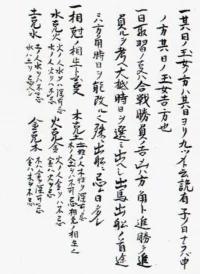
bungo?

A little help will be welcome!

I've received the attached file and I'm quite lost.
There are a lot of kanji and my first thought was: that's not bungo, it's Chinese.
But there some caracters which look like katakana...

I think it's bungo and want to translate it.

Any tips?

Thanks in advance!
 

Attachments

  • Page japonaise.webp
    Page japonaise.webp
    53.7 KB · Views: 124
A little help will be welcome!
I've received the attached file and I'm quite lost.
There are a lot of kanji and my first thought was: that's not bungo, it's Chinese.
But there some caracters which look like katakana...
I think it's bungo and want to translate it.
Any tips?
Thanks in advance!
Yeah, that's defenitly classical Japanese.


一其日ノ玉女ノ方ハ其日ヨリ九ツメト云?有子ノ日ナラバ申
ノ方其日ノ玉女吉方也

一日取習ノ?ハ合戦勝負ノ吉凶ハ方角ト進勝テ進
負ルヲ考へ大抵時日ヲ選シ出ヘシ出馬出舩ノ首途
ニハ方角時日ヲ能改ル?殊ニ出舩ニ忌ム日多シ

一相尅ニ相生ト云?
木克土 土姓ノ人木性ヲ深可忌 木ノ人土ヲハ不可忌相克ノ相生?
水克火 火ノ人水ヲハ深可忌 水ノ人火ヲハ不忌
火克金 火ノ人金ヲハ不忌 金ハ火ヲ忌
土克水 土ノ人水ヲハ不忌 水ハ土ヲ忌ヘシ
金克木 木ハ金ヲ深可忌 金ハ木ヲ不忌


Seems like a kind of fortune-telling and an explanation about 五行説.
 
Thank you very much for typing it. :-)

I was thinking about to doing it but some kanji are very difficult to understand.

I hope my dictionary can reconstitute them with fragments I will give it.
 
日本は、いずれ紙切れになるアメリカ債せっせと買っています。これは超低金利政策といって、金利をタダ同然に押しとどめ、アメリカにお金が流れるように誘導しています。それが日本という国の基本政策です。ドルを支えるために、時には月に数兆円を使っています。

Can someone explain the meaning of the second sentence in this paragraph, I don't understand what the author is trying to convey with 同然に押しとどめ、アメリカにお金が流れるように誘導しています。
 
日本は、いずれ紙切れになるアメリカ債せっせと買っています。これは超低金利政策といって、金利をタダ同然に押しとどめ、アメリカにお金が流れるように誘導しています。それが日本という国の基本政策です。ドルを支えるために、時には月に数兆円を使っています。

can someone explain the meaning of the second sentence in this paragraph, I don't understand what the author is trying to convey with 同然に押しとどめ、アメリカにお金が流れるように誘導しています。
Japan is halting interest rates that are virtually free (very low - 超低) that incites money flowing into America.

Literally. I think. 😌
 
I'm not sure how best to translate つけて in the context of this sentence.
Aside from "turn on" I haven't really encountered it much.
I looked it up, and it seems to have a lot of meanings.
まさか歌詞までつけて

Person A: Sings part of a song
Person B: Sings the second part of the song unexpectedly (in a different language than what A used)
Person A's thoughts: まさか歌詞までつけて
 
I'm not sure how best to translate つけて in the context of this sentence.
Aside from "turn on" I haven't really encountered it much.
I looked it up, and it seems to have a lot of meanings.
まさか歌詞までつけて

Person A: Sings part of a song
Person B: Sings the second part of the song unexpectedly (in a different language than what A used)
Person A's thoughts: まさか歌詞までつけて
Putting lyrics to it !
 
Hi, I would like to know if there are a lot of differences between 盗む, 奪う, 取る when referring to steal and rob?
 
Happy New Year

The new year is coming.
🙂
How can I say"Happy New Year" in Jananese?
Who can tell me ?
 
Back
Top Bottom