Need a word or phrase translated?

But, if it's 日本の古いじじいには刺激が強いですね, then how would it be translated in a way that sounds natural?
"Old Japanese men have strong stimulation" or maybe "Stimulation is strong in old Japanese men"
刺激 can mean motivation too (according to the dictionary), would that be better to use?

刺激が強い means something is (too) strong to one's sense i.e. stimulating, exciting, evocative, titillating, etc.
"It (= tattoo) is too much/strong/radical for Japanese old men"

Edit: Glenn san beat me this time! :)
 
Perhaps "tattoos give old Japanese guys a strong shock" or something along those lines. It's the tattoos that are the strong stimulation.
刺激が強い means something is (too) strong to one's sense i.e. stimulating, exciting, evocative, titillating, etc.
"It (= tattoo) is too much/strong/radical for Japanese old men"

Edit: Glenn san beat me this time! :)
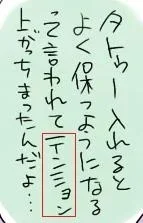
Ah, that makes sense. Thank you both!


Do either of you happen to know what this word means?
I tried looking it up but couldn't find anything.
 

Attachments

  • 128820.webp
    128820.webp
    7.1 KB · Views: 121
It's テンション. I wonder what よく保つ, though... The tattoo itself?

Here's a little more:

テンション 1 [tension]
(1)緊張。不安。
(2)〔物〕 張力(ちようりよく)。
テンションとは - 音楽用語 Weblio辞書

From further down on that page, and more apt, actually:

やる気などを意味する和製英語。ただし、日本語として「張りのある暮らし」や「頑張り」など張りに通じるものでもある。
 
Last edited:
It's テンション. I wonder what よく保つ, though... The tattoo itself?
Here's a little more:
テンション 1 [tension]
(1)緊張。不安。
(2)〔物〕 張力(ちようりよく)。
From further down on that page, and more apt, actually:
やる気などを意味する和製英語。ただし、日本語として「張りのある暮らし」や「頑張り」など張りに通じるものでもある。

Tension! That makes sense. I feel silly for not realizing it...the entire time I was thinking that the シwas a ミ because of how it's written.

I thought that よく would be "Often" and the definition I found for
保つ was "to keep; to preserve; to hold; to retain; to maintain; to support; to sustain; to last; to endure; to keep well (food); to wear well; to be durable"

Any idea on a translation for the sentence?
タトウー入れるとよく保つようになるって言われてテンション上がっちまったんだ

I tried to come up with one, but it ended up sounding really weird, so I'm pretty sure it's wrong.
 
I'm understanding it as "I was told when you get a tattoo it holds really well, and I just really got excited about getting one" or something along those lines. I hope that's at least close. haha 😌
 
I'm understanding it as "I was told when you get a tattoo it holds really well, and I just really got excited about getting one" or something along those lines. I hope that's at least close. haha 😌

I can see how you would get that. I was thinking of it in a different way. What you have sounds way better, though.
When I think of "tension" I have a hard time thinking of it as "excited" or "good" sort of tension, so I was automatically thinking about it in a negative way (like, a regret about getting the tattoo or something), and with the 上がっちまったんだ part, I wasn't sure how that would be translated, I found 上がったり in the dictionary, but I think that's probably something else.
When I was trying to translate it, I just ended up confusing myself.

But anyway,
thank you again for all of your help!
 
上がっちまったんだ is 上がってしまったのだ abbreviated. テンションが上がる is a set phrase, meaning something like やる気が出る, according to the Wikipedia quote. I always thought of it as "get excited", though. I guess they're similar.
 
上がっちまったんだ is 上がってしまったのだ abbreviated. テンションが上がる is a set phrase, meaning something like やる気が出る, according to the Wikipedia quote. I always thought of it as "get excited", though. I guess they're similar.

Isn't しまった the short form for しまいました?
If so, isn't it a term expressing regret?
So, would it be like, regretting having gotten excited over it?
 
Not really the shortened form -- it's the informal form. しまいます is formal/polite, and しまう is informal (the base or dictionary form). It can express regret, yes. It probably also expresses regret in this case, but I took it as being more like just getting excited and not being able to help it. Given that it probably goes with the old men thing, it most likely does express regret.
 
Isn't しまった the short form for しまいました?
If so, isn't it a term expressing regret?
So, would it be like, regretting having gotten excited over it?

しまった is the past form of しまう.
しまいました is a polite form (present is しまいます).

The person might be regretting either the fact he got too excited or the result (= got the tattoo) of the excitement.
 
Not really the shortened form -- it's the informal form. しまいます is formal/polite, and しまう is informal (the base or dictionary form). It can express regret, yes. It probably also expresses regret in this case, but I took it as being more like just getting excited and not being able to help it. Given that it probably goes with the old men thing, it most likely does express regret.
しまった is the past form of しまう.
しまいました is a polite form (present is しまいます).

The person might be regretting either the fact he got too excited or the result (= got the tattoo) of the excitement.

Ah, I see. Thank you both. :)
 
I mean you have to have two things working together with that と, like 友達と会う would mean you meet up with a friend and you had both planned it, or トラックと衝突した would mean that you collided with a truck and you were heading towards each other, but 友達に会う would mean you go to see your friend, but they weren't planning on seeing you, and トラックに衝突した would mean you collided into a truck, and it wasn't moving. Similarly, you can't really say 壁と衝突した, because the wall can't move (normally). Instead, you'd say 壁に衝突した. Also, you can't marry no one, so you have to say 美智子(or whoever)と結婚する. Does that make more sense?

Hmmm, I think I kinda see what you are saying :?.

To make sure I'm understanding this correctly:
悠介さんと賛成する。I agree with Yusuke (... and I guess he's also agree to whatever.)
これに賛成する。 I agree to that [idea/plan/etc] (because the inanimate thing can't agree back?)
Are the particles correct?

What about in "to win"?
試合に勝つ。
Wait... I guess you can't really have the other person planning for you to win, so と isn't possible most of the time?

What about the difference between を and に?
As in:
悠介をいじめる。
悠介にいじめる。
Aren't they both "I bully Yusuke"?

Sorry I'm so dense when it comes to particles... >.< :(
And thanks for your prior explanation (which I think I understood...)
 
To make sure I'm understanding this correctly:
悠介さんと賛成する。I agree with Yusuke (... and I guess he's also agree to whatever.)
これに賛成する。 I agree to that [idea/plan/etc] (because the inanimate thing can't agree back?)
Are the particles correct?

Agree with someone/something : ~賛成する
悠介さんに賛成する。 Agree with Yusuke (to be more precise Yusuke's opinion)

悠介さんと賛成する。 is grammatically possible but it does not mean agree with Yusuke but you and Yusuke agree about something. と means together/along with so you take do the action of agreeing with Yusuke.

What about in "to win"?
試合に勝つ。
Wait... I guess you can't really have the other person planning for you to win, so と isn't possible most of the time?

勝つ win against someone/something
~と勝つ means something quite different from the above.
It means to win against something with someone.

You and Ichiro are playing tennis.
一郎に勝つ : you win against Ichiro
一郎と勝つ : you and Ichiro played together as a partner, and you (you + Ichiro) win against another team.

What about the difference between を and に?
As in:
悠介をいじめる。
悠介にいじめる。
Aren't they both "I bully Yusuke"?

いじめる/bully takes direct object, and for this you use を.
You cannot use に unless you bully someone else and ~に part means "with Yusuke" "to Yusuke" but it does not fit in the context anyway.
 
Agree with someone/something : ~賛成する
悠介さんに賛成する。 Agree with Yusuke (to be more precise Yusuke's opinion)

悠介さんと賛成する。 is grammatically possible but it does not mean agree with Yusuke but you and Yusuke agree about something. と means together/along with so you take do the action of agreeing with Yusuke.


勝つ win against someone/something
~と勝つ means something quite different from the above.
It means to win against something with someone.

You and Ichiro are playing tennis.
一郎に勝つ : you win against Ichiro
一郎と勝つ : you and Ichiro played together as a partner, and you (you + Ichiro) win against another team.


いじめる/bully takes direct object, and for this you use を.
You cannot use に unless you bully someone else and ~に part means "with Yusuke" "to Yusuke" but it does not fit in the context anyway.

So basically と is used when the verb can be used to describe the action of both parties (AとB)?
And に is for verbs that describe what one party is doing to another party/thing?
Could I make these general statements? I realize there's probably exceptions all over the place, but would these statements help me distinguish the two majority of the time?

For verbs that take direct objects, を has to be used. I'm not sure how or where the other particle comes in, so I'm gonna ignore that for now 😌

Is there a resource that you guys know off that could explain particles in similar ways to how you guys explain it? Website, textbook, etc.

Thanks a lot for the explanations to my endless questio
 
So basically と is used when the verb can be used to describe the action of both parties (AとB)?
And に is for verbs that describe what one party is doing to another party/thing?
Could I make these general statements? I realize there's probably exceptions all over the place, but would these statements help me distinguish the two majority of the time?

For verbs that take direct objects, を has to be used. I'm not sure how or where the other particle comes in, so I'm gonna ignore that for now 😌

Is there a resource that you guys know off that could explain particles in similar ways to how you guys explain it? Website, textbook, etc.

Thanks a lot for the explanations to my endless questions!

This might be of some help:
Noun-related Particles – Learn Japanese
(From Tae Kim's Japanese Grammar Guide)
It also offer explanations on other particles.
Introduction – Learn Japanese
 
How would you say
"stop saying that!"
in romaji?
My attempt: kore o iu no o yameru
 
Last edited:
Is this a Princess Bride thing? I think sonna koto mou iu na! would be good. And now I'll wait to see if that was a good thing to think.
 
It's me again 😊 ... with more questions 😌

So, I was wondering if you could contact two verbs with か?
As in... "I have to decide if (I want to) borrow or buy it."
Can I do this:
買うか借りるを決めなくちゃいけない。?
Or do I have to make the verb into a noun by attaching こと or の to it?
買うことか借りることをきめなくちゃいけない。
What is the correct way to say "Verb 1 or verb 2"?

And as for my second question (my questions come in at least doublets 😊 )
How do I say... "I'm here for a year"? I guess it's more of a particle question...
"ここに一年間がいる"? I think this is right?
"一年間にここにいる"?Not so sure if I can phrase it this way...
 
So, I was wondering if you could contact two verbs with か?
As in... "I have to decide if (I want to) borrow or buy it."
Can I do this:
買うか借りるを決めなくちゃいけない。?
Or do I have to make the verb into a noun by attaching こと or の to it?
買うことか借りることをきめなくちゃいけない。
What is the correct way to say "Verb 1 or verb 2"?
When connecting verbs/adjectives, か is generally needed also for the second one.

買うか借りる(を)決めなくちゃいけない
買うのか借りるの(を)決めなくちゃいけない
(こと can't be used for this case.)

Kiyo90;675448 said:
How do I say... "I'm here for a year"? I guess it's more of a particle question...
"ここに一年間がいる"? I think this is right?
"一年間にここにいる"?Not so sure if I can phrase it this way...
No particle is needed for a time span.

ここに一年間いる
一年間ここにいる
 
How would you say
"stop saying that!"
in romaji?
My attempt: kore o iu no o yameru
It depends totally on the speakers & situation, but if you are going to use yameru, I would make it no ha.

そんなこと言うのは、やめて!

Sonna koto iu no ha yamete ! 😌
 
I have a question about using a transitive or intransitive verb.

My English sentence is, "Thanks to Scooter (or maybe it's more like because of Scooter), I became strong(er), and my asthma was cured/got better."

So what I have is, "スクーターのために、強くなって、ぜんそくをなおりました." But I'm not sure if I should be using なおす (transitive) or なおる (intransitive). Asthma is not something that you can cure, but I outgrew it naturally, so that's why I have なおる (as in my asthma was cured, as opposed to I cured my asthma).

I'm not sure if that's right. Can anyone clarify this for me?

Thank you :)
 
I think なおる (治る) is the right word choice here, but it should be 喘息治りました (ぜんそくなおりました). Since 治る is intransitive it doesn't take を.

Other than that, "thanks to Scooter" would be スクーターのおかげで, not ために. If you use ために is sounds like it got better for him.
 
I think なおる (治る) is the right word choice here, but it should be 喘息治りました (ぜんそくなおりました). Since 治る is intransitive it doesn't take を.

Other than that, "thanks to Scooter" would be スクーターのおかげで, not ために. If you use ために is sounds like it got better for him.

Ah, you're right! Thanks :)
 
Back
Top Bottom