Need a word or phrase translated?

ケータイ持ってる? -> "Just asking if you have one. I'm not assuming that you do, I'd just like that piece of information." If you said ケータイ持ってるの? it would be more like "I assume you have one. Everyone else does." I suppose it could also mean "do you have it with you?"

@ riceballs. This one caught my attention. ケータイ持ってる with the rising intonation at the る will turn it into a question. Without the rising intonation it would simple means I have a hp. ケータイ持ってるの with a rising (or falling) intonation at the の will mean "Don't you have a hp? (so use it already will you)". But a lot of grammar books like to put it this way I think "As a matter of fact, you have a hand phone." with reference to the particular context of the conversation involving hps. If the intonation at の flat, then it means "(As a matter of fact, you already know, so)I have a phone", the の doesn't always serve just as a reference, explanation to a context already establish, it can also serve as an indicator that the conversation shouldn't end there and that a response from the listener is expected. In any language, intonation matters.
 
@ riceballs. This one caught my attention. ケータイ持ってる with the rising intonation at the る will turn it into a question. Without the rising intonation it would simple means I have a hp. ケータイ持ってるの with a rising (or falling) intonation at the の will mean "Don't you have a hp? (so use it already will you)". But alot of grammar books like to put it this way I think "As a matter of fact, you have a handphone." with reference to the particular context of the conversation involving hps. If the intonation at の flat, then it means "(As a matter of fact, you already know, so)I have a phone", the の doesn't always serve just as a reference, explanation to a context already establish, it can also serve as an indicator that the conversation shouldn't end there and that a response from the listener is expected. In any language, intonation matters.
の is used with a falling intonation ?

Flat are you talking about the use emotive emphasis used by women or children in an informal situation ? It doesn't indicate what the listener already knows. That sounds more like ね:?
 
Falling intonation like in "keitai motteru nooooo..." instead of the sharp rising intonation normally used to asked questions. Something like saying "You have a phone rightttttt...." Or when saying "ii no?", the intonation rises on the ii and falls on the no.

By flat I mean no change in intonation or stress. I'm not sure what you mean by the "emotive emphasis" but I don't think that's what I'm saying.
 
Falling intonation like in "keitai motteru nooooo..." instead of the sharp rising intonation normally used to asked questions. Something like saying "You have a phone rightttttt...." Or when saying "ii no?", the intonation rises on the ii and falls on the no.
Oh, I'm not familiar with that pattern. But if it isn't on the news than I am probably woefully unprepared to use anything but ね on that example. :(

By flat I mean no change in intonation or stress. I'm not sure what you mean by the "emotive emphasis" but I don't think that's what I'm saying.
Oh, ケータイ持ってるの - the fact is that/Because I have a keitai. it's just a statement particle as a very feminine way to convey an explanatory tone to your sentence.
 
Last edited:
Hi, I am new here, and was wondering if anyone is kind enough to translate a sentence for me. I am not at all familiar with Japanese, and I am trying to follow this origami book, which is in Japanese. I am stuck at this step! thanks so much for your time!!
(please take the * out of the URL)
h*ttp://img228.imageshack.us/img228/2042/5acut.jpg

Here's what I get (best effort, no guarantees):

谷線を織り上げながら➡をきらく押さえるように谷線を折ります

While folding to produce a crease line, lightly hold down the ➡ as you fold the crease.

21と同じ要領で続けて折ります

Continue folding in the same manner as 21.

.

The word I'm translating as "crease" and "crease line" is actually literally "valley line". I'm unfamiliar with the phrase, but "crease" seems a likely candidate.

I hope this helps... even knowing the translation, combined with the pictures, it's not at all clear to me what exactly is intended. But maybe it might be just enough for you to grasp the intention, if you combine it with the before and after pictures for a clearer understanding (previous page and next page).

--
Micah J Cowan
JapaneseReader.com
 
Need translation please

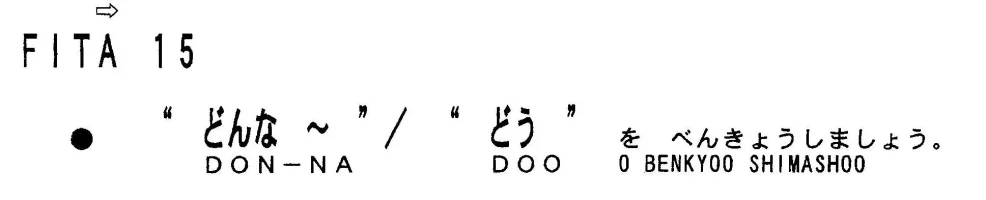
Hi guys. I'm new to Japanese, and a friend of mine (who is from Brazil) got me this "book" (more like 120 pages of teacher-made stuff) that his teacher gave him. Since it didn't has an index, I am writing one, but I'm having difficulty understanding the meaning of this title (the other had translation, but not this one). The title is annexed to this message, and if you are wondering about the meaning of fita is "tape" (like in VHS tape) in Brazilian (it is a home study course his teacher made, free!).

Thanks
Jonythunder

P.S.: Sorry for any English mistakes, but i'm not a native speaker.
 

Attachments

  • 062 - Cテウpia.webp
    062 - Cテウpia.webp
    27.1 KB · Views: 139
Thanks for answering my previous question!

I have some more questions:

1. From a newspaper article I read about the movie "Gantz":
就職活動中の大学生・玄野(二宮)と幼なじみの加藤(松山)は駅のホームで、酔っ払いを助けようとして電車にひかれてしまう。Can someone translate this for me? (I can't tell what's going on...)

2. How would one say "What movies have you watched"?

3. I've noticed that "ここ+length of time" is used to mean "recently," but how does one know when it's used for the past or for the future (besides waiting for the end of the sentence to hear if the verb is past or present tense?)
ここ二、三年は、ベビーブームで高校生の数が多いそうですよ。
ここ一週間雨が降らなかった。

よろしくお願いします!
 
Last edited:
1. "University students Kurono (Ninomiya) and childhood friend Katou (Matsuyama), while out looking for jobs, end up getting hit by a train at the train station's platform while trying to save a drunk."

2. I suppose 今までどの映画を観ましたか would work, but there may be better options. I think knowing what sort of time span you're asking about would be helpful, too. In their whole lives? Incidentally, I keep going back and forth as to whether to make it 観てきました, but that seems like it's focusing too much on the state of having seen movies, and not on the movies themselves. :sick:

3. I've only ever seen it used for recent past, or similarly to 最近 (i.e., "lately").
 
2. How would one say "What movies have you watched"?

3. I've noticed that "ここ+length of time" is used to mean "recently," but how does one know when it's used for the past or for the future (besides waiting for the end of the sentence to hear if the verb is past or present tense?)
ここ二、三年は、ベビーブームで高校生の数が多いそうですよ。
ここ一週間雨が降らなかった。

Glenn;670355 said:
2. I suppose 今までどの映画を観ましたか would work, but there may be better options. I think knowing what sort of time span you're asking about would be helpful, too. In their whole lives? Incidentally, I keep going back and forth as to whether to make it 観てきました, but that seems like it's focusing too much on the state of having seen movies, and not on the movies themselves. :sick:
3. I've only ever seen it used for recent past, or similarly to 最近 (i.e., "lately").

2. Alternatively, you can also say
(今まで)どんな映画を観ましたか?

3. ここ~ = past xxx
As Glenn san mentioned, it is not used for the future. Only the past event or for the duration of time until now.
ここ二、三年 past a few years (up to now)
ここ一週間 (for a week up to now)

高校生の数が多い : present tense is used because so far (for the past few years) the number is big and it has not changed now.
雨が降らなかった : past tense is used because as the past events during the period mentioned are being talked about.
 
3. I've noticed that "ここ+length of time" is used to mean "recently," but how does one know when it's used for the past or for the future (besides waiting for the end of the sentence to hear if the verb is past or present tense?)
ここ二、三年は、ベビーブームで高校生の数が多いそうですよ。
ここ一週間雨が降らなかった。
[6] 現在を含んだ、ある期間。現在を中心に過去にも未来にも用いる。

―数年、豊作続き

―数日が山だ
「ここ」の検索結果 - Yahoo!辞書

3 現在を中心としてその前後を含めた期間をさす。

今まで。「―一、二年というもの、病気ばかりしていた」

これから。「―数年で街もすっかり変わるだろう」

この先 would be more common and clear-cut in meaning for the future, but ここ can be used, too. ここ数日が山だ is a really good example, I believe.;-) Generally, it's hard to know the meaning (the past or the next) till you hear the tense of the verb/adjective at the sentence end. Furthermore, ここ二、三年 in the example sentence can mean both "for the past two or three years" and "for the next two or three years".(The former would be more common, though.)
 
2. Alternatively, you can also say
(今まで)どんな映画を観ましたか?
How about a better question like "How many movies have you ever seen ?" like ((Ima/kore made (ni)) nan bon eiga wo mimashitaka ?

There are several possibilities - just don't use "mita koto ga aru" instead of mimashitaka ? (And don't ask me why !) :D
 
Last edited:
hi... what is "little sister" in Japanese? my sentence will be like, "I miss my little sister."
 
I need a phrase translated:

"We will never forget you" ( or "you will never be forgotten" )

It is a phrase that I need because my most favorite teacher died a while ago, so I think it will need a high formality, or am I wrong about that?
 
Hi all! Thanks for answering my questions last time- I really appreciate all your help :)

I have a question about the "Te-form of transitive verb + ある" structure, as my textbook calls it. Could you use that to say that you've already brushed your teeth? (haha I know this sounds random, but I'd really like to know)

歯はもう磨いてある--would that make sense?

よろしくお願いします!
 
I think you'd just say 歯をもう磨いている there. If it's 〜てある I think it has to be for some purpose. I think it's mostly used with 書く and 開ける (personal experience). There may be more to it that I'm missing, though.

I need a phrase translated:
"We will never forget you" ( or "you will never be forgotten" )
It is a phrase that I need because my most favorite teacher died a while ago, so I think it will need a high formality, or am I wrong about that?
Are you going to be saying this at a eulogy-type situation? I mean, is this a speech you're going to be giving?
 
Last edited:
Hi all! Thanks for answering my questions last time- I really appreciate all your help :)

I have a question about the "Te-form of transitive verb + ある" structure, as my textbook calls it. Could you use that to say that you've already brushed your teeth? (haha I know this sounds random, but I'd really like to know)

歯はもう磨いてある--would that make sense?

よろしくお願いします!
歯はもう磨いた would be more common. もう磨いてある emphasizes that you did it to prepare something, as Glenn-san mentioned. (e.g. you are going to go to a dentist.)
 
Are you going to be saying this at a eulogy-type situation? I mean, is this a speech you're going to be giving?
Well, I'm going to use it in a speech, but I also want to write it down on a poster (we always do those things when someone who teaches at our school dies)
 
I need a phrase translated:
"We will never forget you" ( or "you will never be forgotten" )
It is a phrase that I need because my most favorite teacher died a while ago, so I think it will need a high formality, or am I wrong about that?
先生のことは決して忘れません。

This can be used both in speech and on paper.
 
先生のことは決して忘れません。
This can be used both in speech and on paper.
I thought also of 先生のことを決して忘れてならない but it translates better as I can never, never forget the teacher. 😊
 
Can someone please translate these sentences for me in English? Thank you! ^.^
悪かったら、すでにこの時点でつらいよね

でも、こういう機会だから、言いますけど、最近リーダーを見習いたいなって部分が結構あって…

and also ,what does 演出面 and 切ないバラードmean?

thanks!
 
Last edited:
Can someone please translate these sentences for me in English? Thank you! ^.^
悪かったら、すでにこの時点でつらいよね

でも、こういう機会だから、言いますけど、最近リーダーを見習いたいなって部分が結構あって…

And also ,what does 演出面 and 切ないバラードmean?

Thanks!

Do you need to translate only those sentences? I mean, do you really understand the rest part of their conversations? If so, I wonder why you can't get such a commonplace phrase like 切ないバラード.:emoji_fearful:
 
Hey guys been awhile. I'd like to know what 仕事上 means and how its read (しごとじょうかな). Comes from:
日本人と引越し

日本人は北米の人たちに比べて、一般にあまり引越しをしません。(仕事上、定期的に移動しないといけない人も中にはいますが。) いったん家を買うと、たいていその家に一生住むことになります。私も日本を離れるまで、一度も引越しを経験しませんでした。両親は私が育ったその家に今でも住んでいます。なじみのある家に帰ることができるというのは、いいものです。家はほとんど昔のままで、子供のときの思い出がいっぱい詰まっています。多くの日本人は、引越しすることを考えることがあまりないと思います。その結果、たくさんのものを(使っていないものや、いらないものも含めて)ただでさえ小さい家に、ため込みがちです。私も、母が何年もしまっておいてあるものに、時々驚かされることがあります。

Thanks

Edit: Sorry, I also would like the meaning of ためこみがち, seems like its saved up goods or possessions something like that?.
 
Hi all! Thanks for answering my question last time- I really appreciate all the help :)

I have a question about two sentences I read in my textbook:

運転前には、次の点をチェックしましょう。
発車する前には、車の前後に人がいないかどうか、車の下に子供がいないかどうか確かめましょう。

Is there some specific reason why "before driving" is written as 運転前 and not 運転する前 like in the second sentence?

I also have a question about the various ways of saying "acquaintance": 顔見知り、知人、知り合い
Are there any differences between these three? and are there any other ways to say "acquaintance"?

よろしくお願いします!
 
Last edited:
Back
Top Bottom