Elizabeth
先輩
- 22 Apr 2003
- 9,839
- 135
Did you check the dictionary ?大ばん小ばん出てきました。
Can you translate this please.
Lots of something comes out in different sizes, but I couldn't figure out what it is.
 They fit the context as 大判 and 小判 I do believe.
Follow along with the video below to see how to install our site as a web app on your home screen.
Note: This feature may not be available in some browsers.

Did you check the dictionary ?大ばん小ばん出てきました。
Can you translate this please.
Lots of something comes out in different sizes, but I couldn't figure out what it is.
They fit the context as 大判 and 小判 I do believe.
-darou is used after verbs. But -karou here comes after adjectives. I insist that it is something different from what you say.

I would like to offer another hypothesis.-darou is used after verbs. But -karou here comes after adjectives. I insist that it is something different from what you say.
Well, let's look at this, since it came up. na-adjectives are actually 形容動詞 or adjectival verbs. Although in modern usage there is no distinction, historically, there are two types, the なり活用 and たり活用 .undrentide said:Since "ku" is a part of conjugated i-adjective, I don't think there's such a form for na-adjective.


"and wondered whether there wasn't anything he could do."and thought that there was nothing he could do."
My reading would be slightly different and more within the scope of this:働くということの大変さを近くで見て、何かできることはないかと考えました。
"He looked closely at the difficulties of working, and thought that there was nothing he could do."
近くで <- This is not "IN the vicinity" but a noun in adverb form meaning "Closely". Correct?
Also:
働くということ <- Is there any difference between this and just "Shigoto"? I'm a bit curious here.
As always, help is always greatly appreciated.
My reading would be slightly different and more within the scope of this:
Looking at the difficultly of the work being done by people close to me, I wondered if there wasn't anything I could do (for them) ? ☝

Sorry for butting in.A man is talking about his friend who has gone blind:
目が見えないのに、働くということの大変さを近くで見て、何かできることはない
かと考えました。
I think they were trying to say "Colts won !" (*Colts win !).can someone please translate this:
コルツ勝ったでぇー
thanks again
Sorry for butting in.
I would break this sentence as follows:
目が見えないのに、働くということ working without being able to see
の大変さを difficulty/difficulties of
近くで closely
見て、 saw
何かできることはないか is there anything I can do (for him)?
と (quote)
考えました。 I thought
Having seen closely (his) difficulties of working without being able to see, I wondered if there's anything I can do (for him).
Regards to everyone that answered everyone from me as well !Ah, thank you. That brings everything into perspective. I definitely need to study more sentences with this kind of content. I don't enjoy tripping over everything I come across, but eventually I'll get where I want to. Thanks also to Elizabeth and Mikawa Ossan.
One step towards clarity that would help a lot, though, would be to include as much of the text in the original question as possible....Context is such a faithful, taken for granted friend in Japanese it's easy to forget what a contribution it often can make.
It's actually probably most natural to think of as "personally witnessed" or "saw for myself " in English. 直接見てということでしょうね。働くということの大変さを近くで見て、何かできることはないかと考えました。
"He looked closely at the difficulties of working, and thought that there was nothing he could do."
近くで <- This is not "IN the vicinity" but a noun in adverb form meaning "Closely". Correct?

あれえ、゛あか゛で作ったにんぎょうが、本物の子どもになって
In this sentence it is written as "aka", not "ake" as in previous one.
I wanted to know how would you say 'gesturing with your hand'?
For example, how would you say to someone, "Hey, that person behind you is using hand signals to tell you to move out of the way".
Acutally, thinking about it now, I don't even know how to say that in English. But still I would like to know how to say that in Japanese.
Hello [yeah, Konnichiwa, that one's easy], it's very nice to meet you [I know this too, Hajimemashite].

- After this I'll probably pause and wait for a response and if they ask my name, I'll give to them. But this next one I haven't figured out yet.
I'm very happy that you decided to tour in America. I've been a fan of yours for many years.
Thank you so very much! This is going to be mega helpful and I hope that if I meet them, they'll be impressed that I'm attemping to talk to them in their language. ^__^ I'm sure it's hard for them to tour in a country where Japanese isn't really a big language, ha.Yes, well done.
Note that "hajimemashite" can be used only when you meet the person for the first time. So it is more like "how do you do?".
But I'm sure you'll meet them for the first time in person, so hajimemashite is appropriate.
Amerika ni tsuaa ni kite kurete tottemo ureshii desu.
(I'm veeery happy that you come to America for a tour)
[watashi] nan'nen mo maekara zutto Dir en Grey no fan nan desu!
(I've been your fan since many years back)
*You can omit "watashi", because it is obvious that you are talking about yourself.
I hope you'll enjoy their concert and have a great time!

この年まで子どもがいないわしらに、この先、子どもができるわけがない。わしらの体の゛あげ゛をあつめて、にんぎょうでもこさえておくか
The word "age" in the sentence above is written in quotes in my reading book. I couldn't find its meaning in my dictionary.
By the way, there is no question mark or point at the end of this sentence. Is the か at the end a question tag?
Any answers?あれえ、゛あか゛で作ったにんぎょうが、本物の子どもになって
In this sentence it is written as "aka", not "ake" as in previous one.
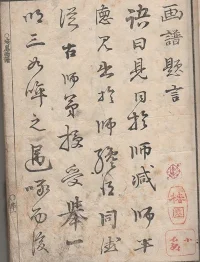
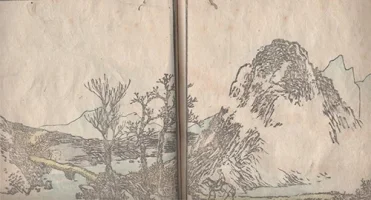
Your grandfather may well have gotten this in Japan, but it is not written in Japanese. It is written in Chinese, and unfortunately, I can not read it.Zaida said:Not sure if this is a Japanese book or not. Anyway the story is I was cleaning my attic and inside this chest was this old book. I opened it and it has a lot of old artwork that someone did and in front page was this kanji writing. Can anyone tell me what it says? Especially the "red stamp"if possible. I scanned the page and scanned one picture , I wonder what this book is. My grandpa went to japan years ago and I assume this was his book since it was in his personal chest of belongings. Thanks!
Are you certain you're quoting this correctly? Could you provide more context? And yes, か is a question marker.Any answers?

Undrentide-san had already answered your question.Any answers?
: