

Navigation
Install the app
How to install the app on iOS
Follow along with the video below to see how to install our site as a web app on your home screen.
Note: This feature may not be available in some browsers.
More options
Style variation
System
Light
Dark

You are using an out of date browser. It may not display this or other websites correctly.
You should upgrade or use an alternative browser.
You should upgrade or use an alternative browser.
Need a word or phrase translated?
- Thread starter Buntaro
- Start date


Elizabeth
先輩
- 22 Apr 2003
- 9,839
- 135
はい、ありがとう。そのとうり!読み誤ってしまいましたね。Cue;420750 said:Elizabeth san, could that 什上げ be 仕上げ(finish), perhaps?

うまくなったかな??
 。。。 多分、早朝に、漢字を読んでみないほうがいい。。。
☝
これからも、問題なく、そのお茶を作れますよ。

beretta627
後輩
- 1 Jan 2007
- 3
- 0
re: help translating
Hi ... I'm new to the forum ... I just don't understand this! Please help me out! Thank you so much...
All the best,
Mark
Hi ... I'm new to the forum ... I just don't understand this! Please help me out! Thank you so much...
All the best,
Mark
Last edited:


beretta627
後輩
- 1 Jan 2007
- 3
- 0
Hey guys, can you please translate this one for me please? Thank you so much!
敬君上機嫌だったもの・・・つい本音がポロリ(?)だったかな
Happy New Years!
Mark
敬君上機嫌だったもの・・・つい本音がポロリ(?)だったかな
Happy New Years!
Mark

- 17 Sep 2005
- 6,017
- 1,970
akemashite omedetou gozaimasu"akemashiteomedetougozaimasu"
Guys may i know how to break it?
thanks alot!
Elizabeth
先輩
- 22 Apr 2003
- 9,839
- 135
I'm not completely confident, so all I will venture to piece together is that "I wonder if Takeshi inadvertently expressed his true feelings because he was in such a good mood." :? Why the question mark ?beretta627;421227 said:Hey guys, can you please translate this one for me please? Thank you so much!
敬君上機嫌だったもの・・・つい本音がポロリ(?)だったかな
Happy New Years!
Mark

Niedy
猿が去る
- 11 Nov 2006
- 128
- 1
If I could get to the reason why I was no more aware what to do,
then that would enable me to do something.
But I could not know at all, what went wrong,
so the story did not go anymore.
Ach, mein englisch ist so schlimm, nein, my english is so bad.
I think its fine ^-^ Danke!
Niedy
猿が去る
- 11 Nov 2006
- 128
- 1
me again... the book again... she is still talking about being stuck in a game...
どっかで石版を探し損ねているのだと思うが、心あたりは一応全部あたったし、思いあたることはやるだけやったつもりだ。
I have a huge problem with どっかで石版を探し損ねているのだと思うが what is that litography thing doing in that sentence... after that as far as I understand it says something like: "My knowledge was all-in-all helpful (?), and I think I did everything I could think of."
Well, thanks again for any help...
どっかで石版を探し損ねているのだと思うが、心あたりは一応全部あたったし、思いあたることはやるだけやったつもりだ。
I have a huge problem with どっかで石版を探し損ねているのだと思うが what is that litography thing doing in that sentence... after that as far as I understand it says something like: "My knowledge was all-in-all helpful (?), and I think I did everything I could think of."
Well, thanks again for any help...

undrentide
Japa'n vagyok
- 18 Jan 2006
- 3,652
- 310
Glenn;422163 said:"I think I failed to look for the lithograph somewhere, but all my ideas were mostly right, and I'm certain I did everything I could think of."
Glenn's translation is excellent.

If anything, I think あたった of 心あたりは一応全部あたったし could be "to check" rather than "turned to be right/correct".
"I checked/searched all the possible places I could think of" for instance.

Absolute Zero
Zero's Dark Side
- 21 Oct 2006
- 484
- 1
Can anyone tell me what "Sakuretsu" means? Thanx.

Glenn
一切皆苦
- 8 Jan 2004
- 7,842
- 200
の英語・英訳 - プログレッシブ和英中辞典 - 英語辞書
You can also use Jim Breen's WWWJDIC to look up words you want to know the meaning of.
You can also use Jim Breen's WWWJDIC to look up words you want to know the meaning of.
Absolute Zero
Zero's Dark Side
- 21 Oct 2006
- 484
- 1
Thanx Glenn. I play Yu-gi-oh! and I have Sakuretsu Armor. I wanted to know what it meant.
Niedy
猿が去る
- 11 Nov 2006
- 128
- 1
"I think I failed to look for the lithograph somewhere, but all my ideas were mostly right, and I'm certain I did everything I could think of."
That's my attempt without any knowledge of the context. Does it help at all?
Thanks, that makes a whole lot of sense...
@undrentide : I'll take that into account too... thanks a lot...
I probably will be back :emoji_blush:
Elizabeth
先輩
- 22 Apr 2003
- 9,839
- 135
Maybe because they are supposed to be ambiguous, but 一応 and つもり are still the most annoyingly hardest parts here.Niedy;422159 said:me again... the book again... she is still talking about being stuck in a game...
どっかで石版を探し損ねているのだと思うが、心あたりは一応全部あたったし、思いあたることはやるだけやったつもりだ。
 一応 is closest to saying "everywhere I could think of, at least for now, I think I have somehow managed to check ?" Or it could be inserted as a softener without any particular meaning ? つもり is like I did what I could think of sufficiently, although I'm still a bit unsure...perhaps there was something left undone ?? ☺
epigene
相変わらず不束者です
- 10 Nov 2004
- 4,354
- 179
I am sure you pretty well know that Japanese evade displaying 100% confidence in declaring facts and opinions, stemming from the sense of humility that is upheld as virtue.Elizabeth;422474 said:Maybe because they are supposed to be ambiguous, but 一応 and つもり are still the most annoyingly hardest parts here.
So, 一応 and つもり is very often added to allow for, say, 0.01% chance of error, even if one is very confident that what one thinks is true. I know ambiguity is something not appreciated by English speakers, but that's the way it is.

I don't like it but catch myself using it very often, too.

Niedy
猿が去る
- 11 Nov 2006
- 128
- 1
Tadaima this time its not about a book or translating... I just don't know what 清道 means or how I should read it... I found kiyomi as a possible reading...
its at the end of
博多祇園山笠のクライマックスにあたる行事。午前4時59分に一番山笠が山留めをスタート、博多の総鎮守櫛田神社境内の清道を回って奉納する。 (source: Wikipedia)
I'm doing a speech about the 博多祇園山笠 and that part is about the 追い山 early on the 15th July (omoshirokatta)...
sorry to be bothering you again...
this time its not about a book or translating... I just don't know what 清道 means or how I should read it... I found kiyomi as a possible reading...its at the end of
博多祇園山笠のクライマックスにあたる行事。午前4時59分に一番山笠が山留めをスタート、博多の総鎮守櫛田神社境内の清道を回って奉納する。 (source: Wikipedia)
I'm doing a speech about the 博多祇園山笠 and that part is about the 追い山 early on the 15th July (omoshirokatta)...
sorry to be bothering you again...
undrentide
Japa'n vagyok
- 18 Jan 2006
- 3,652
- 310
おかえりなさい。
I looked up some key words and found the following:
清道 seems to be pronounced "seidou", meaning "to purify the journey of the emperor (or someone/something of importance)". In case of 櫛田神社, a space on the left after you go through the 鳥居 (gate) into 境内 (within the shrine) is made 清道 during 山笠.
Hope it is of some help.
I looked up some key words and found the following:
清道 seems to be pronounced "seidou", meaning "to purify the journey of the emperor (or someone/something of importance)". In case of 櫛田神社, a space on the left after you go through the 鳥居 (gate) into 境内 (within the shrine) is made 清道 during 山笠.
Hope it is of some help.
Niedy
猿が去る
- 11 Nov 2006
- 128
- 1
undrentide;422613 said:おかえりなさい。
I looked up some key words and found the following:
清道 seems to be pronounced "seidou", meaning "to purify the journey of the emperor (or someone/something of importance)". In case of 櫛田神社, a space on the left after you go through the 鳥居 (gate) into 境内 (within the shrine) is made 清道 during 山笠.
Hope it is of some help.
its perfect, thanks...
now I actually know what to put on the vocab list... wonder if my teacher will understand me
Elizabeth
先輩
- 22 Apr 2003
- 9,839
- 135
文章をやわらかくする意味もありますね。epigene;422481 said:I am sure you pretty well know that Japanese evade displaying 100% confidence in declaring facts and opinions, stemming from the sense of humility that is upheld as virtue.
So, 一応 and つもり is very often added to allow for, say, 0.01% chance of error, even if one is very confident that what one thinks is true. I know ambiguity is something not appreciated by English speakers, but that's the way it is.
I don't like it but catch myself using it very often, too.
この文は、 みたいな肯定だけれど、やり残したこともあるかもしれない....
Anyone recognizes that kanji? I searched by radical, and stroke count to no avail. Hell, I even search Chinese only kanji, but I couldn't find it. Does anyone know the kun/onyomi of the kanji? I apologize, but only that rough sketch done in paint is what I have.
Also, the word 女, is there a way that it would somehow sound like あ, or perhaps a weird reading I'm not aware of?
Also, the word 女, is there a way that it would somehow sound like あ, or perhaps a weird reading I'm not aware of?
Last edited:
undrentide
Japa'n vagyok
- 18 Jan 2006
- 3,652
- 310
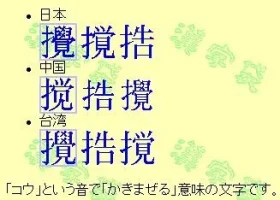
I've never seen it before, and the closest I could find in my 漢和辞典 (kanji dictionary) is 撹 and攪 (see attached image).Fehrant;422791 said:Anyone recognizes that kanji? I searched by radical, and stroke count to no avail. Hell, I even search Chinese only kanji, but I couldn't find it. Does anyone know meaning kun/onyomi of the kanji?
Where did you find the kanji you are asking about? It might be helpful for some of the members to search or answer...
女 can be pronounced め (女神 めがみ for example) but I don't know when it can be something close to あ.Fehrant;422791 said:Also, the word 女, is there a way that it would somehow sound like あ, or perhaps a weird reading I'm not aware of?
Sorry I cannot be of much help.
Attachments
Similar threads


- Replies
- 11
- Views
- 115K