


- 14 Mar 2002
- 21,050
- 18,904
A recent accident involving a low-flying U.S. military aircraft has reignited concerns about the "Orange Route," a designated training airspace that traverses the mountainous regions of Wakayama, Tokushima, Kochi, and Ehime prefectures.
In November 2024, a resident in Mugi, Tokushima Prefecture, was injured when startled by the noise of a low-flying aircraft believed to be from the U.S. military. This incident prompted the Mugi Municipal Assembly to unanimously pass a resolution on 13 December, demanding an immediate halt to low-altitude flight training by U.S. military aircraft.
Prefectural governments in Tokushima, Kochi and Ehime have urged municipalities and residents to report details of the low-altitude flights, including the date, time, location and number of aircraft observed. Data from noise measurement devices installed along the route has been used to petition Japan's Ministry of Foreign Affairs and the Ministry of Defense to demand that the U.S. military adhere to the 1999 agreement.
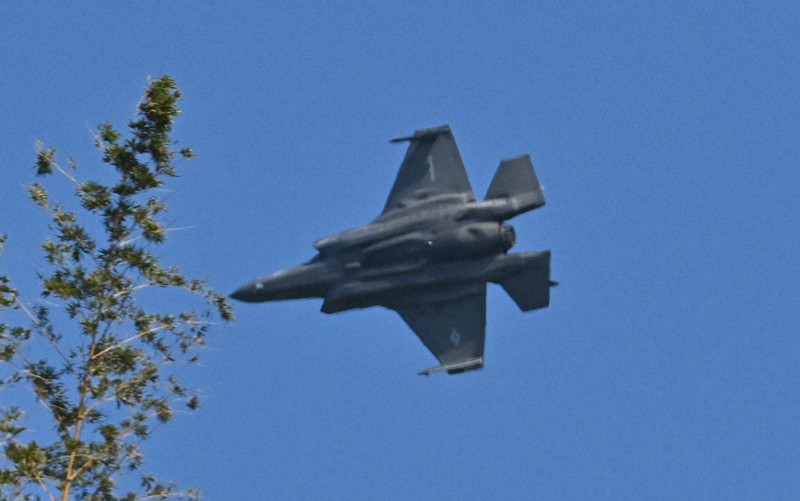
A F-35 on a low-level flight in Tokuhsima in November 2024

 mainichi.jp
In November 2024, a resident in Mugi, Tokushima Prefecture, was injured when startled by the noise of a low-flying aircraft believed to be from the U.S. military. This incident prompted the Mugi Municipal Assembly to unanimously pass a resolution on 13 December, demanding an immediate halt to low-altitude flight training by U.S. military aircraft.
Japan's Civil Aeronautics Act requires aircraft to maintain minimum altitudes of 300 meters over urban areas and 150 meters in other areas, except during takeoff and landing. However, the resolution noted that "low-altitude flights by U.S. military aircraft that disregard Japan's aviation laws have been frequently observed." This marks the fourth time Mugi's assembly has passed such a resolution, following similar actions in 2010, 2012 and 2019. The Orange Route has a history of controversy. In October 1994, a U.S. military aircraft crashed during low-altitude training in northern Kochi Prefecture, killing two crew members. Despite this, U.S. flights have continued in the area, raising long-standing concerns among residents.
Prefectural governments in Tokushima, Kochi and Ehime have urged municipalities and residents to report details of the low-altitude flights, including the date, time, location and number of aircraft observed. Data from noise measurement devices installed along the route has been used to petition Japan's Ministry of Foreign Affairs and the Ministry of Defense to demand that the U.S. military adhere to the 1999 agreement.
A F-35 on a low-level flight in Tokuhsima in November 2024
The Orange Route is one of several flight training paths established by the U.S. military in Japan. It spans mountainous areas across Ehime, Kochi and Tokushima prefectures in Shikoku and extends into Wakayama Prefecture. The route was designated when MV-22 Osprey aircraft were deployed to U.S. Marine Corps Air Station Futenma in Okinawa Prefecture. According to a 2012 document translated and published by Japan's Ministry of Defense, there are at least six such routes in Japan. These include the "Green Route" and "Pink Route" in northeastern Japan's Tohoku region, the "Blue Route" across the Tohoku and Chubu regions, and the "Yellow Route" in the Kyushu region. Like the Orange Route, these paths traverse mountainous areas.
Japan town assembly demands US military stop low flights for 4th time after woman's injury - The Mainichi
TOKUSHIMA -- The


