Gwen Stefani is Japanese

mdchachi

Moderator
Moderator
Twenty-year veteran
Joined
6 Mar 2003
Messages
9,318
Reaction score
9,447
An Asian American reporter is bent out of shape by Gwen Stefani's cultural appropriation of Japanese culture.
"I said, 'My God, I'm Japanese and I didn't know it,'" Stefani told Allure. She later insisted, "I am, you know," calling herself a "super fan" of Japanese culture.

Stefani made the remarks to Allure reporter Jesa Marie Calaor, who is Asian American.

"Like Stefani, I am not Japanese," she wrote. "But I am an Asian woman living in America, which comes with sobering realities during a time of heightened Asian American and Pacific Islander (AAPI) hate. ... I envy anyone who can claim to be part of this vibrant, creative community but avoid the part of the narrative that can be painful or scary."

I'm on Stefani's side. If it's not disparaging who gives a sh*?
In her interview with Allure, Stefani defended her use of Japanese culture and said it "doesn't feel right" if people are criticizing her for being "a fan of something beautiful and sharing that."

"[It] should be okay to be inspired by other cultures because if we're not allowed then that's dividing people, right?" she told Allure.

Even before the interview, Stefani had defended her "Harajuku" era.

In May 2021, she told Paper magazine: "If we didn't buy and sell and trade our cultures in, we wouldn't have so much beauty, you know?

"We learn from each other, we share from each other, we grow from each other. And all these rules are just dividing us more and more," she said.

 
Last edited:
An Asian American reporter is bent out of shape by Gwen Stefani's cultural appropriation of Japanese culture.


I'm on Stefani's side. If it's not disparaging who gives a sh*?


I think the most important factor is the feelings of the people whose culture is being appropriated (or not) about the issue. It's perfectly possible to adopt something of another culture in an attempt to honour it and cause offence to people of that culture. In this case, I can't imagine Japanese people being bothered, but as the reporter pointed out, she's cherry picking the bits of Japanese culture that she likes with no understand of the problems sometimes experienced by Asian people in America, which I imagine will annoy some Asian Americans.
 
I think whenever we discover something we like we want to get as close to it as possible, and some people want to make it a part of their identity. Perhaps it's also about taking control of their narrative, and trying to establish their own "tribal" identity. To me it seems pretty narcissistic to think in these terms, because they're reducing a culture to a label you can project onto yourself and claim for your own, rather than recognizing it as something you appreciate or something that resonates with you.

In Stefani's case, it seemed more like a dismissive throwaway to dodge the cultural appropriation conversation. She definitely took aesthetics and elements of harajuku (is "hara-gyaru" a thing?) culture, and stepped into an ethical gray area by profiting off it, but culture thrives and evolves by being shared. The attention she brought to this subculture may have even been a boon for some Japanese people positioned to capitalize on it... I don't know how much collaboration she did with actual progenitors of that culture but promoting them and saying "look at what these people are doing, I love this, let's jam together" is a far cry from "this is my culture" and trying to serve as a peephole into that culture for your audience. I don't know how the French Japonisme artists talked about their influences, but I doubt any of them started claiming to BE Japanese, no matter how much they loved ukiyo-e .

think her biggest misstep is actually in failing to recognize that the cultural question isn't about her; she made it about herself by reducing the culture she'd been profiting from to a badge for her to wear.
 
Up to this thread, I had never heard of Mrs Stefani, but I like how the Japanese reacted to that farce. :)

When Eriko Sairyo, a 30-year-old professional who lives in Shizuoka, Japan, saw that American pop singer Gwen Stefani was being accused of "cultural appropriation" in Western media, she couldn't understand the controversy. "I personally think that it's pretty cool that people want to incorporate Japanese styles into their fashion," Sairyo, who works in the medical devices industry, told Al Jazeera. "I don't have any issues when, for example, foreigners wear kimonos and walk around Kyoto for sightseeing. I love it that people love our culture."

And:

In Japan, the controversy has barely registered a blip. Japanese media have largely ignored the Stefani interview, with the only references to the controversy appearing on small webzines and blogs. [...] Sairyo said most Japanese are neither familiar with nor sensitive about cultural appropriation. This once-obscure academic term has recently moved from US university departments into the Western mainstream. Some Japanese even use the term pori-kore – a portmanteau of "political correctness" – to describe those who discuss such issues, she said. Lyn Tsuchiya, a 23-year-old Japanese professional living in Tokyo, said she was unfazed by Stefani's comments. "I think it's fine to take inspiration from something you love into your work, as long as there is respect, with no stereotypical themes or misconceptions involved," Tsuchiya told Al Jazeera.

 
I thought Gwen Stefani's "Harajuku Girls" schtick was a bit cringey at the time. It pandered to a certain stereotype. But, as the saying goes, it neither picked my pocket nor broke my leg. It was also a way for a ton of American teenagers to become exposed to this phenomenon of Harajuku street fashion, in all its forms: from the cute to the outlandish. And...it was 15 years ago. Not that there is a statute of limitations on cringey behavior, but really...how worked up do we need to be?

Her comments about being Japanese are stupid and are the stuff of facepalm memes, but does it rise to the level of Rachel Dolezal (the white lady who insists she's black)? The girls themselves (the ones who appeared in the video) used it as a springboard to further their dancing careers - more power to them. Gwen apparently had a lot of exposure to Japan through her father's business - so it seems she has a genuine appreciation for Japan, even if it may be shallow. But of course Twitter is throwing itself into a frenzy of outrage and counter-outrage without any room for nuance.
 
It feels especially silly to get worked up over a throwaway comment when there are people like Oli London, a British guy who got a bunch of plastic surgery to claim he's now Korean, or Rachel Dolezal, who passed herself as black and rose to some prominence before being exposed for fraud.
 

Attachments

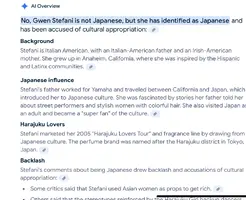
  • IMG_0154.webp
    IMG_0154.webp
    105.6 KB · Views: 76
Whatever she said in that one interview was probably tongue in cheek. It's not like she has a history of claiming to be Japanese.
 
Whatever she said in that one interview was probably tongue in cheek. It's not like she has a history of claiming to be Japanese.
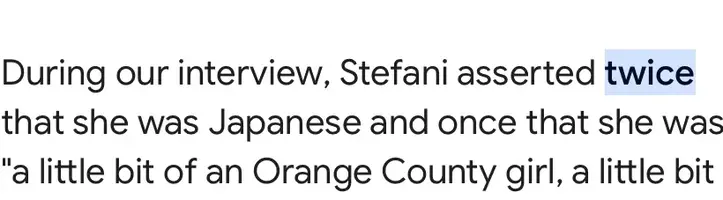
Maybe this is one interview, but it is two claims. (I can't stand it when people claim to be a certain nationality that they aren't.)
 

Attachments

  • IMG_0155.webp
    IMG_0155.webp
    15.9 KB · Views: 61
When I lived in Japan, people there told me I was Japanese all the time, even though I most definitely am not. I sometimes would respond by saying, "perhaps I was in a prior life."

Perhaps Japanese are less sensitive to these things due to their history of not having suffered nearly the humiliation/exploitation of other nations/countries in the not too distant past.

In my opinion, this is nothing like the Dolezal case. Stephani did not profit at any Japanese person's expense by this. She is not misleading or lying to people as a way to further her career. It's a comment that would go largely unnoticed in Japan itself. I think it's a non-issue, unless you're just looking for a reason to be upset. At that level, it's no different than any other trivial reason to be aggrieved.
 
Back
Top Bottom