Economy The weakening of the yen

At the rate US politicians are giving away money and going trillions in debt , our dollar may soon become worthless.View attachment 114626
I don't see any evidence for this, however much it suits your view of the Biden government. Have a play with this site yourself. The US dollar has not changed much over the last 2 years and in fact has slightly strengthened against other major currencies.
 
Seems way back , it had to be proved the US had the gold to back any money printed. I vaguely recall them doing inventory on the gold in Fort Knox. I haven't seen anything about that for many years. The value of the dollar now is not what I worry about , it's way down the road in the future that I wonder about.
 
The 'value' of the US dollar is quite high right now, and if it goes down I would see that as reverting to the norm, or average, over the last 5-20 years. (tho conspiracy theorists would have a field day) And in my opinion, it will probably revert at some point.

Americans complain about inflation, but in fact US inflation is less than in many other parts of the world. And if the dollar drops, that could be inflationary, since the US imports quite a lot, and a weaker dollar would make imports more expensive.

*

The US pretty much went off the gold standard in 1933, tho kind of went back on in 1944 (bretton woods), but then that failed (miserably) and in 1971 that agreement was tossed and the agreement was dead (and a Republican president--Nixon--did that). That's when the yen started appreciating from the 'artificial' level of ¥360:$1.The idea of returning to a gold standard has been tabled now and then, but most economists believe that it's impractical/impossible to do so, and that it would cause economic chaos.
 
With US inflation taking its toll, the BOJ might edge closer to intervening. However, experts say this is unlikely to have any effect.

On Friday, the Japanese yen experienced a sharp decline, falling below 158 JPY to the U.S. dollar. This drop occurred after the Bank of Japan decided to maintain interest rates despite the fading prospects of an early U.S. rate cut. The 158 level represents a new 34-year low for the yen, which had previously hovered around the mid-155 JPY range before the BOJ's decision. While there is speculation that Japanese authorities may intervene to support the yen, the U.S. interest rate outlook suggests that Tokyo's options for altering the overall direction of exchange rates are limited.


Masamichi Adachi, chief economist for Japan at UBS Securities and a former BOJ official, said in a note Friday that he thinks the Finance Ministry "will intervene in the FX market to buy the yen and sell the U.S. dollar very soon, possibly today, London time or New York time." Shoki Omori, chief desk strategist at Mizuho Securities, said, "Today's [yen] move was a shock. But the move is gradual and that is not going to be a reason for intervention." But considering the yen's fall to a fresh 34-year-low, "intervention could come anytime," he said. "The ball is in the dollar's court. An intervention is not going to work because the dollar is so strong," he added. Japanese Finance Minister Shunichi Suzuki said Wednesday that he is "watching the market moves with a high sense of urgency," suggesting a move may be coming.


Paywall alert:


On Japanese TV, news crews interviewed Japanese tourists bound for the U.S. during GW: many brought Japanese food items to save on their (now prohibitively) expensive trip. :oops:
 
Interesting to read various views of it. Some think Japan is not exporting enough any more to build back strength and intervention will not work like My Financial Times Oped On The Yen

Some imply due to the weak yen you could almost get trapped in Japan like retirejapan Don't move to Japan or consider leaving Japan if you are there.

On the other hand my wife wants us to go back to japan at a minimum when I retire (I am 50s now). If I do the US dollar retirement may give us a better standard of living if the dollar stays stronger than the yen, taxes get interesting though.
 
Last edited:
Some imply due to the weak yen you could almost get trapped in Japan like retirejapan Don't move to Japan or consider leaving Japan if you are there.

If you are an expat looking for a quick buck, that's sound advice. However, many of us do not have that choice due to family circumstances, age, etc. And surely, Japan will not become a third-world country any time soon. :)
 
If you are an expat looking for a quick buck, that's sound advice. However, many of us do not have that choice due to family circumstances, age, etc. And surely, Japan will not become a third-world country any time soon. :)
I agree they will not become a third world country any time soon. The retirejapan person who wrote has lived in Japan around 25 years himself and is staying. I guess the point is if you are not committed to spend the rest of your life in Japan then to try and move abroad if the yen does not recover can be prohibitively expensive trapping you. This is a lot of assumptions (how confident are we on the future value of the yen vs the US dollar or Euro or pound?). In your case I would stay, as I believe you are also in your 50s does not make a lot of sense to leave.
 
Yes anybody there now is pretty much trapped. But there are worst places to be stuck in the world.
 

Not certain yet, but it looks like relief efforts are beginning. As expected, actually, I didn't save a link to the article but one of the CNBC frequent guests had explained that there would likely be an intervention if the 155JPY line was crossed.

What's less clear to me is how effective such support is and what the secondary effects are. Also, yeah, like thomas points out, in the initial article in this topic the value of the intervention in the first place is questionable.
 
Last edited:
Yes anybody there now is pretty much trapped. But there are worst places to be stuck in the world.
Yea it would not be so bad at all.

No worries, the 日本酒 is still flowing here. :)


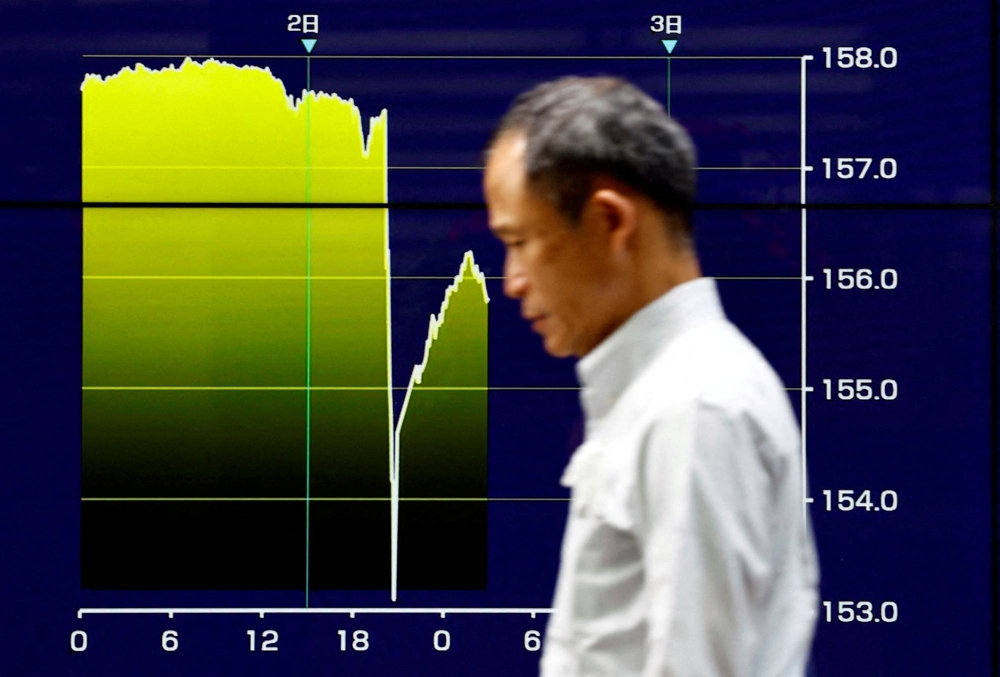
The yen miraculously recovered after dropping to 160 against the dollar yesterday, triggering suspicions that the Japanese government might have intervened.

The Japanese yen experienced a significant increase after momentarily falling beyond 160 against the U.S. dollar on Monday morning, marking a new 34-year low against the U.S. currency. At a certain point, the yen recovered, strengthening by 5 yen against the dollar. As of 10 p.m., the yen was valued at 156.40. Additionally, the yen dropped below 171 per euro, reaching a record low since the inception of the European currency in 1999. By 10 p.m., it was trading at 167.40.

Paywall alert:


What is a currency intervention?

Japan employs two primary types of currency interventions: selling dollars for yen to rectify excessive weakness in the yen, and selling yen for dollars to address excessive strength in the yen. The legal authority to decide on an intervention lies with the finance minister, although the vice minister of finance for international affairs often makes the actual decision. The Bank of Japan (BOJ) then executes the intervention on behalf of the finance minister. In a yen-buying intervention, the BOJ sells dollars from the Ministry of Finance's Foreign Exchange Fund Special Account to private banks and purchases yen. Given that Japan imports a significant portion of its food and natural resources, a weak yen can make imports more expensive, potentially leading to inflation. Rapid changes in exchange rates can also pose challenges for businesses, and buying yen can be beneficial in such situations. Interventions can also occur outside of Japanese trading hours or on holidays, either through the BOJ trading in foreign markets or via overseas intermediaries like the Federal Reserve Bank of New York or the European Central Bank. Requests for such assistance are reportedly seldom, if ever, refused.

Examples of Japanese currency interventions

In September and October of 2022, Japan intervened in the currency market three times, expending approximately 9.2 trillion yen ($58.7 billion at current rates). The Finance Ministry strategically times these interventions to optimize their impact. The intervention in September was conducted following a news conference by then-BOJ Governor Haruhiko Kuroda at the latest monetary policy meeting. The interventions in October were executed either early in the morning or late at night during periods of reduced market scrutiny. It's believed that Japan carried out the 2022 interventions independently, utilizing only its own foreign reserves. However, currency authorities also have the option to conduct coordinated interventions with foreign counterparts, allowing them to combine resources for a more significant market impact. Historically, Japan and the U.S. performed a coordinated yen-buying intervention in June 1998. The 1985 Plaza Accord was a joint effort by the U.S., Japan, the U.K., West Germany, and France to restrain the excessive strengthening of the U.S. dollar. The Group of Seven also participated in currency interventions, purchasing euros in 2000 and selling yen in 2011.

Paywall alert:


Not certain yet, but it looks like relief efforts are beginning. As expected, actually, I didn't save a link to the article but one of the CNBC frequent guests had explained that there would likely be an intervention if the 155JPY line was crossed.

What's less clear to me is how effective such support is and what the secondary effects are. Also, yeah, like thomas points out, in the initial article in this topic the value of the intervention in the first place is questionable.
These relief efforts have had very little effect. Since the big intervention a few days ago (and I can't see any other reason for the sudden appreciation of the yen), the pound and dollar have regained two-thirds of their lost value against the yen and the euro has regained half of its lost value.
 
These relief efforts have had very little effect. Since the big intervention a few days ago (and I can't see any other reason for the sudden appreciation of the yen), the pound and dollar have regained two-thirds of their lost value against the yen and the euro has regained half of its lost value.

Sadly true.

Dollar-yen rate 1 May 2024 after BOJ intervention


We don't know how much was pumped into that intervention, but it didn't last long. :(
 
Another intervention this morning ... and the US dollar has regained half its lost value in a few hours. I'm getting sick of the BOJ pissing away its reserves.
 
For just my wife and I , it runs about $200 US almost every week and we are not big eaters.
 
Sugar free soda is my downfall. I drink about 10 to 12 bottles a week because I hate plain water or juices. Since today's health problems all seem to be solved with prescription pills , that's a hefty cost every 90 days when you get older , LOL.
 
9.7885 trillion JPY

Japan has recently confirmed its intervention in the foreign exchange market to support its currency against the dollar. Over five weeks between 26 April and 29 May, the Ministry of Finance purchased 9.7885 trillion JPY. This amount exceeds the record annual intervention of 9.188 trillion JPY in 2022. The yen initially jumped to 154 against the dollar on 29 April after falling below 160. On 1 May, it rallied again in New York, reaching 153 from 157. Although the ministry did not confirm its market entry then, traders and analysts suspected that intervention was responsible for the yen's rally.

As of the end of April, Japan had foreign exchange reserves worth $1.278 trillion. "We think the [Ministry of Finance] can credibly defend the yen for now, be it 160 or 165, with enough liquid dollar assets in the reserves," Bank of America Securities economists said in a research note on Thursday, adding, however, that the yen could fall to 165 without intervention. Currency intervention is a delicate subject for Group of Seven countries. The nations have agreed that "excess volatility and disorderly movements" can be dealt with but also that exchange rates should be determined by the market. Such principles are especially important for global currencies like the yen, which is the third most actively traded unit after the dollar and the euro, accounting for 17% of global volume, according to the Bank for International Settlements.


Paywall alert:
 
I have a question for you all. I'll be leaving for Thailand at the end of the month. I will be cycling/touring for a month. My question is this...
1. Should I exchange yen to dollars while I'm at Fukuoka airport?
2. Should I wait till landing in Bangkok and exchange Yen to Baht ?

I'm not sure if what I'm thinking is correct. I'm looking about 3 grand spending money for one month cycling around the country.
Thanks
 
I have a question for you all. I'll be leaving for Thailand at the end of the month. I will be cycling/touring for a month. My question is this...
1. Should I exchange yen to dollars while I'm at Fukuoka airport?
2. Should I wait till landing in Bangkok and exchange Yen to Baht ?

I'm not sure if what I'm thinking is correct. I'm looking about 3 grand spending money for one month cycling around the country.
Thanks
how fun! What's your plan? I've never been to Bangkok but I have gone to Railay/Tonsai near Krabi for climbing, Phuket and Khao Lak for a scuba trip, and Chiang Mai, Pai and Mae Hong Son in the north (and through Chiang Rai to get to Laos). I stayed at a forest monastery for a week up near Mae Hong Son, which is on the border with Myanmar. I highly recommend the northern part of the country.

Money-wise, you generally will take a hit every time you exchange money, so I would recommend just going straight from JPY to THB. Here's an article with more information:
 
how fun! What's your plan? I've never been to Bangkok but I have gone to Railay/Tonsai near Krabi for climbing, Phuket and Khao Lak for a scuba trip, and Chiang Mai, Pai and Mae Hong Son in the north (and through Chiang Rai to get to Laos). I stayed at a forest monastery for a week up near Mae Hong Son, which is on the border with Myanmar. I highly recommend the northern part of the country.

Money-wise, you generally will take a hit every time you exchange money, so I would recommend just going straight from JPY to THB. Here's an article with more information:
I had to get some Hong Kong dollars last year and got a really good rate at one of those little currency exchanges near Shinjuku station by Ame Yokocho. I wonder if there are similar places near you.
 
Back
Top Bottom