Ukiyo-e - Japanese woodblock prints and paintings
Ukiyo-e (浮世絵, lit. pictures of the floating world) are woodblock prints and paintings of a school of artists that emerged in the early part of the Edo period (1603-1868). With the increasing wealth of the merchants and the urban middle classes, ukiyo-e became tremendously popular. The subject matter revolves around the entertainment centres of its patrons, kabuki theatres and pleasure houses, landscapes, and scenes of history and folk tales. Ukiyo-e formats include albums and book illustrations, single-sheet prints, and greeting cards, ranging from inexpensive large editions to elegant, costly, or privately commissioned works. Ukiyo-e woodblock prints flourished throughout Japan and became one of the most characteristic forms of Japanese visual art in the Edo period.
Early ukiyo-e
The origins of ukiyo-e can be traced back to the early 17th century when the Tokugawa shogunate had established peace after centuries of war and conflict. The bakufu was still in the process of consolidating its power, and the shōgun had not yet fully implemented the repressive policies of later years. In the cities of Kyōto and Ōsaka, the distinctive milieu from which ukiyo-e would emerge was starting to flourish in the early Kan'ei era (寛永, 1624-1644). The earliest known genre paintings (風俗画 fūzokuga) depict the entertainment districts along the Kamogawa River in Kyōto with crowds of people partying, parading, quarrelling, and watching the sideshow attractions: they show society engrossed in the pursuit of pleasure across all social strata, samurai , priests, the highborn and the lowly. This depiction of hedonism was the subject matter for which ukiyo-e would be primarily known. The term ukiyo-e ("pictures of the floating world") is derived from the boisterous and flamboyant lifestyle of the entertainment districts.Fūzokuga (genre painting) by Miyagawa Chōshun (pre-1754)
The first famous ukiyo-e works, which used woodblock prints, appeared around 1660. Before the second half of the 17th century, the evolution of ukiyo-e could only be traced through the study of ukiyo-e painting (肉筆浮世絵 nikuhitsu ukiyo-e). Some early ukiyo-e artists, such as Miyagawa Chōshun (宮川長春, 1683-1753), were painters who rarely designed prints. Although woodblock printing had been practised in Japan for centuries, it would take until the early 18th century for prints to overtake paintings in ukiyo-e and until 1745 to develop techniques for colour printing. Until then, colours were added by hand.
Hishikawa Moronobu (Yoshiwara no tei, ca. 1680)
The earliest types of prints were of a sexual nature - manuals and courtesan critiques - often based on Chinese prototypes imported in the early 17th century. These works comprise albums and books of highly explicit love scenes between rarely completely naked figures, often with a touch of humour. Very few of the early "spring pictures" (春画 shunga) from around 1660 or shortly after have survived, nor were they signed, so the artists remain unknown. Hishikawa Moronobu (菱川師宣, 1618-1694) and Sugimura Jihei (杉村治平) are two of the first recorded artists whose individual works have been identified. Shunga became part of every ukiyo-e artist's stock in trade, and for many, it was their primary source of income.
Torii Kiyonobu (Ukiyo tsurezure, 1725)
"Courtesan critiques" (遊女評判記 yūjo hyōban ki) were picture books with commentaries and appeared at the same time as the first printed shunga. Although the pictures referred to the leading courtesans of the day, they were drawn entirely from imagination. The courtesans were displayed in their daily routine, adjusting their hair or reading and always at ease, emphasising their poses and draping. Those poses became tokens for later books, albums and prints dealing with courtesans. They became a long-lasting tradition manifested in masterpieces as Torii Kiyonobu's (鳥居清信, 1664-1729) Keisei ehon (傾城絵本, 1700), Suzuki Harunobu's (鈴木春信, 1725-1770) Ehon seirō bijin awase (繪本青樓美人合, 1770), and Santō Kyōden's (山東京伝, 1761-1816) Yoshiwara keisei shin bijin awase jihitsu kagami (吉原傾城新美人合自筆鏡, 1781).
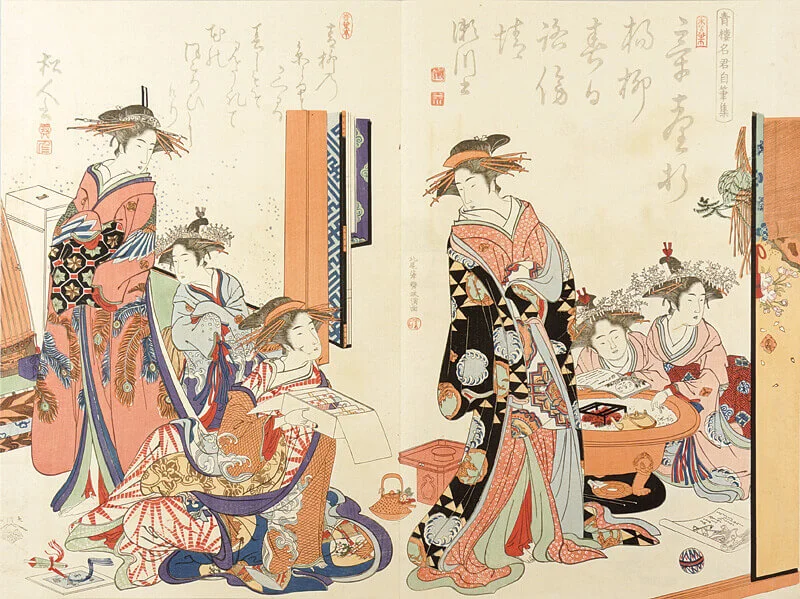
Santō Kyōden (山東京伝, 1761-1816), Yoshiwara keisei shin bijin awase jihitsu kagami (吉原傾城新美人合自筆鏡, 1781)
Another category similar to the courtesan critiques are bijin-e (美人絵), the pictures of beautiful women that frequently depicted higher-ranking courtesans known as tayū (太夫) or keisei (傾城, "castle breakers"), in an allusion to the devastating power of their beauty. One of the most characteristic images of ukiyo-e is the celebrated courtesan parading through the Yoshiwara district of Edo or the Shimabara district of Kyōto, flanked by two young female attendants. She is often preceded by an elderly maid carrying a lantern and followed by a servant holding an umbrella over her. The courtesans, with their elegance and refinement, inspired generations of artists. Some schools, such as the Kaigetsudō artisans who worked in the early 18th century, focused solely on this motive. Many of Kitagawa Utamaro's (喜多川歌麿, 1753-1806) prints from the 1790s depicted the lives of famous courtesans.
Suzuki Harunobu (鈴木春信, 1725-1770), Courtesan on veranda (ca. 1765-70)