

Navigation
Install the app
How to install the app on iOS
Follow along with the video below to see how to install our site as a web app on your home screen.
Note: This feature may not be available in some browsers.
More options
Style variation
System
Light
Dark
You are using an out of date browser. It may not display this or other websites correctly.
You should upgrade or use an alternative browser.
You should upgrade or use an alternative browser.
Why Japaneses copy everything?
- Thread starter power_of_foot
- Start date
- Status
- Not open for further replies.


TwistedMac
後輩
- 4 Mar 2004
- 2,267
- 96
why do soooooo many english words look like french words? and isn't paris the place for trendsetters for all of europe and fashionable americans?
trying to say we want to be french?
i don't, that's for god damned sure
trying to say we want to be french?
i don't, that's for god damned sure

sima_yi
engineer
- 12 Aug 2004
- 95
- 3
You don't quite answer my questions. Besides, since when I said or meant that Japanese ppl wanted to be Chinese -.-. Did you carefully read all my posts? The point I am trying to prove here is that Japan may learn some customs or cultures from Korea or China -.-.
sima_yi
engineer
- 12 Aug 2004
- 95
- 3
England once was ruled by Norman who were from France, so some English words are similar to French. But I didn't know that China or Korea once ruled Japan, so Japanese words are not necessary similar to Chinese or Korean. I think that Japan must send some students to ancient Korea or China to learn their cultues. But this thread says, "Why do Japanese copy everything?"; there is a big difference from copying and learning -.-. From my point of view, Japan learns what are good for its people and nation. The question I ask is set to prove that Japan didn't copy anything but adoption -.-.

Nuala
Hell's Finest Daughter
- 15 Jul 2004
- 1,725
- 39
The eiffel tower is a 1000 foot phallus, nothing to be proud of.nuovo said:Where did you get that? What's his name? The Eiffel Tower was built to represent France at the Universal exhibition!


jeisan
Kongming
- 24 Feb 2003
- 3,523
- 69
not neccesarily ruled but the cultures developed around each other, so there were things that got traded back and forth between them all. religion, words, customs, people, writing systems etc. just like the nations of europe. the japanese adopted the chinese writing system the kanji anyway but made their own additions to it with the kanas. similar to most western nations using the roman alphabet. though korean doesnt look anything like chinese or japanese, at least not to me.
sima_yi
engineer
- 12 Aug 2004
- 95
- 3
Well, I always want to get on Eiffel tower, but due to the lack of financial resource.......
1000 feet is real high, I bet one jump will be deadly LOlz
1000 feet is real high, I bet one jump will be deadly LOlz
Man, you really know Chinese, korean, and Japanese cultures and history very well. No wonder you are called "Kong Ming". I totally agree with what you say, but I can't put my mind into sentence. Thank you. (your words were in my mind originally, no copying Lolz)jeisan said:not neccesarily ruled but the cultures developed around each other, so there were things that got traded back and forth between them all. religion, words, cutoms, writing, people systems etc just like the nations of europe. the japanese adopted the chinese writing system the kanji anyway but made their own additions to it with the kanas. similar to most western nations using the roman alphabet. though korean doesnt look anything like chinese or japanese, at least not to me.
- 12 Aug 2004
- 73
- 4
jeisan said:not neccesarily ruled but the cultures developed around each other, so there were things that got traded back and forth between them all. religion, words, customs, people, writing systems etc. just like the nations of europe. the japanese adopted the chinese writing system the kanji anyway but made their own additions to it with the kanas. similar to most western nations using the roman alphabet. though korean doesnt look anything like chinese or japanese, at least not to me.
The Korean writing system is very different from the Japanese and Chinese systems. It is an alphabet, and quite a clever one, too! It is very unusual, because it is not based on any other system. All other alphabets are based (directly or indirectly) on the Phoenician alphabet. One of the clever things about it is that each letter is a diagram of how the mouth, throat and tongue are shaped when pronouncing the sound it represents. That helps make it easier to remember the letters, so it is probably the easiest alphabet in the world to learn. The letters are bunched into boxes representing syllables, so they look a bit like kanji.

Glenn
一切皆苦
- 8 Jan 2004
- 7,842
- 200
Thor said:The eiffel tower is a 1000 foot phallus, nothing to be proud of.
One could say the same thing about the Washington Monument.
jeisan
Kongming
- 24 Feb 2003
- 3,523
- 69
thanks, that i didnt know. i just always thought it looked very different and knew it was phoenetic, meaning they were sounds not words, but the whole shape of mouth etc is new to me.chikazukiyasui said:The Korean writing system is very different from the Japanese and Chinese systems. It is an alphabet, and quite a clever one, too! It is very unusual, because it is not based on any other system. All other alphabets are based (directly or indirectly) on the Phoenician alphabet. One of the clever things about it is that each letter is a diagram of how the mouth, throat and tongue are shaped when pronouncing the sound it represents. That helps make it easier to remember the letters, so it is probably the easiest alphabet in the world to learn. The letters are bunched into boxes representing syllables, so they look a bit like kanji.
and while we're on the subject of copying things that's an ancient egytian tower.Glenn said:One could say the same thing about the Washington Monument.

bossel
後輩
- 28 Sep 2003
- 1,485
- 45
Not quite so, it was probably - at least in parts - based on some older Mongolian script & 'Phags Pa (also Mongolian, based on Tibetan script). Before they developed their own script, the Koreans used Chinese for a long time, but also adapted/changed it to their convenience, like the Japanese.chikazukiyasui said:The Korean writing system is very different from the Japanese and Chinese systems. It is an alphabet, and quite a clever one, too! It is very unusual, because it is not based on any other system.
Again not quite so. I agree, most modern alphabets are based on Phoenician (except eg. Ethiopian). But Phoenician is not at the base. It has a predecessor in Proto-Canaanite, which itself was based upon other writing systems. Here is a nice family tree of alphabets.All other alphabets are based (directly or indirectly) on the Phoenician alphabet.
Hmm, as an afterthought: I think, the whole discussion is based on the false assumption that copying is something bad. I would say the contrary is true. If you don't copy something that is useful for you, you must be quite stupid. It's all nice & well to try developing things yourself, but if somebody else was quicker or smarter, why not adopt it?
- 12 Aug 2004
- 73
- 4
bossel said:Not quite so, it was probably - at least in parts - based on some older Mongolian script & 'Phags Pa (also Mongolian, based on Tibetan script).
Okay, sorry. On the evidence, the Koreans didn't have any model for their alphabet. There's no evidence that Hangul is based on Phags Pa beyond the remote possibility that it might be. Maybe the Koreans got the idea that it could be done from hearing or reading about Phags Pa, but Phags Pa never caught on and was not in use anywhere when Hangul was devised. Nor is there much resemblance between the alphabets, either in the way they are organized, or in the number of letters, or in their shapes. The only two letters that look nearly identical are the Hangeul "j" and the Phags Pa "o". That bespeaks coincidence to me. Therefore, I would say that although there is a faint possibility that Phags Pa influenced Hangul just a little bit in some barely noticeable way, it is not very likely.
bossel said:Before they developed their own script, the Koreans used Chinese for a long time, but also adapted/changed it to their convenience, like the Japanese.
Of course, and it was the fact that the Chinese system was awkward to use with the Korean language that was the impetus for devising a new system. The same goes for Japanese Kana.
bossel said:Again not quite so. I agree, most modern alphabets are based on Phoenician (except eg. Ethiopian). But Phoenician is not at the base. It has a predecessor in Proto-Canaanite, which itself was based upon other writing systems. Here is a nice family tree of alphabets.
I concede you the Ethiopian script, though it might be argued that asserting a dichotomy between Phoenician and "Proto-Canaanite" is a case of splitting hairs.
bossel said:Hmm, as an afterthought: I think, the whole discussion is based on the false assumption that copying is something bad. I would say the contrary is true. If you don't copy something that is useful for you, you must be quite stupid. It's all nice & well to try developing things yourself, but if somebody else was quicker or smarter, why not adopt it?
Well, I agree, it is a mistake to think copying is bad. I've already expressed that opinion in this thread. However, it remains interesting that Hangul was invented apparently without a model, and it also remains true that Hangul is a clever invention (regardless of whether there was a model for it).

byp
先輩
- 24 Jul 2004
- 110
- 4
i think thor is an uncultivated and ignorant little one. probably a teenager who need a representation of a phallic dream..., and anything that can stand straight will do...Glenn said:One could say the same thing about the Washington Monument.
he could have mentionned the empire state building...
but then that's an american symbol... don't touch !
to
bossel and
chikazukiyasui
thank you guys, very interesting and wise arguments. I'll give you good marks, and do it publicly.
I won't go into details, it's clear and simple.
Ta !
- 12 Aug 2004
- 73
- 4
If they wanted to build a big phallus in Japan, they'd probably just build a big phallus, wouldn't they? Why would they build a tower like the Tokyo Tower instead, when they could call on Shinto tradition as an excuse for building the real thing?
Example:
The Yamasa Institute - Study Japanese in Japan
Example:
The Yamasa Institute - Study Japanese in Japan

bossel
後輩
- 28 Sep 2003
- 1,485
- 45
The last is partly true. Phags Pa was used by the Mongolian administration up to 1352. It was abandoned for the most part after the collapse of the Yuan dynasty in the 14th century, but it was used even later (though rarely) in China & is still used in Tibet (only for more or less decorative purposes, though).chikazukiyasui said:Okay, sorry. On the evidence, the Koreans didn't have any model for their alphabet. There's no evidence that Hangul is based on Phags Pa beyond the remote possibility that it might be. Maybe the Koreans got the idea that it could be done from hearing or reading about Phags Pa, but Phags Pa never caught on and was not in use anywhere when Hangul was devised.
Since I'm not an expert (& knowing that nothing human comes out of the blue, but has its roots somewhere else), I go with what the experts say which is that it is partly based on Phags Pa. There were of course other influences as well. I read that king Sejong & his researchers also looked at Sanskrit & Chinese phonological theory.
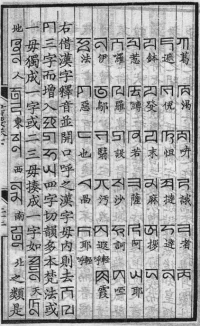
Well, I see some more similarities, eg. Korean d/t or l/r are resembled in Phags Pa, look at the attachment (BTW, from "Shushi Huiyao" a Chinese book, hence the Chinese characters). But that's not the point, anyway. "Partly based upon" doesn't mean that they copied the alphabet. It means, they looked how other writing systems were designed, & going from there to develop their own system.Nor is there much resemblance between the alphabets, either in the way they are organized, or in the number of letters, or in their shapes. The only two letters that look nearly identical are the Hangeul "j" and the Phags Pa "o".
Maybe this is a problem of me being a non-native speaker, but 'based upon" to me means there is a foundation & you build your thing with the support of that foundation.
Hmm, well, also not an expert myself here, hence I follow the experts again. They are scientists, which means splitting hairs should be their job. If you're not a nit-picker, you're probably not a good scientist. Anyway, even the Proto-Canaanite system was developed with help of yet another foundation.I concede you the Ethiopian script, though it might be argued that asserting a dichotomy between Phoenician and "Proto-Canaanite" is a case of splitting hairs.
Attachments
- 12 Aug 2004
- 73
- 4
bossel said:The last is partly true. Phags Pa was used by the Mongolian administration up to 1352. It was abandoned for the most part after the collapse of the Yuan dynasty in the 14th century, but it was used even later (though rarely) in China & is still used in Tibet (only for more or less decorative purposes, though).
Since I'm not an expert (& knowing that nothing human comes out of the blue, but has its roots somewhere else), I go with what the experts say which is that it is partly based on Phags Pa. There were of course other influences as well. I read that king Sejong & his researchers also looked at Sanskrit & Chinese phonological theory.
First of all, that nothing human comes out of the blue sounds to me like dogma, not fact. If it were true, how would we have inventions? Anyway, the idea isn't that Hangeul came out of the blue. They already had writing, they had a good reason to want to improve the writing system they had, and they were willing to put in the effort to think up a new system. That, it seems to me, is quite enough to account for the invention of the Hangeul alphabet. There's no need to go searching for other causes unless they present themselves.
Second, since there isn't an expert consensus that says Hangeul is definitely based either partly or entirely on Phags Pa, going with the experts does not oblige you to believe Hangeul is based on Phags Pa.
Third, King Sejong and his researchers probably looked at Sanskrit and Chinese phonological theory. What they actually looked at is not known.
bossel said:Well, I see some more similarities, eg. Korean d/t or l/r are resembled in Phags Pa, look at the attachment (BTW, from "Shushi Huiyao" a Chinese book, hence the Chinese characters). But that's not the point, anyway. "Partly based upon" doesn't mean that they copied the alphabet. It means, they looked how other writing systems were designed, & going from there to develop their own system.
That's fine, except that it is pure speculation that they ever saw Phags Pa, let alone that they knew what it was even if they did see it.
Regarding the resemblances that you see, the Hangeul "L" (rieul) resembles the Phags Pa NGA much more closely than it does the Phags Pa LA. Indeed, it also resembles PA, SHA, and -A better than it does LA. Again, the Hangeul T (digeut) looks as much like the Phags Pa EE as it does DA. So, are these "resemblances" enough to signify influence? What happens if we consider a comparison of the Latin alphabet and Hiragana for an analogy? We see that the Hiragana KA and KU both resemble, in different ways, the Roman letter K. The Hiragana RE looks a bit like a Roman R (NE and NU look even more like R, but we're looking for similarities, not differences), and the TA, TI and TE characters all have shapes that suggest a lower-case T. Do these resemblances amount to evidence that Hiragana is based on the Latin alphabet? Not on your nelly! I don't know if you noticed, but the Hangeul "I" looks a lot like the Latin "I", but I would want to see a much stronger correspondence between the two alphabets than that before I concluded that one was based on the other. Perhaps you would, too.
There's no need to speculate on what alphabet or pre-existing writing system gave Hangeul its letter-shapes, because the origin of those shapes is well-documented, and those shapes are not based on any other alphabet or writing system. They were entirely rooted in proto-scientific linguistic ideas developed by the Koreans themselves.
Here's an explanation:
http://www.wam.umd.edu/~stwright/korean/korean-linguistics-origins.html
The sheer ingenuity of this is what, to me, makes the Hangeul writing system interesting and special.
bossel said:Maybe this is a problem of me being a non-native speaker, but 'based upon" to me means there is a foundation & you build your thing with the support of that foundation.
Well, sure, but what you're claiming is just this: that the Koreans could conceivably have seen Phag Pa, so they did, and because they did, they based Hangeul on Phag Pa, even though Hangeul bears scarcely any resemblance to Phag Pa. All without a shred of evidence (indeed, contradicting perfectly good evidence that the Koreans based Hangeul on something else entirely). Hey, maybe some ideas do come out of the blue, after all!
bossel said:Hmm, well, also not an expert myself here, hence I follow the experts again. They are scientists, which means splitting hairs should be their job. If you're not a nit-picker, you're probably not a good scientist. Anyway, even the Proto-Canaanite system was developed with help of yet another foundation.
I'm a damned good nit-picker, trust me, but I'm also good at spotting when someone is making a distinction without a difference. And sure the Proto-Canaanite system was developed with the help of yet another foundation, but that other foundation was not an alphabet. Now, if the Proto-Canaanites were able to invent an alphabet inspired by their experience of an ideographic writing system, why would you suppose that the Koreans (a more developed culture) could not do the same?
bossel
後輩
- 28 Sep 2003
- 1,485
- 45
By enhancing things we learned/experienced/saw/whatever. (There are things that might come out of the blue, eg. when an experiment goes wrong & you find something new, but I would call that a discovery, not an invention) A dogma, nah, just experience.chikazukiyasui said:First of all, that nothing human comes out of the blue sounds to me like dogma, not fact. If it were true, how would we have inventions?
There is always need to search for other causes. That's what science is at least partially about: going beyond things people (think to) know. Looking for alternative explanations of common "knowledge".There's no need to go searching for other causes unless they present themselves.
Who said anything about being obliged to?Second, since there isn't an expert consensus that says Hangeul is definitely based either partly or entirely on Phags Pa, going with the experts does not oblige you to believe Hangeul is based on Phags Pa.
Yes, & ...?Third, King Sejong and his researchers probably looked at Sanskrit and Chinese phonological theory. What they actually looked at is not known.
Well, I'll look further into it: if there is actual evidence or if it's just extrapolation. But that will take a while, the book I need is in another city.
Why shouldn't they know? Just because you don't like them to?That's fine, except that it is pure speculation that they ever saw Phags Pa, let alone that they knew what it was even if they did see it.
Again: based upon doesn't mean they copied it.I would want to see a much stronger correspondence between the two alphabets than that before I concluded that one was based on the other. Perhaps you would, too.
In your original post you talked about the system, not about individual letters: "The Korean writing system is very different from the Japanese and Chinese systems. It is an alphabet, and quite a clever one, too! It is very unusual, because it is not based on any other system."
Maybe you're a nit-picker, but not good in reading. That's not what I said.Well, sure, but what you're claiming is just this: that the Koreans could conceivably have seen Phag Pa, so they did, and because they did, they based Hangeul on Phag Pa, even though Hangeul bears scarcely any resemblance to Phag Pa. All without a shred of evidence
I didn't say that the Proto-Canaanite foundation was another alphabet. Neither did I say the Koreans were not able to develop an alphabet. Everybody can do that. I did it as a child. So what?I'm a damned good nit-picker, trust me, but I'm also good at spotting when someone is making a distinction without a difference. And sure the Proto-Canaanite system was developed with the help of yet another foundation, but that other foundation was not an alphabet. Now, if the Proto-Canaanites were able to invent an alphabet inspired by their experience of an ideographic writing system, why would you suppose that the Koreans (a more developed culture) could not do the same?

Lina Inverse
後輩
- 29 Apr 2004
- 1,700
- 49
Indeed, and that's not even half of it... there are still much more anime-wannabes. Those that aren't quite that bad, like "Totally Spies" and Martin Mystery, and those are badly done like "Witch". And then there are still bad rip-offs of these again, like "Minx", which is a poor rip-off of "Witch", which by itself is already a poor rip-offden4 said::?
US car companies copied the Japanese business model, to some degree.....then there are the cars that all look identical now.....now there are the anime wannabe copies...Disney copies Kimba to make Lion King, copies Laputa to make Atlantis...I think it works both ways.....

- Status
- Not open for further replies.
Similar threads
- Replies
- 124
- Views
- 138K


