News The next big one: Nankai quake study

thomas

Unswerving cyclist
Admin
Joined
14 Mar 2002
Messages
21,054
Reaction score
18,909
While Japan is still struggling with the aftermath of the 2011 tsunami and the Fukushima clean-up engineers and scientists prepare for the next Big One, a massive earthquake striking the Nankai Trough off the southeastern coast of Japan that could cause 1,240 trillion yen in economic damage. The probability of such a quake happening within the next 30 years is 70-80%.

The Nankai Trough (in yellow):
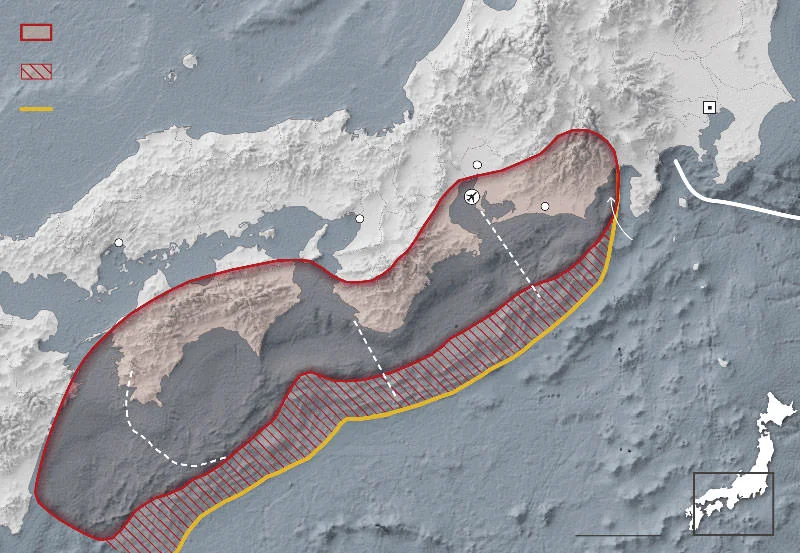
nankaiTrough.webp


Study: Damage from Nankai quake could hit 1,240 trillion yen:The Asahi Shimbun

Nankai Trough quake, tsunami could cost Japan ¥1.4 quadrillion over 20 years, engineers say | The Japan Times

According to a report from 2016 the expected number of casualties (323,000 in the worst case) could be reduced to 61,000 "through a combination of swift evacuation and ensuring that all buildings are earthquake resistant, compared with 79 per cent of them now. It would not only save more lives but could halve the economic damage" (FT):

Japan: the next big quake
 
Last edited by a moderator:
Here we are seven years later, standing at 80%.

The government's Earthquake Research Committee now estimates an "around 80 per cent" chance of a massive earthquake (magnitude 8 or 9) striking the Nankai Trough within the next 30 years. This is an upward revision from their previous estimate of "70 to 80 per cent." The Nankai Trough is a seismic zone stretching from Shizuoka Prefecture to Kyushu . The probability of earthquakes in this region is calculated based on historical data, the time between past quakes and the elapsed time since the most recent one. The risk increases slightly each year if a major earthquake doesn't occur.

Officials said the Jan. 15 recalculation was not due to abnormal phenomena in the possible hypocenter area of the Nankai Trough, but simply because of the automatic annual update. "We concluded there wasn't any data that increased the possibility of a large earthquake occurring compared to normal times," said committee chairman Naoshi Hirata in reference to a temblor centered in the Hyuganada Sea off the coast of Miyazaki Prefecture in the Kyushu region on Jan. 13. According to the committee, the probability of a Nankai Trough megaquake increases by less than one percent each year. The probability of one happening, calculated under multiple scenarios, was 75 to 82 per cent as of Jan. 1 this year. It was rounded off as usual and revised to about 80 per cent this time around. In 2018, the probability increased to "70 to 80 per cent" from the previous "about 70 per cent." The committee also discussed the status of seismic activity following the magnitude-7.6 earthquake that struck the Noto Peninsula on Jan. 1, 2024.

 
There was talk of this already when I still lived in Aichi, back in the naughties. It's going to be bad. I always figured that all parts of Japan will get a huge natural disaster if only you wait long enough. The Hanshin quake was very much in the back of my mind every day I lived there, and still is, to be honest.
 
Here we are seven years later, standing at 80%.

The government's Earthquake Research Committee now estimates an "around 80 per cent" chance of a massive earthquake (magnitude 8 or 9) striking the Nankai Trough within the next 30 years. This is an upward revision from their previous estimate of "70 to 80 per cent." The Nankai Trough is a seismic zone stretching from Shizuoka Prefecture to Kyushu. The probability of earthquakes in this region is calculated based on historical data, the time between past quakes and the elapsed time since the most recent one. The risk increases slightly each year if a major earthquake doesn't occur.


I've probably gone on about this before. I've proofread dozens of academic papers written by Japan's seismologists, some of them focusing on the Bungo Channel between Shikoku and Kyushu, where the current action is. They never give percentage likelihoods, and the language they use to talk about an increased likelihood of a large earthquake is extremely tentative. I imagine that no self-respecting seismologist would give a percentage of an earthquake happening, probably because they are guessing when they put the parameters into the models (it's not easy to work out what is going on tens of kilometres below us).

The government want a percentage, so the seismologists give them one because the government pay the wages. I'm not saying that an earthquake isn't likely, just not to take the percentages seriously.
 
"Prepare for the worst, and you'll have no regrets."

Training Conducted by Osaka Prefecture for a Potential Nankai Trough Megaquake During Expo 2025
(January 18, 2025, 1:30 AM)


Osaka Prefecture and other organizations conducted a training exercise to prepare for the possibility of a Nankai Trough megaquake occurring during the Osaka-Kansai Expo.
The drill took place in Maishima, Konohana Ward, Osaka City, and involved Osaka Prefecture, the Self-Defense Forces, and other agencies simulating responses to a megaquake occurring on April 20, shortly after the Expo opens.
The exercise included a search for tsunami survivors adrift at sea and a simulation of transporting supplies using drones.
[Hirofumi Yoshimura, Governor of Osaka Prefecture]
"This year marks 30 years since the Great Hanshin-Awaji Earthquake. It is extremely important for relevant organizations to share information through regular training."
The Japan Association for the 2025 World Exposition has developed a disaster prevention plan that includes measures such as converting pavilions into temporary shelters if the Expo site becomes isolated due to a quake.
 
Preparing for a Nankai Trough Earthquake: Kobe City's Tsunami and Storm Surge Countermeasures

A Nankai Trough megaquake, predicted to have a 70% chance of occurring within the next 30 years, is expected to bring a 4-meter tsunami to Kobe City. In response, Kobe City launched the "Once-in-a-Millennium Tsunami Countermeasure" project to prevent flooding in residential and urban areas.
The project has already been completed, with seawalls installed along approximately 60 kilometers from Higashinada Ward to Suma Ward, which are under Kobe City's jurisdiction. These seawalls are designed to prevent flooding in populated areas, even in the event of a 4-meter tsunam
 
A top-level warning for a Nankai Trough megaquake would trigger a government evacuation advisory for 670,000 people, but according to an Asahi Shimbun survey, less than half of the municipalities at risk are adequately prepared. Such a quake could unleash a massive tsunami, impacting Pacific coastal areas from Kanto to Kyushu.

The Japan Meteorological Agency suspects that specific seismic activity might signal the onset of the long-anticipated Nankai Trough earthquake. Following Cabinet Office guidelines, if the agency determines a high likelihood of a major quake, it will urge residents in 139 vulnerable municipalities to evacuate one week in advance, either to acquaintances' homes or evacuation shelters outside potential flood zones. The early evacuation warning is based on concerns that residents may not have enough time to escape once the earthquake strikes.

The 139 municipalities are in 14 prefectures from Chiba to Kagoshima prefectures. The Cabinet Office did not have an exact count of the affected residents. "While listening to the municipalities' opinions, we also want to grasp the situation as a nation," an official said. But the Asahi survey estimated the total number of evacuees at 667,860, while the capacity of available evacuation centers is only 422,676, based on responses from 70 municipalities. By comparison, around 470,000 people were forced to evacuate after the 2011 Great East Japan Earthquake, while more than 310,000 people fled from their homes after 1995 Great Hanshin-Awaji Earthquake.

During the Great East Japan Earthquake, the tsunami reached shore about 30 minutes after the quake. But a tsunami could hit land within minutes in a Nankai Trough megaquake, making pre-emptive evacuation crucial to saving lives.

 
The Japanese government revised the number of estimated fatalities in case of a Nankai Trough quake. Still grim enough:

A revised estimate by the government's earthquake task force on Monday indicated that a massive earthquake in the Nankai Trough could result in up to 298,000 fatalities in Japan. Efforts to mitigate damage have lowered the projected death toll by about 10 percent compared to the 2012 estimate. However, this reduction remains far from the government's 2014 basic disaster prevention plan, which aimed to cut fatalities by approximately 80 percent. The findings underscore the urgent need for significant revisions in evacuation strategies and infrastructure enhancements.

In its latest report, the task force projected the number of evacuees would rise from the previous estimate in 2012 of 9.5 million to 12.3 million, equivalent to around 10 percent of Japan's population. A total of 764 municipalities across 31 of Japan's 47 prefectures would experience shaking measuring at least a lower 6 on the Japanese seismic intensity scale of 7, or tsunami waves at least 3 meters high. While economic losses are projected to reach up to 270 trillion yen, rising from the previous estimate of 214 trillion yen, the maximum number of buildings expected to be completely destroyed was slightly reduced to 2.35 million due to improvements in residential seismic retrofitting. According to the report, 215,000 out of the projected 298,000 deaths would be caused by tsunami, based on the assumption that only 20 percent of people would evacuate immediately. Increasing the evacuation rate to 70 percent could reduce the tsunami death toll to 94,000, underscoring the importance of swift evacuation. The area expected to experience flooding of at least 30 centimeters increased 30 percent from the previous estimate due to advancements in topographical data analysis. The overall death toll is not expected to decline significantly despite seawalls and tsunami evacuation facilities.


The brunt would be borne by Shizuoka:

Nankai Through


Look at Wikipedia's list of Nankai Through occurrences from the 7th to the 20th century. The next one is overdue. I cannot deny that the thought is quite disconcerting.

 
Back
Top Bottom