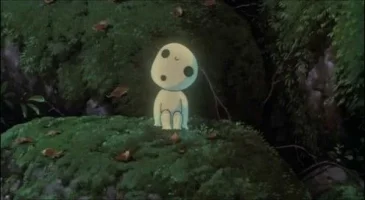
For your information, I tried posting this in the Eupedia section, only to be consistently kicked out at the password level...I am sharing on an interesting observation I have made, hoping if any Japanese similar ancient God-designs are recognizable...
In my research on more comparisons between the ancients peoples of Japan, South America, and the Middle East, I came across another tribe, called the Hurrians. Originally from Iran, they emigrated into the Syrian/Turkey areas and were integrated into the Hittite tribal culture.
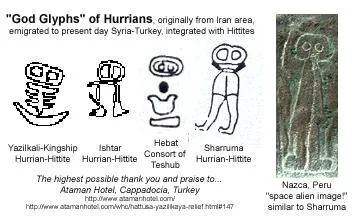
In studying their deities, I came across the fascinating similarity with their name depictions for their Gods, which is displayed over one hand or another. These depictions or naming conventions are called "God Glyphs". A certain Ataman Hotel in Cappadocia, Turkey had taken the time to graphically outline and explain in detail, the stone glyphs that appear locally. Their efforts may have helped decipher the Nazca glyphs from Peru.
http://www.atamanhotel.com/whc/hattusa-yazilikaya-relief.html#147
I immediately recognized the plausible connection between these God Glyphs and the figure etched into the desert plain of Nazca, in Peru. The "God Glyph" of Sharruma most clearly resembles that Nazca figure. Ironically, he is considered the "Son of the Storm God" Teshub, which is interesting in the sun-parched land of the high desert of Nazca.
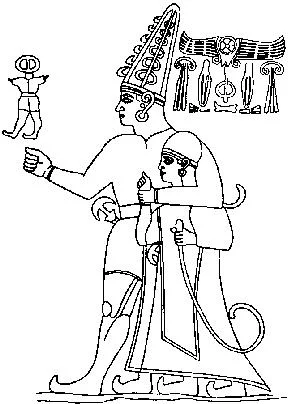
http://img474.imageshack.us/my.php?image=yazilikayamainmw8.gif
http://www.britannica.com/ebc/article-9071812
There are at least 5 other Nazca similar objects among the Hurrian depictions which I could show, but this object seems to be the most interesting.
In my research on more comparisons between the ancients peoples of Japan, South America, and the Middle East, I came across another tribe, called the Hurrians. Originally from Iran, they emigrated into the Syrian/Turkey areas and were integrated into the Hittite tribal culture.
In studying their deities, I came across the fascinating similarity with their name depictions for their Gods, which is displayed over one hand or another. These depictions or naming conventions are called "God Glyphs". A certain Ataman Hotel in Cappadocia, Turkey had taken the time to graphically outline and explain in detail, the stone glyphs that appear locally. Their efforts may have helped decipher the Nazca glyphs from Peru.
http://www.atamanhotel.com/whc/hattusa-yazilikaya-relief.html#147
I immediately recognized the plausible connection between these God Glyphs and the figure etched into the desert plain of Nazca, in Peru. The "God Glyph" of Sharruma most clearly resembles that Nazca figure. Ironically, he is considered the "Son of the Storm God" Teshub, which is interesting in the sun-parched land of the high desert of Nazca.
http://img474.imageshack.us/my.php?image=yazilikayamainmw8.gif
http://www.britannica.com/ebc/article-9071812
There are at least 5 other Nazca similar objects among the Hurrian depictions which I could show, but this object seems to be the most interesting.