


- 14 Mar 2002
- 21,050
- 18,903
Japanese researchers have reported the discovery of a sea anemone whose cone-shaped body resembles Mount Fuji. They explained that the creature is not just a new species but also belongs to a previously unknown genus and family. It has been given the Japanese name Umi no Fujisan (海の富士山) — "Mount Fuji in the sea" — in honour of the country's highest peak, since it was first identified in Suruga Bay, an area that lies beneath the shadow of the 3,776-metre volcano.
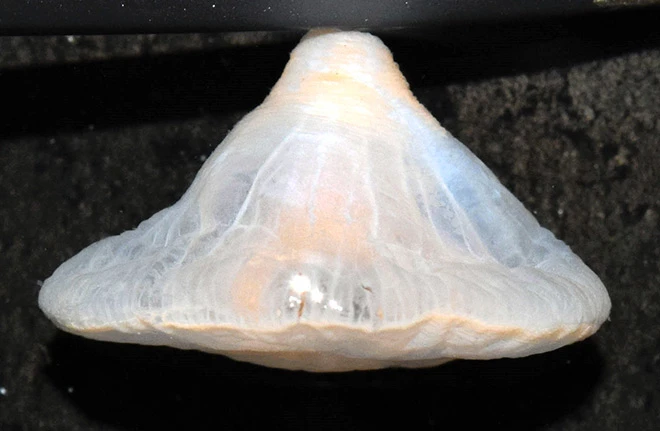
Umi no Fujisan (海の富士山), provided by Izumi Takato, a lecturer at Fukuyama University via Asahi
According to Takato Izumi, a taxonomy specialist at Fukuyama University, the name was chosen because the animal's form so closely mirrors the outline of the mountain. The sea anemone has a pale, almost white body, displays a neat radial symmetry, and measures about 2 centimetres across its base and 1 centimetre in height. The first specimen was retrieved in 2003 from a depth of 311 metres in Suruga Bay. Since that time, similar anemones have been recorded in waters off Kanagawa, Iwate, Nagasaki and Kōchi prefectures, among other locations.
Umi no Fujisan (海の富士山), provided by Izumi Takato, a lecturer at Fukuyama University via Asahi
According to Takato Izumi, a taxonomy specialist at Fukuyama University, the name was chosen because the animal's form so closely mirrors the outline of the mountain. The sea anemone has a pale, almost white body, displays a neat radial symmetry, and measures about 2 centimetres across its base and 1 centimetre in height. The first specimen was retrieved in 2003 from a depth of 311 metres in Suruga Bay. Since that time, similar anemones have been recorded in waters off Kanagawa, Iwate, Nagasaki and Kōchi prefectures, among other locations.
While its external appearance conjures up images of Mount Fuji, that fact alone does not distinguish the species from other types of sea anemone. Umi no Fujisan has only 10 membranes to separate the interior structure of its body, whereas most seaflowers have 12. Taking this and other characteristics into account, the research team concluded that Umi no Fujisan should not be classified as any already known species, genus or family. It marked the second time Izumi has found a new sea anemone family. Umi no Fujisan ranks as the fifth previously unknown genus Izumi has confirmed.


