Murdering English

Mark of Zorro

先輩
Joined
4 Oct 2012
Messages
2,427
Reaction score
316
As we all know, Japan not only imports a lot of English and other languages, they also put their own spin on it, as well as their own pronunciation. They also make their own combinations of English words.

It annoys the crap out of me. I don't mind loan words per se, in the sense that we have French words in English. But, as far as I know, most of the French words in English are used correctly, especially the more modern imports. And even when they are not used correctly, I believe those are from the Norman occupation of England, and you cannot really blame an occupied people for messing up the language of their occupiers.

Japan is not occupied, at least not in the classical sense. They are not having English forced on them with a weapon at their head. So do they have any excuse for terms like ガソリンスタンド、 テンション、and マイカー? I don't think so.

And while I am well aware of English speakers mangling words like futon (no, its not a kind of couch...grrrr) I don't think the bastardization of languages is anywhere near the level it is in Japan.

I think Engrish is a national embarrassment to this country, and I would like to see some legislation to make it stop. I am not talking about having word police, but just some restrictions on the TV and dictionaries, an approval panel for them that checks for meaning accuracy, and maybe even some guys checking spelling on signs that are supposed to be in English. They can keep their horrible katakanized pronunciation and their silly katakana for loan words, but by God, I want them to get the meanings right or just speak Japanese!
 
As long as most-to-all Japanese agree on the meaning, does it matter if it doesn't match the original, "right' meaning?

I'm thinking of your reverse example, futon in the West. My parents brought some back from Japan in the 60s, and it was one of the first English words (haha) that I ever knew. To this day, my whole family pronounces it in a way that is neither Japanese nor like English fooo-ton. We say f'TON, and we think of it as a cushion that unfolds almost like a triptych.

In college, Americans always corrected my pronunciation to FOOO-ton, and I had to learn that it means couch over here. My family are the ones who are "wrong."
 
Actually I think f'TON is a fairly common way to say it in Japan.

As long as most-to-all Japanese agree on the meaning, does it matter if it doesn't match the original, "right' meaning?

When there is so much emphasis placed on English education, I think it does. It is one of many answers to the question "Why can't Japanese speak English?". Starting from a position of finding that more than half of the English you "thought" you knew are in fact utterly, stupidly wrong is on one hand daunting in itself, and on the other, going to dissuade a great many English speakers from attempting to communicate with you for injecting such silliness in your English speech which so many Japanese do.

I also think it matters when people have such a lax attitude that they believe whatever without checking or making any attempt to be correct. One could say the Japanese are trying...VERY trying. I say if a thing is worth doing, its worth doing right.

Why bother to import a word if you are just going to murder it? I think it just shows and fosters a total disconnect with reality and the people around, which does seem to be a part of the Japanese national character, but certainly not something that needs any sort of reinforcement.

Then you have even Japanese who don't know what is being said, and cannot even resort to an English dictionary for help. People waste time and energy trying to keep up with made up verbal garbage not yet even in Japanese dictionaries. One man is actually suing NHK over this issue because he says he cannot follow the news anymore.
 
Well, yeah, I agree. A distinction needs to be made in English class between what is the fool's gold (loan word) and what is the genuine pronunciation & meaning.
 
Sorry , I have to disagree. The moment it becomes a word in Katakana is the moment that word ceases to be English IMO.
 
Sorry , I have to disagree. The moment it becomes a word in Katakana is the moment that word ceases to be English IMO.

But why hijack the word when there is a perfectly good Japanese word? Why destroy possible communication with the very people you kidnapped and raped the word from, not to mention the rest of the world where English is the universal language? Why shoot yourself in the foot so badly?

Or go ahead and be the village idiot and reap all the rewards of the position.
 
hijack, destroy, kidnap, rape, shoot

Now that's a Zorro response. Who could guess that this is merely about Japan borrowing words, something they also did with Chinese characters long ago. If a Chinese person sees "非常" on the glass enclosing a fire extinguisher in Japan, they may mind it curious. In Chinese, those characters mean "unusual" or "very". The Japanese borrowed Chinese writing and gave their own meaning to it. Seems ok to me, as long as Japanese understand each other. Same deal with borrowing from English.
 
I have to admit that I am not as familiar with Chinese characters, but I think there is a bit more excuse. I also think there is more correct usage. Further, I think it is generally known that that is not straight Chinese.

I cannot say the same with loan words. They don't know what language it is, but tend to always assume its English. They also assume its correct. I think more Japanese themselves would have a problem if it were more generally known how awfully incorrect so much is.

Then you have the simple fact that this is not the Middle Ages. We have jet planes, the internet and dictionaries. How hard is it to get your loan words correct? Its not. Particularly spelling. How can you mispell an English word and put it on a big sign?? Zero effort, that is how.

As for my strong language, well, that is how I feel about it. If they get the word right, I say they borrowed. If they mangle it, bastardize it, rape it, hijack it, murder it, etc. well, that is what they did. I will feel so until I am presented with a legit reason why they had to say "maikaa" "rajikon" "yanki" "piaasu" etc. and have them so damned wrong.
 
English import alot of words from Greek and Latin and change the original meaning.
Indeed. A very good point.
And, even the meanings of our own words change over time.

I do get your point, though, Zorro, that Japanese may have a problem with English that other language learners do not.
 
Katakana with modified meaning or 和製 katakana only comprise a small percentage of total Katakana vocabulary, majority are still direct English import with original meaning.

And what's so wrong with テンション and ピアス, both means tension and pierce respectively, with no deviation in meaning.
 
Katakana with modified meaning or 和製 katakana only comprise a small percentage of total Katakana vocabulary, majority are still direct English import with original meaning.

I don't know how you figure that. Maybe you are correct if you take all katakana terms in use even in specialized fields, like medicine and aeronautics. But I don't think it holds up if we are talking about common usage.

Just today I had to endure a guy announcing at a r/c car race who kept saying "mashiin" over and over. And I cannot say its totally wrong, but its a slang term for car and you don't repeat it endlessly or there becomes a question about what you actually mean. As if the word "kuruma" or jidousha" has something wrong with them anyhow.

And what's so wrong with テンション and ピアス, both means tension and pierce respectively, with no deviation in meaning.

Well, correct me if I am wrong, but in Japan, tension, like "tenshon ga takai" means a joyful boisterous atmosphere or mood, but in English, it means stress, and if you said "high tension" it would mean very tense and quite the opposite of joy. In Japan "piasu" means earring (noun), and in English "pierce" is usually used as a verb, and "pierced" as in "pierced ears" is an adjective. It would be closer to English if the Japanese at least said "piasuto". But no. They murder it in more ways than one!
 
English import alot of words from Greek and Latin and change the original meaning.

I think that with Greek its more like imported, past tense. I can't think of anything that has been imported lately, or, smashed together to make new words from Greek. If it happens though, believe me, I feel the same. It should not be happening. Because we have Latin. To wit:

Latin is a dead language. For all intents and purposes, what we do with Latin IS Latin. And while I do not think we are importing what is patently mistaken Latin, I am aware of new words made with Latin combinations. But that is okay since there are no native Latin speakers keeping the language modern. And if there were, I would say we should either follow their lead or make our own words or find another dead language grave to rob.
 
And, even the meanings of our own words change over time.

I cannot deny that is a bit of a fly in the ointment. But I guess the thing that gets me is that the Japanese have a near zero chance of affecting the course of the English language. All that they do is adrift and lost at sea, whereas the native alterations have a much greater tendency to stick.

I do get your point, though, Zorro, that Japanese may have a problem with English that other language learners do not.

Thanks. I guess as so many of us are English teachers or have been, it might be the thing that resonates most.

I hope to find more agreement though. I may not have thought about this long enough to explain it in the best way possible. On the other hand, I may be making some mountains out of molehills on a few points. And I am sure there are other aspects yet to be discovered.
 
I don't know how you figure that. Maybe you are correct if you take all katakana terms in use even in specialized fields, like medicine and aeronautics. But I don't think it holds up if we are talking about common usage.

I have studied all kanakata considered "common word" by edict, there are around 3100 with direct English Katakana, 40 English abbreviation katakana, 80 non-English katakana, and 60 wasei Katanaka. That's around 95% of all edict common katakana is direct English translation. Of course, some of the 3100 direct English translation have change meaning, I have not finish working through the 3100 meaning part yet, but currently I have found only 16, my estimate would be around 100-150 out of 3100 will have modified meaning or 5% of the direct English katakana. I will report back to you once I'm done.

Just today I had to endure a guy announcing at a r/c car race who kept saying "mashiin" over and over. And I cannot say its totally wrong, but its a slang term for car and you don't repeat it endlessly or there becomes a question about what you actually mean. As if the word "kuruma" or jidousha" has something wrong with them anyhow.

Just like many people in the English world call their vehicle "machine" too, and marijuana "grass", steroid "juice", their woman "*****"...etc


Well, correct me if I am wrong, but in Japan, tension, like "tenshon ga takai" means a joyful boisterous atmosphere or mood, but in English, it means stress, and if you said "high tension" it would mean very tense and quite the opposite of joy.

テンション = tension. I don't see any difference in dictionary explanation.

テンション ローマ(tenshon)
1 〔緊張〕 tension.
▲テンションが高くなりすぎると状況判断を誤りやすい. If you get too tense, it is easy to make errors of judgment.
▲テンションの高さ the level of tension.
▲決勝戦に向けてチームのテンションを高めてゆかなくてはならない. Our team needs to ┌be psyched up [have the tension racked up] with the final approaching.
2 〔錠前破りの道具〕 a tension ┌wrench [tool].


In Japan "piasu" means earring (noun), and in English "pierce" is usually used as a verb, and "pierced" as in "pierced ears" is an adjective. It would be closer to English if the Japanese at least said "piasuto".

I stand corrected.
 
That dictionary is not reflecting a common use, if not in fact, the most common use. Watch this and notice the title.

朝からテンションが高い子供さま - YouTube

Just like many people in the English world call their vehicle "machine" too,

Well, on the one hand I cannot deny that some do. On the other hand its not really that common. I suppose I should just let that one go for the argument, although it does still bug me.

I will report back to you once I'm done.

Looking forward to it!
 
I guess you shouldn't be hating this because not just in Japan that the English language is being your so called murdered. Even here in our place. More, I guess not only English are being murdered but other languages as well.. Even native English speakers changes some of our words, like the bundocks which is supposedly be Bundok..So I guess that should be fine. :sorry:
 
I guess you shouldn't be hating this because not just in Japan that the English language is being your so called murdered. Even here in our place. More, I guess not only English are being murdered but other languages as well.. Even native English speakers changes some of our words, like the bundocks which is supposedly be Bundok..So I guess that should be fine. :sorry:

I don't know. I think its acceptable to pluralize loan words in English, just like it would be acceptable to feminize or masculinize a word in a romance language. I see nothing wrong with adapting for grammar or the language borrowing the word, just like I am not taking to task katakanized pronunciation. In some ways the word has to adapt. But completely changing the meaning or inventing new English-ish words is NOT mere adaptation.

Also, if there is any more guilty offender than Japan, I am not aware of it. Are there really people out there equally sloppy?
 
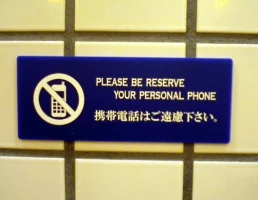
Murdered!

engrish-1.webp

Is it so hard to just ask a native speaker with so many of them walking around?
 
Is it so hard to just ask a native speaker with so many of them walking around?

A friend of my family in Japan had that exact job in the sixties. She saved a lot of companies from naming their cars and computers some embarrassing things, lol. Things I can't even repeat here.
 
I think that with Greek its more like imported, past tense. I can't think of anything that has been imported lately, or, smashed together to make new words from Greek. If it happens though, believe me, I feel the same. It should not be happening.

It's called a neologism, which itself is probably a neologism.*
A favorite example of mine is technophobia. Even "homophobia" only dates back to 1969.
(* neologisms don't have to be formed from Greek roots. These are a subset of all neologisms. How about hypermarket? Half Greek).
Neologism - Wikipedia

Originally Posted by Mark of Zorro
In Japan "piasu" means earring (noun), and in English "pierce" is usually used as a verb, and "pierced" as in "pierced ears" is an adjective. It would be closer to English if the Japanese at least said "piasuto".

I wonder how you say "piercings"? Would that also be piasu?

As for the mashiin thing,
Would you believe that English borrowed the words "egg" and "skin"? It's true. These are from Scandinavian languages, though I have no doubt we had perfectly good words for them in Anglo-Saxon. (In Anglo and Saxon ;-) ) So, we're just as "bad".
 
Would you believe that English borrowed the words "egg" and "skin"? It's true. These are from Scandinavian languages, though I have no doubt we had perfectly good words for them in Anglo-Saxon. (In Anglo and Saxon ) So, we're just as "bad".

I don't doubt it. But, do we use the words incorrectly? When did the borrowing occur?

In this jet and internet age of English language education gaining more emphasis every day, there is simply no excuse for this level of sloppiness. I can agree that we are bad too, but not "as bad".
 
I don't know if we borrowed the words incorrectly or not, but enough time has passed that they're correct now. We made them our own.

In this "jet and internet' age, more people are exposed to the incorrect spelling of "L-O-O-S-E" for lose than ever before, because this is a basic mistake that would never make it past any diligent editor of printed matter. Now everything is self-published instantaneously on the web.

I don't disagree with you on the sloppiness with the signs. I see them in Taiwan. A friend of a friend of mine owns a place called "Locally Beef". I was asked not to mention the error to the owner. I guess everyone decided that the sign is for Chinese consumption anyway, so it would be more trouble than it's worth to change it. Never mind that the island's kids are trying hard to learn proper English grammar for several hours after regular classes each school day. :-)
On top of that, there was a highway sign over a huge highway that had the Chinese characters out of order because the sign was put up by migrant workers who could not read the local language! Of course, that made it to the newspaper.
 
Back
Top Bottom