News M7.1 earthquake hits Kumamoto

thomas

Unswerving cyclist
Admin
Joined
14 Mar 2002
Messages
21,079
Reaction score
18,950
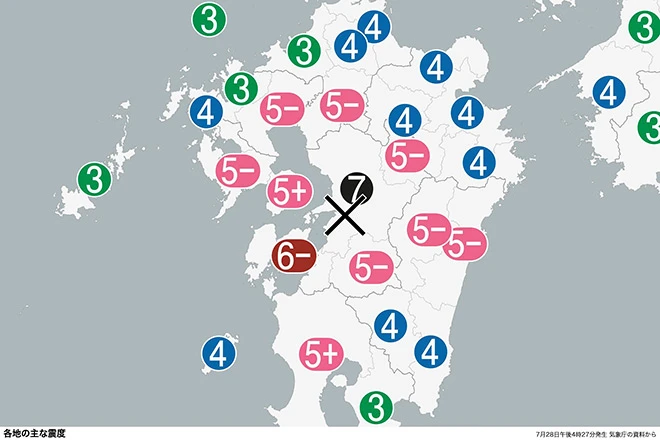
A powerful earthquake measuring a maximum seismic intensity of 7 struck Kumamoto Prefecture at 4.27 pm on 28 July, prompting tsunami warnings for coastal areas along the Ariake and Yatsushiro seas. The Japan Meteorological Agency said the quake had a preliminary magnitude of 7.1. Its hypocentre was at a shallow depth of about 10 kilometres. A series of aftershocks followed within minutes. One registered a lower 5 on the Japanese seismic intensity scale at 4.29 pm, followed by two more measuring 4 at 4.39 pm and 4.59 pm.

kumamoto-earthquake-28072026.webp


A quake with an epicenter over land at a shallow depth means seismic activity is active, which is likely to cause many aftershocks, he said. The quake was caused after two faults slid horizontally in different directions, the official said. But he said it was too early to say whether the latest quake was related to the 2016 Kumamoto quakes. The epicenter of Tuesday's quake was about 20 kilometers from the Hinagu fault zone, which caused the 2016 quake, the official said.

 
kumamoto-earthquake-28072026.webp

The pictures shown on TV show significant damage across Kumamoto. A freight train derailed.

The quake in the prefecture in the center of the island of Kyushu registered the maximum 7 on the Japanese seismic intensity scale in Uki and Hikawa and upper 6 in surrounding areas. Several people were believed to have been injured in the quake, while a power outage affected about 48,000 households in the prefecture, according to the local fire department and power company. It also registered upper 5 in neighboring Kagoshima Prefecture and lower 5 in Fukuoka and Saga prefectures.


All train services, including the Kyushu Shinkansen, the West Kyushu Shinkansen, and local lines within the Kyushu region, have been suspended, according to JR Kyushu.

 
The video shows people in need of help and assistance and yet this person is just walking around and recording it for likes on social media. 😞
I saw zero people in that video requiring any help or assistance. Or maybe that's why he shut it off so quickly, to help someone there at the end.
 
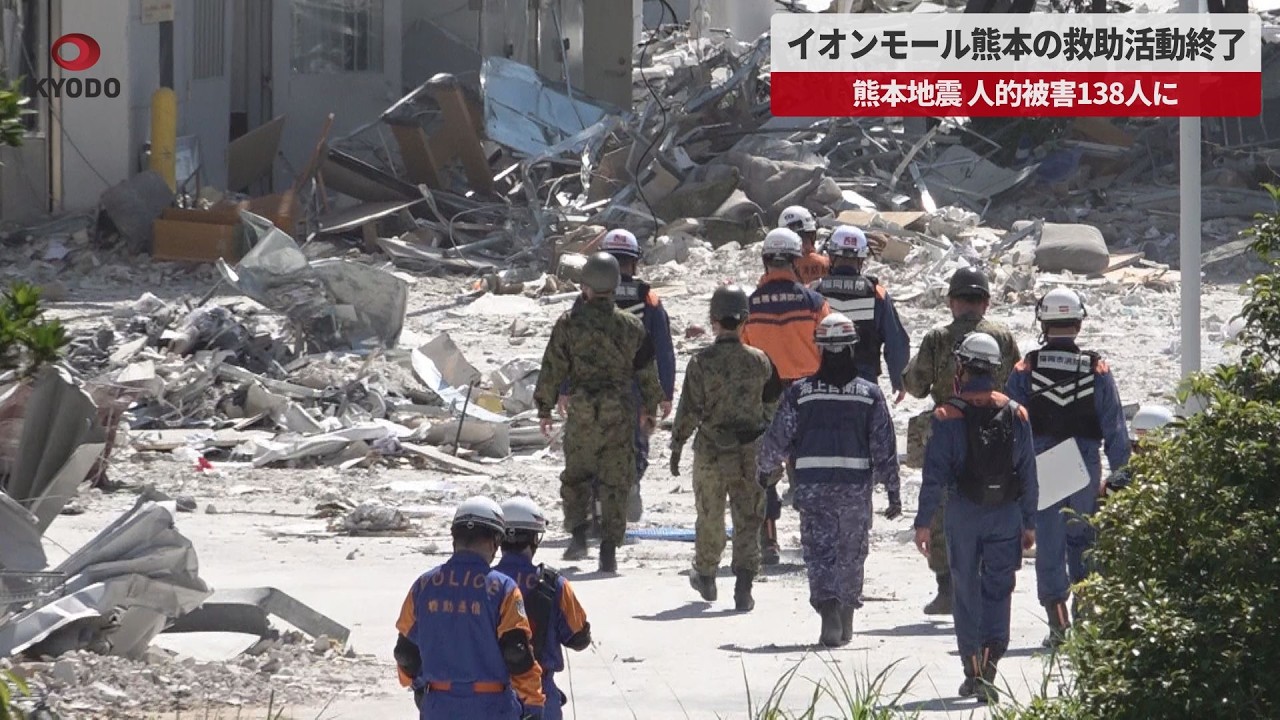
Similar/same photo of the aeon mall on the front page of this morning's paper. Seems to have exploded, perhaps a pressure wave from a floor collapse? --the appearance of 'ejecta' out in front of it.
 
I saw zero people in that video requiring any help or assistance. Or maybe that's why he shut it off so quickly, to help someone there at the end.
Did we watch he same video because there were people on the ground and others needing help getting through toppled items. Or maybe we just have different ideas of what needing assistance is?

As soon as whomever I was with no longer needed immediate assistance I would have been looking for others who needed help and giving what assistance I could, not walking around recording for a social media post.
 
Similar/same photo of the aeon mall on the front page of this morning's paper. Seems to have exploded, perhaps a pressure wave from a floor collapse? --the appearance of 'ejecta' out in front of it.

They said it was a gas explosion.
 
Did we watch he same video because there were people on the ground and others needing help getting through toppled items. Or maybe we just have different ideas of what needing assistance is?

As soon as whomever I was with no longer needed immediate assistance I would have been looking for others who needed help and giving what assistance I could, not walking around recording for a social media post.
There was one person crouching down hugging a child and a girl coming behind her that looked like she was checking on her. That was about it. Before that everybody was mostly standing around. At the end when he shut off the video he had reached an area where it seemed that people might have needed assistance. Since he stopped videotaping in that area, I think we can safely assume that he single handedly righted all the carts, cleared the aisles of debris, comforted the crying children and returned all the fallen goods to their pallets.
 
I didn't see any images of firefighting there. Maybe they were able to put it out quickly...

I claim no expertise, but depending on the surrounding material, a gas explosion does not necessarily have to result in a conflagration if the gas-air mixture ignites instantaneously. The gas is consumed so quickly that there may be little or no fire afterwards.

Kumamoto Aeon


Kumamoto Aeon


Looks like the aftermath of a massive compression wave to me.
 
During the Kumamoto earthquake, we experienced a strong earthquake measuring a seismic intensity of 4 in Fukuoka, which is quite far from Kumamoto. I lived in Tokyo for many years, so I am used to earthquakes. However, Fukuoka rarely experiences earthquakes, so my mother and the others were quite surprised.

Fortunately, nothing fell or was damaged in our house. An emergency alert sounded on our smartphones, and announcements warning people to be careful were also broadcast through the speakers in our neighborhood.

I am saddened by the loss of life and injuries caused by this earthquake.

Timeline and Current Understanding of the Aeon Mall Kumamoto Explosion

Based on the latest available reports, the sequence of events appears to be as follows:

4:27 p.m. on July 28, 2026: A powerful earthquake struck Kumamoto Prefecture, with a maximum seismic intensity of 7 recorded in Uki City and Hikawa Town.
Immediately after the earthquake: People inside Aeon Mall Kumamoto were evacuated. According to reports, approximately 200 people had evacuated the facility before the explosion occurred.
Later: An explosion occurred at the shopping mall, causing part of the second floor to collapse and trapping some employees.
Possible cause: A government official indicated that gas leakage may have been involved, but the exact cause has not yet been officially determined.
Casualties: The latest reports indicate that two people died at Aeon Mall Kumamoto, and several others were injured. Rescue operations and investigations have continued.
Important point: The available evidence suggests that the mall was already being evacuated before the explosion. Therefore, it would be inaccurate to assume that people simply remained inside for an hour after the earthquake without evacuation measures.
Key Issue for the Investigation

The most important questions are likely to be:

When did the gas leak begin?
Was the gas leak detected before the explosion?
Did the gas shut-off and safety systems operate correctly?
Was the building evacuated because of the earthquake alone, or was a gas leak also suspected?
Why did the explosion occur after evacuation had already begun?
Did the earthquake damage gas pipes or equipment in a way that bypassed or defeated the safety systems?

At this stage, it is too early to conclude that the accident was caused by inadequate inspection or a defective gas safety system. The fact that approximately 200 people had already evacuated is important, and the investigation should focus on what happened to the gas system between the earthquake and the explosion.

In other words, the central question is not simply "Why weren't people evacuated?" but rather "Why did a major explosion occur after evacuation had already taken place?"

This distinction is important when assessing whether there was a failure in emergency response, gas safety equipment, maintenance, or the building's emergency procedures.
 
I'm glad you and your family are well, @Hiroyuki Nagashima!
Thank you for your concern. The well pump that we had been using at home for many years broke down during this heat wave, completely unrelated to the earthquake. I called a repair company yesterday to inspect it, and I have just asked them to replace it with a new pump.

There may be some delays or difficulties in getting well pumps repaired or replaced because of the demand for repairs in the earthquake-affected areas. Fortunately, our house is also connected to the municipal water supply, so we won't have any serious problems in our daily life. However, it is still inconvenient not to have access to the cold water from our well.
 
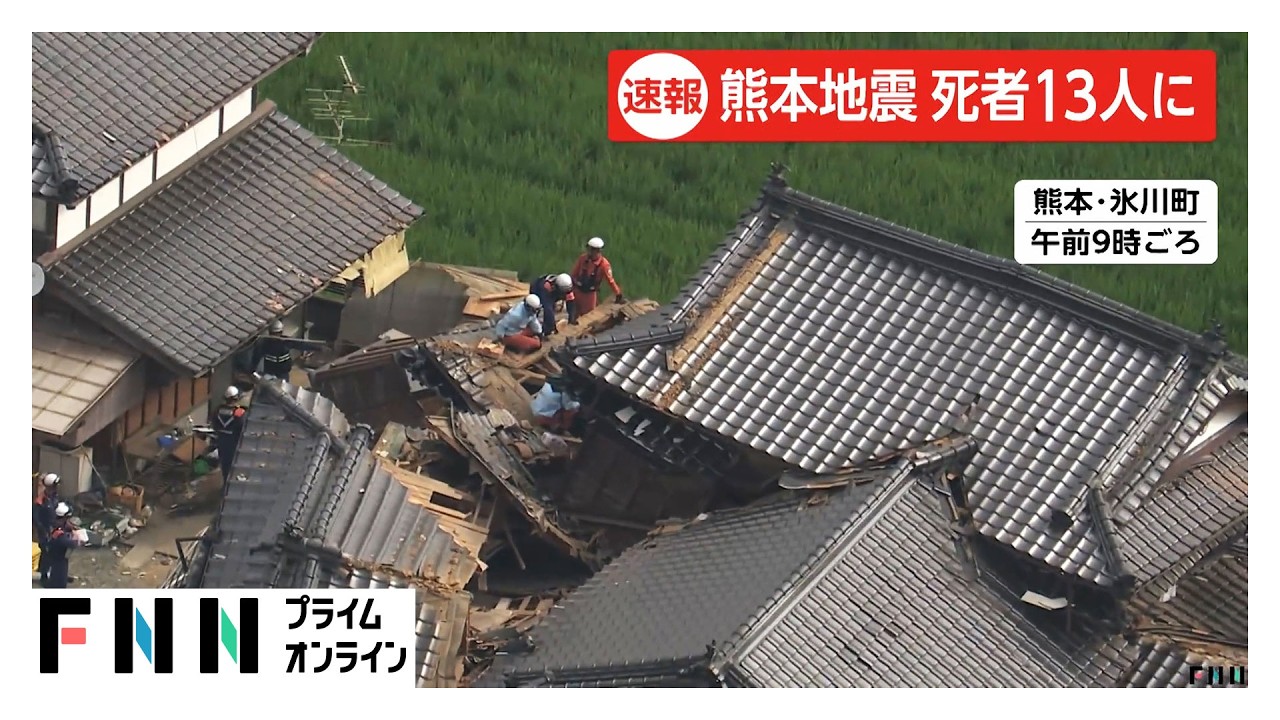
The death toll climbed to 13 as rescue crews continued searching through damaged buildings in Kumamoto Prefecture after a powerful earthquake struck on 28 July, causing widespread destruction and triggering an explosion at a major shopping centre.

An unknown number of people remained trapped inside the collapsed AEON Mall Kumamoto in the town of Kashima. Several workers were also still unaccounted for at a badly damaged paper factory in Yatsushiro. The central government said that, as of 8.30 am, 13 people had been confirmed dead. Seven others had suffered serious injuries, and 29 had minor injuries. By 7 am, 9,186 people were staying at 506 evacuation centres across five prefectures. :(


Another major rescue operation was being conducted at a Nippon Paper Industries Co. factory in Yatsushiro, where at least one chimney collapsed in the shaking, trapping 11 people. The prefectural government said four people were pulled from the wreckage by the morning of July 29. Two of them were in a state of cardiopulmonary arrest and the other two were seriously injured. Seven people were unaccounted for. Around 20 fire engines and ambulances remained near the factory entrance on the morning of July 29.


Supermarket Stays Open Despite Being Hit by a Magnitude-7-Level Earthquake: "It's a Huge Help," Say Residents in Uki City, Kumamoto

In Shiranuhi Town, Uki City, Kumamoto Prefecture, a local supermarket continues to support the community despite suffering severe earthquake damage.

Reporter:
"This is a supermarket in Shiranuhi Town, Uki City. Two days after the area experienced the maximum Japanese seismic intensity of Shindo 7, the store remains open even though both the building and its employees were affected by the disaster."

Earthquake Damage Still Visible Inside the Store

Fresh Kumai Shiranuhi Store reopened for business on the 29th.

However, the inside of the store is still far from fully restored.

Worker:
"The display cases shifted during the earthquake, causing the water pipes to come loose. As a result, water is leaking into the store, and we're still in the middle of repair work."

The damage is evident throughout the store.

Reporter:
"The signs indicating where products are located are hanging down, and the shelves have been pushed backward from their original positions. The lights used to illuminate the merchandise are still dangling, and some of the glass has been shattered."

The earthquake has left its mark throughout the store, and the situation in the back storage area is equally severe.

Mikio Kumai, President of Fresh Kumai:
"Just look at this. It feels beyond repair."

Even the store's saltwater processing machine, which is used to keep fish fresh, was damaged.

Wanting to welcome local residents back as quickly as possible, employees worked urgently to restore the store.

Mikio Kumai:
"The ceiling, the glass—everything. Products were scattered everywhere. I'm amazed we've managed to get the store back to this point."

"We'll Stay Open as Long as We Have Products to Sell"

Long lines formed at the checkout counters.

Customer in her 80s:
"They even called me this morning to let me know they were open. It's such a tremendous help. I know the store itself is going through a difficult time."

Shopper from Uki City:
"I went to several places, but most of the stores were closed. That's why I came to Kumai."

Customer in his 30s:
"This was the only nearby store that was open. It's been a real lifesaver."

Fresh Kumai says it intends to continue operating as long as it has products available.

Mikio Kumai:
"We still have a limited amount of merchandise to sell, so we want to make it available to our customers. Otherwise, it would simply go to waste. Our customers need these goods to continue their daily lives, and if we don't sell them, it becomes a loss for us as well."

Note: Shindo 7 is the highest level on the Japan Meteorological Agency's seismic intensity scale, indicating extremely violent shaking capable of causing devastating damage. It is not the same as earthquake magnitude, which measures the energy released by an earthquake.
 
Support Efforts Expanding After the Kumamoto Earthquake — and Important Precautions


Water Outages Continue in Earthquake-Hit Areas; Support Arrives from Across Japan with Showers, Toilets, and More (July 31, 2026)

Following the Kumamoto earthquake, relief efforts are expanding across the affected areas. Government agencies, local municipalities, volunteers, businesses, and nonprofit organizations are working together to provide emergency assistance to residents.

Relief Efforts Underway

Emergency Shelters
Many evacuation centers have been opened to provide temporary accommodation, food, drinking water, blankets, and basic necessities for displaced residents.

Food and Water Distribution
Local governments, the Japan Self-Defense Forces, volunteers, and aid organizations are distributing emergency supplies, including bottled water, ready-to-eat meals, and hygiene products.

Medical Assistance
Medical teams are providing emergency treatment, mental health support, and care for elderly people and individuals with chronic illnesses.

Restoration of Lifelines
Electricity, water, gas, roads, and communication networks are being restored as quickly as possible, although repairs may take time in heavily damaged areas.

Volunteer Support
Volunteers are helping with debris removal, cleaning homes, transporting supplies, and assisting vulnerable residents.

Donations and Fundraising
Many organizations have begun collecting monetary donations to support long-term recovery and reconstruction.

Important Precautions
Verify Information Before Sharing

False information and rumors often spread rapidly after major disasters. Always rely on official announcements from government agencies, local authorities, or trusted news organizations before sharing information.

Be Careful of Fraud

Unfortunately, disasters sometimes lead to scams, including:

Fake donation requests
Individuals pretending to represent charities
Fraudulent repair contractors
Phishing emails and fake websites

Donate only through well-established organizations or official municipal donation programs.

Avoid Unnecessary Travel to Disaster Areas

Unless you are an authorized volunteer or have official business, avoid traveling to affected areas. Roads may be needed for emergency vehicles and relief operations.

Respect the Privacy of Victims

Avoid photographing disaster victims without permission or sharing personal information on social media.

Follow Official Instructions

Residents should follow evacuation orders and safety guidance from local authorities, especially regarding aftershocks, landslides, and damaged buildings.

How People Can Help

People outside the affected area can make a meaningful contribution by:

Donating money through reputable relief organizations.
Donating supplies only when specifically requested by local authorities.
Participating in organized volunteer activities after registration and when local governments indicate that volunteers are needed.
Sharing only verified information from official sources.

Thoughtful and well-coordinated assistance helps ensure that aid reaches those who need it most while minimizing additional burdens on disaster response efforts.
 
2026 Kumamoto Earthquake: JGSDF V-22 Osprey Transports Emergency Relief Supplies

The Significance of Deploying the V-22 Osprey During the Kumamoto Earthquake Response

The deployment of the Japan Ground Self-Defense Force (JGSDF) V-22 Osprey during the Kumamoto earthquake response demonstrated how Japan has applied the lessons learned from the 2011 Great East Japan Earthquake. Rather than replacing the CH-47J Chinook, the Osprey complements it by providing capabilities that were previously limited.

Lessons from the 2011 Great East Japan Earthquake

During the 2011 disaster, the CH-47J Chinook played a central role in transporting personnel, supplies, and heavy equipment. However, several operational challenges became apparent:

The disaster affected an extremely wide area.
Aircraft often had to establish forward operating bases for refueling.
Frequent refueling reduced the number of daily transport missions.
Delivering emergency responders to isolated communities quickly was difficult.

These experiences highlighted the need for an aircraft capable of flying faster and farther while maintaining vertical takeoff and landing capability.

Advantages of the V-22 Osprey

The V-22 Osprey addresses many of these challenges through its unique combination of helicopter and fixed-wing aircraft capabilities.

Its major advantages include:

High speed: approximately 450 km/h, nearly twice the cruising speed of the CH-47J.
Long range: more than 1,600 km under favorable conditions.
Vertical takeoff and landing (VTOL): allowing operations without runways.
Rapid deployment: able to deliver rescue teams, medical personnel, and emergency supplies much more quickly.

These characteristics make the Osprey particularly valuable during the critical first 24 to 72 hours after a major disaster, when saving lives depends on rapid response.

Significance During the Kumamoto Earthquake

With the Ospreys based at Saga Garrison, close to Kumamoto, the JGSDF was able to respond much more rapidly than if aircraft had been deployed from more distant bases.

The Osprey enabled the rapid transport of:

Search-and-rescue teams
Medical personnel
Communications units
Emergency medical supplies
Satellite communication equipment

Because it can fly over damaged roads and collapsed bridges, the aircraft can reach isolated communities even when ground transportation is impossible.

Complementary Roles of the Osprey and the CH-47J

The Osprey is not intended to replace the CH-47J Chinook. Instead, each aircraft performs a different mission.

V-22 Osprey CH-47J Chinook
High-speed, long-range transport Heavy-lift transport
Rapid deployment of personnel Large-scale cargo transport
Medical evacuation Transport of heavy machinery and vehicles
Initial emergency response Sustained logistical support

In simple terms:

The Osprey saves time.
The Chinook moves volume.

Together they create a far more effective disaster response capability than either aircraft alone.

Conclusion

The Kumamoto earthquake response demonstrated the practical value of introducing the V-22 Osprey into Japan's disaster relief operations. Building on lessons from the 2011 Great East Japan Earthquake, the Osprey significantly strengthened Japan's ability to respond rapidly to large-scale disasters by delivering personnel and critical supplies over long distances without relying on intact roads or nearby refueling bases.

Rather than replacing the CH-47J, the Osprey fills a critical operational gap. The combination of the Osprey's speed and range with the Chinook's heavy-lift capability provides the Japan Ground Self-Defense Force with a more flexible, efficient, and resilient disaster response system for future earthquakes and other national emergencies.
 
Authorities ended the five-day search-and-rescue operation at AEON Mall Kumamoto on 1 August after confirming that everyone reported missing had been accounted for. The explosion, which devastated the shopping complex shortly after the powerful Kumamoto earthquake, left seven people dead and five others injured.


Three of those killed were employees of apparel group Onward Holdings, which operated the any SiS and WEGO stores at the mall. Seven Onward group employees had been working at the facility when the earthquake struck. All initially evacuated outdoors and were contacted after the quake, but the company lost contact with three of them following the explosion. The bodies of the three employees were found near a delivery entrance on the first floor.

Among the other victims was a 22-year-old woman who worked at a different store near the area believed to have been affected by the explosion. Her mother said the woman had evacuated outside after the earthquake and happened to meet a relative. She reportedly told the relative that she had been instructed to return to the store and place money in a safe. The relative attempted to stop her, but the woman went back into the building. The explosion occurred afterwards. Her mother said she believed her daughter and a colleague had returned under instructions from the store to secure sales proceeds.

:(


The death toll has risen to 36.

 
What Happened at Aeon Mall Kumamoto Between the Earthquake and the Explosion? (NHK)

August 1, 2026, 8:23 p.m.
2026 Kumamoto Earthquake


A large explosion occurred after the earthquake at Aeon Mall Kumamoto, a shopping center in Kashima Town, Kumamoto Prefecture, killing seven people and injuring five others.

According to Kumamoto Prefecture, search operations by police and firefighters ended at noon on August 1.

What exactly happened between the earthquake and the explosion?

Testimonies from several employees who were working at stores inside the mall are shedding light on how people evacuated and what conditions were like inside the facility.

Contents
Employees evacuated once. Why did some return to the stores afterward?
Where was the smell of gas detected?
[Video from Inside] Search Operations at Aeon Mall Kumamoto

This article, published on July 31, summarizes the search operations conducted by police and others. It also includes video footage filmed by a drone showing conditions inside the building.

4:27 p.m. — The Earthquake Strikes

It was during the summer vacation period, and approximately 3,000 people are believed to have been visiting the mall that day.

The earthquake struck at 4:27 p.m.

Testimony from Female Employee A

(Worked at a store on the second floor)

"The shaking was so strong that I could barely remain standing. Products and other objects fell over, and several customers who had been near the store entrance sat down on the floor. Everyone appeared shocked and confused."

An announcement informing people that an earthquake had occurred was made inside the mall. People believed to be Aeon Mall employees came near the stores and repeatedly told people, "Please evacuate without taking your belongings with you."

They guided customers who were near the store entrances outside. At around 5 p.m., I left through an employee entrance and went out into the parking lot.

Many people crowded around the employee entrance during the evacuation, and there were moments of confusion.

Even after I reached the parking lot, I had no idea what I was supposed to do. It was completely different from a routine evacuation drill, and I felt helpless.

In the parking lot, some people were treating those who had been injured, while others waited anxiously in the shade.

Employees Evacuated Once — Why Did Some Return to the Stores?

The employees initially evacuated the building.

However, some of them later returned inside.

Several employees described what happened.

A said that after waiting in the parking lot for a while, she decided to go home. However, she had evacuated without taking her car keys or other belongings, so she asked whether she could return to the store.

Female Employee A

(Worked at a store on the second floor)

"I told someone involved with the facility that I wanted to go back and get my car keys and other belongings. At first, I was told, 'Please wait a little while.' Then I was told, 'I think it should be okay,' so I went back inside."

Testimony from Female Employee B

(Worked at a store on the second floor)

At around 5:15 p.m., someone believed to be an Aeon Mall employee called out to people, telling customers to either wait outside or go home.

Employees who had their house keys, car keys, or other belongings inside and could not go home without retrieving them were told to return to their stores as a group.

Testimony from Female Employee C

(Worked at a store on the second floor)

"A person believed to be an Aeon employee wearing a vest labeled 'Information Team' gathered the employees and explained, 'We will not be able to operate today, so please go home as you are.' They also told us, 'It is dangerous, so please do not go inside.'"

However, several employees said they could not go home because their car keys or house keys were still in their lockers, and they went back inside.

The employees who returned went to retrieve their belongings. I also went back inside to lock the cash register and put the money away in the safe.

Evacuated Two Minutes Before the Explosion

Female Employee B returned to the second-floor store together with six employees from the same store. She recorded the conditions inside the building at the time.

Photographs show that the sprinkler system had been activated, leaving corridors and other areas flooded with water.

According to the time recorded on B's smartphone, she filmed the video on a staircase on the north side of the building at 5:43 p.m., just before the explosion.

She then evacuated through an exit on the north side of the central part of the building.

About two minutes later, she heard a deep "BOOM," similar to the sound of the ground shaking, and fine ash-like particles came flying toward her along with the blast wave.

B ran away from the building, but said that her entire body was covered in white dust.

Where Was the Smell of Gas Detected?

Several employees who returned inside after initially evacuating said they noticed the smell of gas.

Testimony from Female Employee D

(Worked at a store on the first floor)

"I went back to the store twice to retrieve my belongings and turn off the electricity. While I was heading outside after finishing what I needed to do, there was an extremely strong smell of gas. I felt that it was dangerous, so I quickly evacuated through an exit on the restaurant area side of the north side of the building."

She said that she did not notice any smell of gas when she returned to the store the first time.

"It Smells Like Gas. It Might Explode." — Employees Evacuate

C also said that at around 5:30 p.m., an employee who had returned with her said:

"It smells like gas. It might explode, so we should get out of here as quickly as possible."

C stopped what she was doing before she could finish locking the cash register and putting the money into the safe. She then evacuated through the employee entrance.

Female Employee C

(Worked at a store on the second floor)

"I was wearing a mask, but I definitely noticed an unusual smell that seemed like gas. After leaving the building, I got into my car and heard the sound of the explosion near the exit of the parking lot."

In addition, Female Employee E, who worked at a different second-floor store from C, said that she smelled gas in an employee passageway on the second floor when she returned to retrieve her belongings at around 5:20 p.m.

Female Employee E

(Worked at a store on the second floor)

"I went back to the second-floor store to get my belongings. As I approached the store, there was an incredibly strong, unusual smell. The dust made me feel a headache and nausea.

"To leave the building, I tried to use the employee passageway in the back area on the second floor, where the break room was located. When I opened the entrance door, I smelled what seemed to be leaking gas as well as another foul, fishy odor. The floor was also wet, so I decided not to go inside."

E then left the building through an exit on the north side, on the opposite side from where she had been, and got into her car in the parking lot. The explosion occurred while she was there.

Multiple Reports of a Gas Smell in the Southern and Western Areas of the Building

So far, several witnesses have reported smelling gas in areas on the southern and western sides of the building, where employee passageways were located.

On the other hand, some employees who returned to the eastern side of the building said they did not notice any smell of gas.
 
Back
Top Bottom