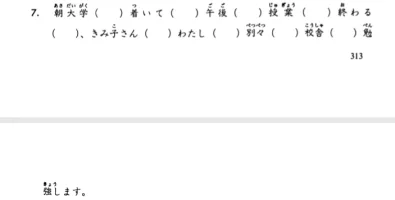
Zizka said:
(3)(4)には: where the action takes place
"Where the action takes place" isn't に.
It's 図書館で本を読みました, not 図書館に本を読みました.
Even with the double particle, the rule governing に vs. で still applies.
Zizka said:
(5)の I'd say connector as in "about the Meiji restoration".
のついて is not valid. As I might have mentioned before, you can think of ~について as a compound particle meaning "about". You won't see any other particles before ついて in this usage.
Zizka said:
(6)ついて, I've seen that before. It's the same as in #10. So I'll go with the same answer. に. It was the reverse: に and の. So の to connect the "book" and "about" for (6). And に after 明治維新 as in? Don't know. It's weird, I thought it was the exact same thing as #10 as both had ついて followed by a blank.
It's not weird. に connects 明治維新 with ついて (as above, you can consider ~について as a single compound particle). If you want to connect the modifying phrase 明治維新について to the noun 本 the answer has to be の. This is similar to 日本での生活 ("[my] life in Japan") and other constructions you've seen before, where a noun/particle combination is modifying another noun.
Zizka said:
(1)に: time when an action take place. は: topical
お昼に isn't necessarily invalid when talking about time, but this is essentially using お昼 as a stand-in for 昼ご飯. It's talking about lunch as a meal, so は is more natural (it's also the topic of everything that follows, so it makes sense that it's the widely "ruling" は rather than a more strictly binding particle like に)
Zizka said:
(6)と: and も although I thought saying "and also" would be grammatically correct to be honest.
と is not necessarily invalid, but note that the nuance is different.
In AもBもあって , both A and B are marked by も as the subjects of ある, meaning "There's both A and B..." (with a nuance emphasizing the variety).
In AとBもあって, the noun phrase AとB is being marked with も, so it specifically means "There is also A and B (in addition to other things)."
If you wanted to say "The cafeteria serves mostly Japanese food, but
there's also Western and Chinese food (i.e. in addition to Japanese)" then that would be 洋食と中華もあって.
Zizka said:
(2)は: topical, same thing as in #7. が as it turns out, go figure.
This goes back to what Toritoribeさん said about the topic "ruling" the entire sentence. If you make this は, it implies the entire sentence is talking about class. But it isn't; after the comma, class's role in the sentence is done, and the topic is completely something else. So "class" is simply the grammatical subject of 終わる (hence が).
Zizka said:
(3)まで: I'm tempted to use まで as in "until"... と... no clue why.
I'm a bit surprised that your book is springing this on you here, because this is a completely different use of ~と that is considered a conditional. Maybe look up と in your Dictionary of Basic Japanese Grammar and read up on the conditional usage where と follows a plain form verb.
Note that if it were まで, that would mean something like "Until class ends at 4 o'clock, Kimiko and I go home," which doesn't really make sense at all.
Zizka said:
(5)は: topical と so this time we were suppose to make the full list with と. I guess you need to take a wild guess with that situation.
Honestly, きみ子さんと私は一緒にうちに帰ります is perfectly valid and sounds more natural to me than きみ子さんと私とうちに帰ります。
Are you sure your answer key says that both (4) and (5) have to be と?