- 1 Oct 2024
- 26
- 25
Published Jan. 5, 20121 comments
The law promulgated on October 20, 2011, by the Assembly of the State of Amazonas, was historic: the cultivation of jute became recognized as a cycle of economic development in the State of Amazonas - and what's more, it contained a "formal apology " for the "excesses" committed during World War II.
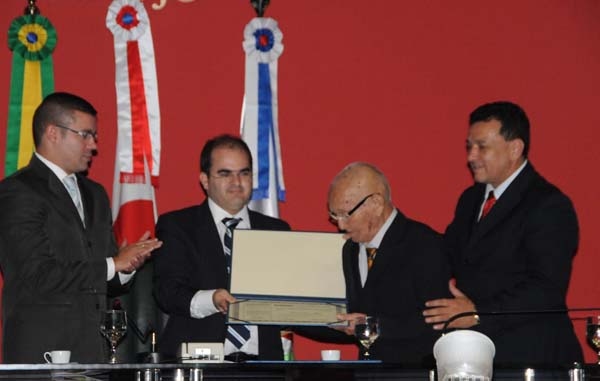
The Koutakusei Zennonshin Shoji at the moment he receives the title of Citizen of Amazonas (Manaus)
Certainly, this was an act loaded with one of the most significant symbols in the history of Japanese immigration to Brazil. Along with the celebrations and tributes, it gave a never-imagined historical dimension to the 80th anniversary of the beginning of the koutakuseis colonization movement in the Amazon.
Koutakusei is a term that refers to students at the Kokushikan Koutou Takushoku Gakkou (Kokushikan Colonization Higher School), Koutaku for short. They were young people trained to lead Japanese colonization in the Amazon region, from the Vila Amazônia Institute, founded on October 21, 1930 in a location located on the banks of the Amazon River, currently known as Parintins, famous nationally and internally for the Boi Folk Festival. -Bumba.
Led by the then parliamentary deputy Tsukasa Uetsuka, this colonization project, like so many others designed at the time, suffered all sorts of difficulties arising from local natural conditions. From the 1st class, made up of 43 people (35 of whom were graduates), who arrived in Parintins on June 20, 1931; until the 7th and final class, in 1937, there were 243 graduates.
After countless adversities, April 24, 1937 can be considered the day of redemption – finally, Companhia Industrial Amazonense (founded on February 4, 1936), from Vila Amazônia, sent the first jute uniform to Cia. Martin Jorge , which, classified as high quality, achieved a higher price than other common jutes, making the "Oyama" variety economically viable. This meant that Brazil was no longer importing jute fiber, mainly from India, to manufacture the bags used to export coffee.
This story that seemed to have a happy ending suffered a mortal blow with the beginning of the Second World War, when, on January 29, 1942, Brazil broke off relations with Japan. Thus, on September 25, 1942, soldiers of the Brazilian Army arrived at Vila Amazônia to confiscate the Company's assets and arrest all project members. On April 6, 1946, after the war, the properties were auctioned and acquired by one of the companies in the JG Araujo & Cia. Ltda group.
"Despite all the difficulties, the feeling of unity and mutual help has always been one of the characteristics of the Koutakuseis", highlights the book "A Saga dos Koutakuseis no Amazonas", launched by the Koutaku Association of Amazonas, in celebration of the 80th anniversary of the Koutakuseis in Amazonas. Amazon. "Little by little, with a lot of work and sacrifice, they made progress. Jute was already widespread in the State. The caboclos of the region were already planting it on a large scale, in Parintins there were several jute presses and in Manaus two jute weaving plants were installed. With progress, the Koutakuseis improved their homes and were able to buy boats and transport jute."