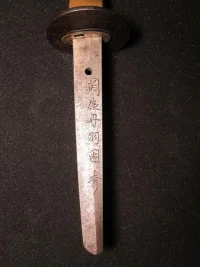
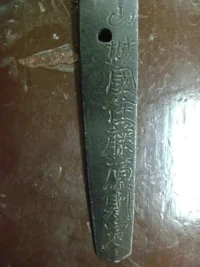
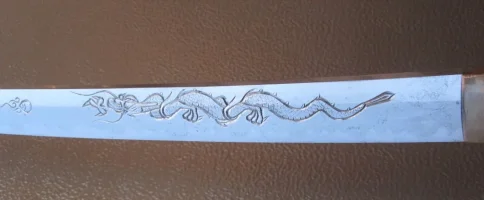
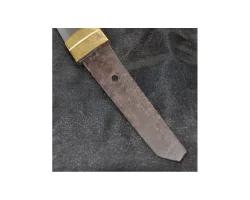
I have a nice Japanese sword in fairly good shape. I have attempted to translate the signature, but have had no luck finding the kanji in any lists on the internet except maybe the last one "hide"? There is a showa stamp on the tang so I am pretty sure it is a WWII era blade. It has a well done horimono carving of a dragon on the blade. Any help with translation would be appreciated.
Note the kanji for ba/pa in the text example above is 波 instead of 羽, as is on your sword, but the actual sword to which that link points has the identical kanji signature to the one on your sword.
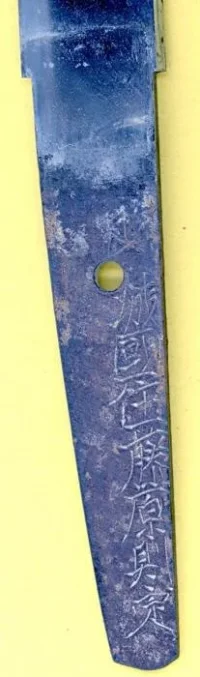
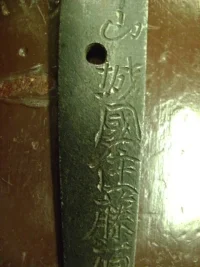
Can anyone help me translate this? I'm not sure about the first character, but the rest of it "...城國住藤原則定" reads as "...shiro Kuni-ju Fujiwara Norisada". It has been suggested that the first part reads "Yamashiro" (山城), but that doesn't look right to me.
Majestic-
Thanks very much. One more favor if you please? What does is all mean in English? I know Ju can mean "province" and I see Seki often associated with it. Is Tanba a Province? I see a Tamba listed as an old province name. Or maybe part of Kunihide's name?
Indeed the listed sword papers show an identical signature, but the stamp looks to be a kanji rather than the standard showa stamp on my blade. I'll attach a copy of the horimono in case you would like to see it. Again, I sure appreciate the help.
Rich
Hello Dr. Jay, yes it is Yamashiro kuni ju, Fujiwara Norisada.
In my opinion, which may be surplus to your requirements, the signature looks fake. The stroke orders are not correct, the signature has been added so that it accommodates the peg hole, and the kanji look unlike anything I've seen before. But, I'm always coming across surprising things in the sword world, so I could be wrong.
A poster here called Toritoribe knows this stuff pretty well. His opinion might be good to hear.
"Ju" (住) indicates location (we use it today in words like "address" (住所), or "resident" (住民)). Tanba is the city (town/village). The individual smith is Kunihide. So in English we might render it as Kunisada of Tanba in the province of Seki. Seki would correspond to modern-day Gifu.
Hello Dr. Jay, yes it is Yamashiro kuni ju, Fujiwara Norisada.
In my opinion, which may be surplus to your requirements, the signature looks fake. The stroke orders are not correct, the signature has been added so that it accommodates the peg hole, and the kanji look unlike anything I've seen before. But, I'm always coming across surprising things in the sword world, so I could be wrong.
A poster here called Toritoribe knows this stuff pretty well. His opinion might be good to hear.
It would be a concern to me if the signature is gemei, as this is a sword I am currently looking at purchasing and I want to determine its authenticity. I would be interested to hear Toritoribe's opinion as well. Thanks!
Er, I'm not an expert of swords or anything.:emoji_blush:
Anyway, [MENTION=62411]rloose[/MENTION]-san, the site Majestic-san linked did a typo and misreading. 関住丹羽國秀[Seki jū, Niwa Kunihide] "Niwa Kunihide living in Seki" is correct. Niwa is a family name, and Kunihide is a male given name. This name is in the list of swordsmiths in Seki. According to the list, 國秀/国秀 is a sort of artist name and his real name is 蒲一. (I don't know the correct reading of this name, but it would be "Hoichi".)
Seki is the name of a region/town/city in Gifu Prefecture, as Majestic-san wrote. Seki, Gifu - Wikipedia, the free encyclopedia
[MENTION=62419]Dr Jay[/MENTION]-san, I agree with Majestic-san's opinion. The inscription seems too dull in the first place. See how sharp the real inscription is in the pictures in the site Majestic-san linked.
[MENTION=62419]Dr Jay[/MENTION]-san, I agree with Majestic-san's opinion. The inscription seems too dull in the first place. See how sharp the real inscription is in the pictures in the site Majestic-san linked.
It's about 340 years old (supposedly), so maybe some dullness is to be expected.
I've tracked down two other versions of this mei.
The first mei looks very similar, including the gap beneath the 'Yama'. The second one doesn't have the gap and the 'Yama' is distinctly different. I'll keep researching. Thanks!
Thanks for all your help. I now know a lot more about this sword. I wish it could talk and tell me how it got to a 1980 gun show in Albuquerque, New Mexico.
It's about 340 years old (supposedly), so maybe some dullness is to be expected.
I've tracked down two other versions of this mei.
The first mei looks very similar, including the gap beneath the 'Yama'. The second one doesn't have the gap and the 'Yama' is distinctly different. I'll keep researching. Thanks!
Thanks for all your help. I now know a lot more about this sword. I wish it could talk and tell me how it got to a 1980 gun show in Albuquerque, New Mexico.
Thank you for your advice, I really appreciate it. I'm learning a lot here about how to identify forgeries. I take it you agree that the stroke orders look wrong? If so, that would indicate (probably) that the forger was not native? Here's a closer look:
The shapes of the kanji seem regular. I think it's inscribed by the one who is familier with kanji/Chinese characters. (It doesn't mean they are Japanese, though.)
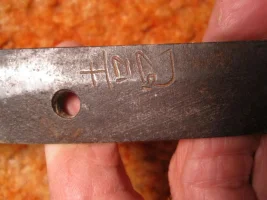
Hello again. Here is another mei. This one is clearly Yoshikane, but which one? John Yumoto's book shows 3 and I am sure there are many more. This wakizashi has an almost diamond shaped cross section and a very narrow mune. It has some big kizu (I believe the term for forging flaws), so I am sure is it genuine folded steel. The grain in nearly straight, with small waves. There is no yokote and I can see gunome hamon near the tip. Any information on the age would be appreciated.
It had a matched tsuba and fuchi with ginger root motif. The tsuba is iron and the fuchi is copper and is made in two pieces where one fits inside the other.
Yes there are at least 6 or 7 smiths by that name, according to my sword reference. Sorry I cannot help with the age, as there are Yoshikane smiths in both the koto and shinto periods. It would be hard to say anything without looking at the blade in detail. Having no yokote and forging flaws is not a great sign. Are these part of a collection, or are you looking to buy these?
The advice that is usually given is: buy the sword, and not the name. Meaning; first buy the sword for what it is, not for what name is engraved on the tang. The name is usually secondary, especially with obscure smiths. So a sword with flaws by a minor smith - even if authentic - will not have much value. The value increases if the flaws are not fatal, and can be remedied by a good polishing. As for the tsuba and the other fittings, these should be considered separately, and they will be of no help in identifying the sword. Usually the fuchi is one piece. The thing you describe as being two pieces with one fitting inside the other sounds more like the habaki, maybe? Anyway, its like describing the frame for a Van Gogh painting. It might be a very interesting frame, and might be valuable as an artifact, but it probably tells us very little about the painting.
So, with that long-winded preface, I would say that pics of the sword with all its flaws would be better than a description, and I would point you to the Nihonto Message Board, as that forum has some fabulously knowledgable people on it who know a lot more about this stuff than I do. I would also add that all collectors probably start out by paying too much for a crap sword, and then slowly learning the details about what makes a sword valuable.
Don't get me wrong about the sword. It could be an interesting find. And don't fret the age. A 600 year old sword is not necessarily more valuable than a 300 year old sword. Age is a frustratingly poor indicator of value in the sword world (I think I used that phrase in another sword-related post on this forum... apologies if I'm repeating myself). Figure out what the sword is first, and then move on to the signature.
Oh, and let me add that I don't have even a wild opinion on whether or not the Yoshikane signature is genuine or not. Like I said, the sword would be far more interesting to look at than the signature. It's just that the previous signature sent in by Dr Jay looked so odd that I felt compelled to comment on it. (But again, I'm no expert, so I could very well be wrong).
Thanks for the reply. I own the wakizashi and have had it for over 30 years. I am not expert enough to evaluate a signature's authenticity. I am not really a collector. When I was younger, I was a member of a dojo in Albuquerque that had classes in Aikido, Karate, and Kenjutsu. The instructor insisted that we use genuine Japanese blades and not reproductions. He was informed enough to keep us from using a national treasure as an iato. He unfortunately passed away before I learned any tanto or wakizashi techniques. I moved to southern New Mexico and could not find an acceptable dojo for any sort of martial art. I did earn an apprentice instructor's license from the Albuquerque dojo (Sandia Budokan) in 1983. So the wakizashi has been sitting on a sword stand for 30 years or so. I was just curious about how old it is. I am not concerned about the monetary value because I am sure it is not worth a lot of money.
I will give the nihonto message board a try and see what they have to say.
Thanks again,
Rich
P.S. I drive a 500cc Royal Enfield (2009 Indian version)
I did a bit more digging around in my references and on the web. The Yoshikane smiths who signed their swords with just two characters would have been from the ko-bizen school that spans the time between, say 900 to 1500, in other words very old swords indeed. There are few examples of these swords with signatures on them, and those that are signed are worth a fortune, or are national treasures on display in museums. The swords attributed to him that do not have signatures are equally precious, pricey, and rare. I'm attaching links to a few examples. If you look on the "emuseum" link below, you can pull up a close-up of the Yoshikane signature on a sword in the national museum in Tokyo.
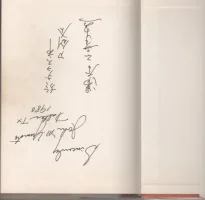
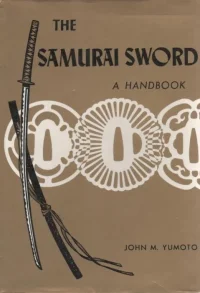
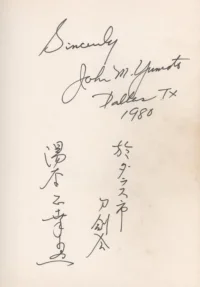
I received some chastisement from the Nihonto Message Board for submitting such a substandard blade from their consideration. The thread moderator did tell me that it was no older than shinto. The Nihonto Club moderator told me it was likely a gimei signature. I have another favor to ask for a translation. This was a signature from John Yumoto at the 1980 sword show in Dallas, Texas. He good-naturedly chided me for having a book in such pristine condition and said that I was not using it enough! What he wrote in the front may express that thought.
Best Wishes,
Rich Loose
This site uses cookies to help personalise content, tailor your experience and to keep you logged in if you register.
By continuing to use this site, you are consenting to our use of cookies.