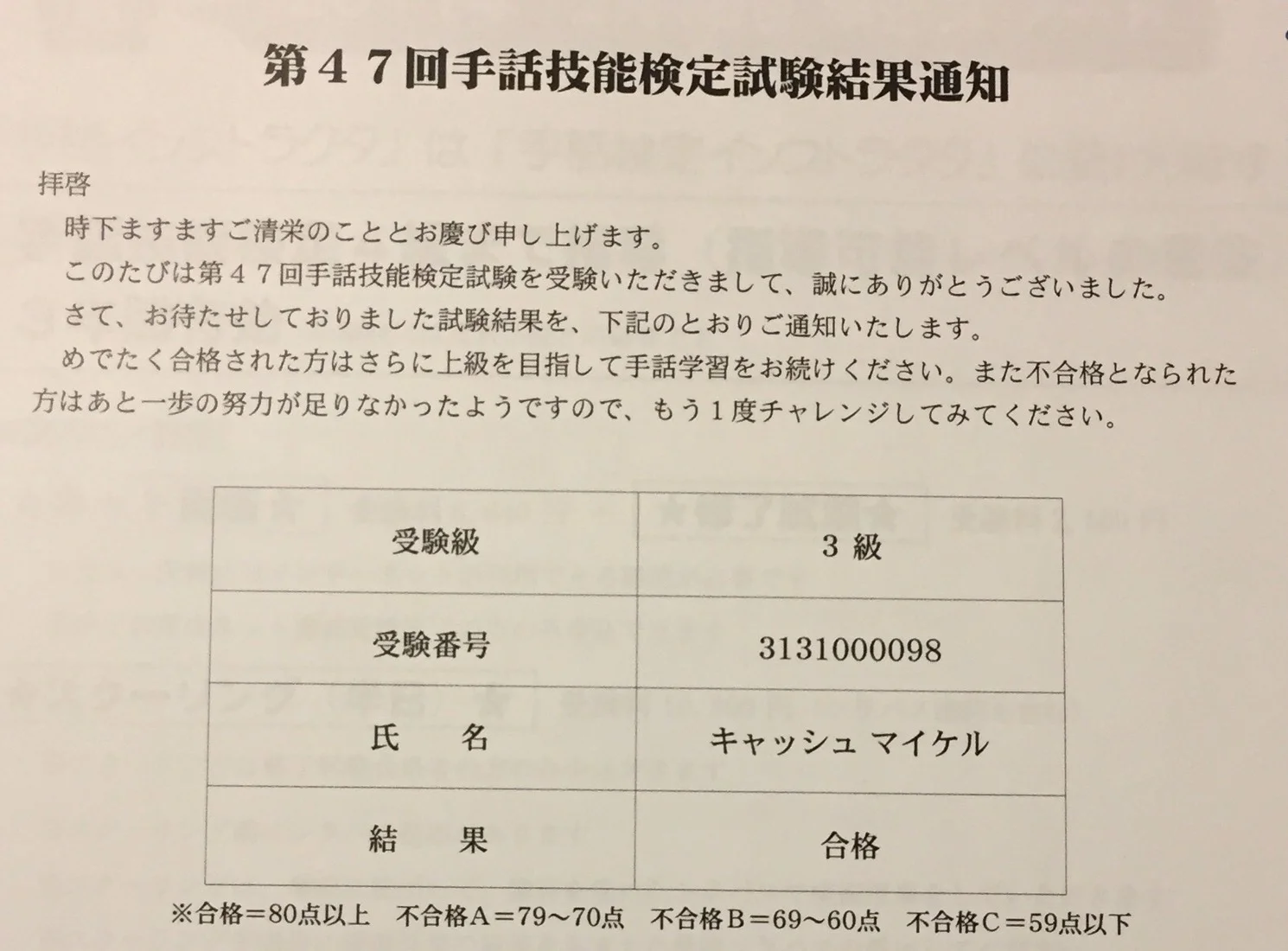
Congratulations Mike! What exactly motivated you to start with sign language?
Thank you. Ever since I first started learning Japanese, way back when, and first had to contemplate how it is possible to use another language while
not translating in your head in order to do it I have been fascinated by the idea that language must at some level exist independent of the set of sounds we are used to thinking of as being a language. After all, people who have never heard a sound in their entire life are capable of thought and language acquisition.
Over the years I have occasionally run across the NHK-E program for learning sign language and have looked at it a bit and managed to pick out a sign or two here and there by watching and listening, but it has always been somewhere in the middle of the 24 week series and it is just impossible to jump into it in the middle. By coincidence I happened to catch Episode 1 of the new run in April and decided that would be a good time to actually look into the feasibility of learning it.
Have you had much opportunity to use it?
Having the experience of never having had any opportunity to use Japanese until I learned Japanese and knowing how
that turned out, I was fully confident that learning it would lead to opportunities to use it.
One of the very first things I did was to google sign language circles in my area. I found there is a group that meets about 300m from my home. In Japan, sign language circles are everywhere and serve almost like an auxiliary group to the local organization for deaf people. There are always a few deaf people who are active in helping to spread the use of sign language, so they show up and help out. And there are always different activities being put on by the deaf organizations, where hearing members of the circles often attend, participate, or help out.
There are about as many opportunities as one wishes to create.
I've only witnessed people signing to each other a handful of times myself.
I've been here long enough to have personally witnessed the revolutionary transformation in the way Japan deals with people who have disabilities. I can remember when you would practically
never see anybody out in public. These days it is no longer unusual to see blind people or people using wheelchairs who are moving about on their own, going about their day just like everybody else and hardly getting a second glance.
Things are a bit different with the deaf, whose disability is not visibly apparent. They've
always been there among everyone else....the reason we've not noticed them by their telltale signing is that historically they have tended
not to sign in public. They have been subjected to bullying, teasing, mocking, and just general tormenting from the hearing in Japanese society for so long, and had it beaten out of them (sometimes literally) at the schools for the deaf
which prohibited sign language that they just went very insular with sign language and as a matter of prudence didn't sign in front of people they didn't know. This has only recently began to change. The deaf in Japan are right in the middle of having the equivalent of their civil rights movement.
I was getting on a train in Tokyo last Thursday and by coincidence there were two old ladies signing to each other who got on at the same door where I boarded the train. I talked to them just a bit before I had to get off two stops later.
I didn't realize the variety of sign languages until then, and it made total sense that the sign language would reflect the grammar and vocabulary of the spoken language.
I thought it was just Japanese with the spoken words replaced by signs. I soon learned how very wrong that was. While it shows very unmistakable influence from the Japanese language and culture it is surrounded by, it is very definitely a separate language unto itself. In fact, various local governments around the country passing ordinances recognizing the status of JSL as a legitimate, separate,
real language (instead of a bunch of desperate gesturing) is a large part of the impetus behind the change in attitude among the deaf community alluded to earlier.
There are aspects to it which are very reminiscent of kanji. Hell, some of the signs
are kanji. But many others employ elements similar to kanji radicals, which make them much easier to learn, recognize, and remember. And many combine to form compounds, causing what would be some rather rarely used and hard to remember vocabulary items in spoken language to actually be really easy to remember in signing.
I've tried to get my wife to learn also, but she's not interested. She thinks it must be impossibly difficult. So every now and then I show her a sign for something and have her guess at the meaning. I purposely choose obvious ones and she always says, "But that's just a gesture!" And I tell her, "Yeah, it's not a super-secret code designed to baffle everybody. It's a practical means of communication. When gestures work, gestures are used."
Speaking of ASL and the fact that deafness is an invisible disability...
One of the things that surprised me at first, when meeting deaf people, was their asking me if I was deaf too. That was an eye-opener.
Another thing that surprised me was the assumption that since I was attending a deaf event or sign language event in Japan and I'm an American then naturally I
must know ASL. I don't have the first clue about ASL. The people who have learned a little ASL are happy to have the chance to try it out on the gaijin, though. You know how it is when someone says something to you in Japanese and you don't understand it? You don't know if it is a word you haven't learned yet, a regionalism, bad pronunciation, or what....you just know you didn't understand it. Same thing with me watching them sign something I
might understand if it was JSL, but I can't tell the difference between ASL I've never learned and JSL I haven't learned yet. They always seem so disappointed when I tell them I don't know any ASL.