


- 14 Mar 2002
- 21,050
- 18,903
Japanese dentists are conducting clinical trials on a pioneering drug that may enable the regrowth of lost teeth, offering a potential alternative to dentures and implants. It is widely accepted that humans, unlike reptiles and fish, typically only grow two teeth. However, Katsu Takahashi, head of oral surgery at the Medical Research Institute Kitano Hospital in Osaka, has revealed that dormant buds for a third set of teeth exist beneath the gums.
His team initiated clinical trials at Kyoto University Hospital in October, administering an experimental medication to adult subjects. This medication is believed to have the potential to stimulate the growth of these concealed teeth. Takahashi emphasized that this technology is "completely new" to the world. Prosthetic treatments for tooth loss are often considered costly and invasive. Therefore, Takahashi, the lead researcher, highlighted that "restoring natural teeth has its advantages."
Research conducted on mice and ferrets suggests that blocking a protein called USAG-1 can activate the growth of the third set of teeth. The researchers have published laboratory photographs of regrown teeth in animals. In a study published last year, the team stated that their "antibody treatment in mice is effective for tooth regeneration and can be a breakthrough in treating tooth anomalies in humans.
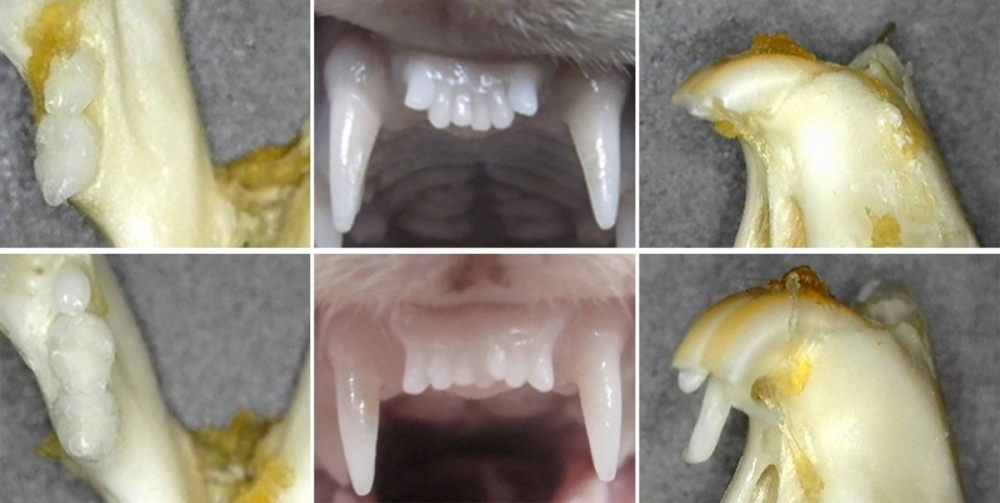
Before (top) and after images of the regrowth of a tooth in a ferret (centre top and bottom) and mice (right and left)
Photo credit: Medical Research Institute Kitano Hospital via Jiji

 www.japantimes.co.jp
His team initiated clinical trials at Kyoto University Hospital in October, administering an experimental medication to adult subjects. This medication is believed to have the potential to stimulate the growth of these concealed teeth. Takahashi emphasized that this technology is "completely new" to the world. Prosthetic treatments for tooth loss are often considered costly and invasive. Therefore, Takahashi, the lead researcher, highlighted that "restoring natural teeth has its advantages."
Research conducted on mice and ferrets suggests that blocking a protein called USAG-1 can activate the growth of the third set of teeth. The researchers have published laboratory photographs of regrown teeth in animals. In a study published last year, the team stated that their "antibody treatment in mice is effective for tooth regeneration and can be a breakthrough in treating tooth anomalies in humans.
Before (top) and after images of the regrowth of a tooth in a ferret (centre top and bottom) and mice (right and left)
Photo credit: Medical Research Institute Kitano Hospital via Jiji
Japanese researchers test pioneering drug to regrow teeth
Tests on mice and ferrets suggest that blocking a protein called USAG-1 can awaken a third set of teeth.


