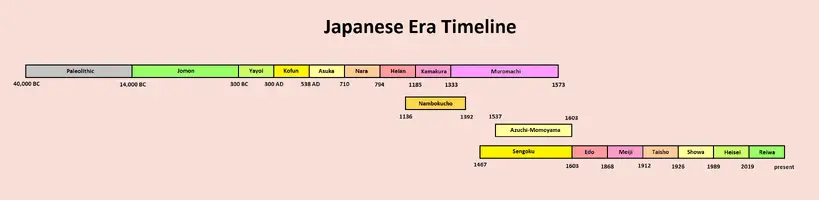
Japanese Era Timeline courtesy of Buntaro
An overview of the historical periods of Japan
Jōmon Period (ca 11000 BCE-ca 300 BCE)
Yayoi Period (300 BCE to ca 300 CE)
Kofun Period (300 to ca 538 CE)
Asuka Period (ca 250-710 CE)
Nara Period (710-794)
Heian Period (794-1185) [II] [III]
Kamakura...
No, it's not for a project. Yes, JREF may use it however it likes.
I will post an updated image with the Nambokucho Era addition tomorrow. (That's one more era I can finally fit into a clear timeline. This has been a fun way to put together all these pieces.)
I just learned them by constant repetition and little silly associations that trigger the correct number and have dawned on me as I was repeating them, eg. Nanbokucho = 1336-1392. I remember it's 133- something and if I add the two middle numbers it gives me the last number, 6. It ended 599 years before I started my first degree, 1392.
Azuchi-Momoyama - I know a Swedish 7th Dan in Iaido called 'Momoyama' sensei. It started 399 years before I was born, 1568 and ended in the years of the battle of Sekigahara .
Oda Nobunaga 1534-1582. I just remember his birth date for some reason, but he died 400 years before my one of album was recorded, 1582 (Tangerine Dream's 'Logos 1982 Live at the Dominion' - a masterpiece!)
Now, I remember Tokugawa Ieyasu was born in 1543 -the last two digits are swapped over from Nobunaga's birth date and he died in a different century and the numbers are repeated, 1616.
Toyotomi Hideyoshi is interesting because his birth date is ambiguous because he was a peasant and records weren't kept of births etc 1536/7! He died two years before the decisive battle of Sekigahara 1598.
I have many more…
These apparently random associations trigger the numbers I'm looking for when they don't come to hand immediately. It's not unique to me but I refined this method for myself when I was learning human anatomy and the repetition of teaching it to medical students every year makes has made it unforgettable -'the facial nerve emerges from the pons of the brain stem, travels slightly anteriorly before turning laterally and entering skull's internal auditory meatus of the petrous portion of the temporal bone before dropping downwards and exiting the skull via the stylomastoid foramen, moving anteriorly, piercing the parotid gland (but not innervating it, that's the glossopharyngeal nerve, CN IX)….blah-de-blah
Memorising is such a neuro-healthy thing to do and I try and memorise something regularly, especially if it's awkward. The last week I memorized Shakespeare's Sonnet 18. I don't get, nor understand the archaic language of The Bard but I liked the opening line, 'Shall I compare thee to a summer's day, thou art more lovely and more temperate…' so I just went for it. Interestingly, the repetition in learning it made me understand it and really appreciate its beauty and I discovered that reciting it to the ladies makes them go weak at the knees……or run away screaming!
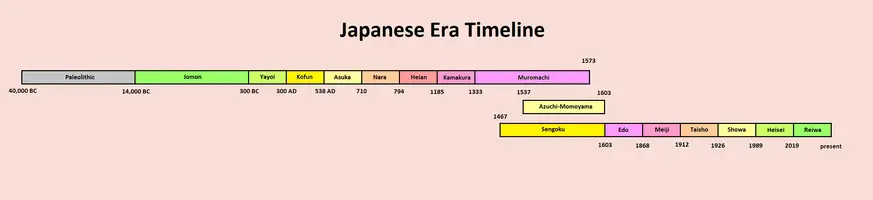
I need to mention how these dates are not 'carved in stone.' For example, some people say the Edo Period started in 1600, whereas others say it started in 1603.
For those of you who are eagle-eyed students of Japanese history, you may have noticed how my timeline seems to say the Muromachi Period started in 1333, but it actually seems to have started in 1338. I can only assume that the Kamakura Period ended in 1333, the Muromachi Period started in 1338, and that there was a period of great anarchy in 1333-1338.
It seems the start of the Jomon Period varies widely, depending on who you talk to. I have heard it said that it started as early as 14,000 BC, or as late as 11,000 BC.
I guess you're talking about the Kenmu Restoration.
Below is a table listing every major Japanese historical era from the Jomon period to the present day, including their approximate start and end dates. Note that the earliest periods are archaeological/cultural, while later periods are defined by imperial rule and official era names (nengō).
Era / Period
Start Date
End Date
Jomon
14,000 BCE
300 BCE
Yayoi
300 BCE
250 CE
Kofun
250 CE
538 CE
Asuka
538 CE
710 CE
Nara
710 CE
794 CE
Heian
794 CE
1185 CE
Kamakura
1185 CE
1333 CE
Kenmu Restoration
1333 CE
1336 CE
Muromachi (Ashikaga)
1336 CE
1573 CE
Azuchi-Momoyama
1573 CE
1603 CE
Edo (Tokugawa)
1603 CE
1868 CE
Meiji
1868 CE
1912 CE
Taisho
1912 CE
1926 CE
Showa
1926 CE
1989 CE
Heisei
1989 CE
2019 CE
Reiwa
2019 CE
Present
The Jomon, Yayoi, and Kofun periods are based on archaeological and cultural developments, not official era names2310.
From the Nara period onward, Japanese history is marked by official era names (nengō) and imperial reigns239.
The Kenmu Restoration was a brief period between Kamakura and Muromachi2.
The Azuchi-Momoyama period bridges the end of the Muromachi and the start of the Edo period23.
The Reiwa era is the current era, having started in 201912.
If you need a more granular list of every official nengō (era name) within each period (e.g., Meiji, Taisho, Showa, etc.), please specify, as there are hundreds of official era names, especially from the Nara period onward58.
This site uses cookies to help personalise content, tailor your experience and to keep you logged in if you register.
By continuing to use this site, you are consenting to our use of cookies.





 …or run away screaming!